
Konservasieng
Conservation: CITES – Appendix III (India); IUCN – Lower Risk (lc).
Sumber: Order Carnivora
Family Viverridae · Order Carnivora
Data diperbarui secara berkala dari berbagai sumber observasi biodiversitas.
61 titik observasi Viverricula indica di Indonesia
Memuat peta...
Setiap titik merepresentasikan satu lokasi observasi yang tercatat. Klik titik untuk melihat detail.
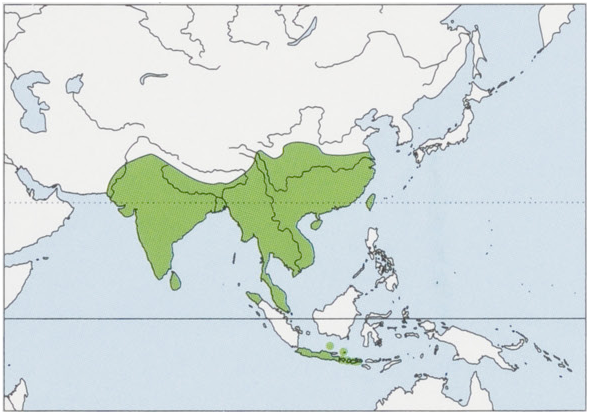
Foto: Don E. Wilson;Russell A. Mittermeier
Otoritas penamaan: (É.Geoffroy Saint-Hilaire, 1803) (1803)
Status taksonomi: ACCEPTED
Status konservasi (IUCN): LC Risiko Rendah
Dipublikasikan dalam: Cat. Mamm. Mus. Nat. Hist. Nat. p.113
Total Catatan di Indonesia
0
Provinsi Ditemukan
0
dari 38 provinsi
Catatan Pertama
0
tahun pertama tercatat
Tren Tahunan
+0%
+150.0% vs 2025
Khatash (Viverricula indica) termasuk dalam famili Viverridae, ordo Carnivora, kelas Mammalia. Berdasarkan data yang terhimpun, spesies ini telah tercatat sebanyak 198 kali di Indonesia, tersebar di 9 provinsi. Catatan pertama tercatat pada tahun 1817.
Jawa Barat merupakan provinsi dengan catatan observasi terbanyak untuk spesies ini, dengan 30 catatan (15.2% dari total). Data distribusi ini mencerminkan akumulasi dari berbagai kegiatan survei, penelitian, dan kontribusi citizen science. Pola distribusi yang tercatat mungkin tidak sepenuhnya menggambarkan persebaran alami spesies, karena dipengaruhi oleh intensitas pengamatan di masing-masing wilayah.
Tren observasi tahunan Viverricula indica menunjukkan peningkatan signifikan (+150%) pada periode terakhir dibanding tahun sebelumnya, dengan catatan pertama pada tahun 1817.
Catatan deskriptif tentang Viverricula indica dari sumber literatur primer (via GBIF).
Conservation: CITES – Appendix III (India); IUCN – Lower Risk (lc).
Sumber: Order Carnivora
Distribution: Afghanistan, Bangladesh, Burma, Cambodia, China, Hong Kong, India, Indonesia (Borneo, Sumatra, Java, Kangean Isl, Sumbawa, Bali), Laos, Malaysia, Nepal, Pakistan, Sri Lanka, Taiwan, Thailand, Vietnam. Introduced to Yemen, Zanzibar and Pemba Isl, Socotra Isl, Madagascar, the Comoro Isls, and the Philippines; scattered distribution on many SE Asian islands due to introductions.
Sumber: Order Carnivora
DISTRIBUTION: Sri Lanka; India to S. China and Hainan IsL, and Malay Peninsula; Taiwan; Java; Kangean IsL; Sumbawa; Bali. Introduced to Madagascar.
Sumber: Order Carnivora
Habitat. Semi-evergreen and deciduous forest, mixed deciduous forest, bamboo forest, scrubby areas, grasslands, and riverine habitat. Also found near plantations and human settlements. Reported up to 1200 m in north-east India. In Thailand, a radio-collared male moved in an area consisting of 62 % dry deciduous forest, 25 % dry evergreen forest, and 13 % mixed deciduous forest. In Thailand, out of 29 individuals live-trapped, 16 captures were in open shrub habitat, ten were semi-evergreen / mixed deciduous forest, and four were in grassland; camera-trapping produced 14 photographs, with 13 photos from semi-evergreen / mixed deciduous forest, and one from open shrub habitat. In India (Western Ghats), Small Indian Civets were found to be more abundant in rainforest fragments than in relatively undisturbed large tracts of rainforest.
Nama-nama ilmiah lain yang pernah digunakan untuk Viverricula indica dalam literatur taksonomi.
| Nama Sinonim | Otoritas | Status |
|---|---|---|
| Civetta indica | É.Geoffroy Saint-Hilaire, 1803 | SYNONYM |
| Viverra indica | Desmarest, 1804 | SYNONYM |
| Viverricula indica | (Desmarest, 1804) | SYNONYM |
| # | Provinsi | Catatan | % |
|---|---|---|---|
| 1 | Jawa Barat | 30 | 15.2% |
| 2 | Bali | 8 | 4.0% |
| 3 | Nusa Tenggara Barat | 5 | 2.5% |
| 4 | Aceh | 4 | 2.0% |
| 5 | Banten | 3 | 1.5% |
| 6 | Jambi | 1 | 0.5% |
| 7 |
Jumlah catatan observasi Viverricula indica di Indonesia per tahun
Viverricula indica
Foto: Don E. Wilson;Russell A. Mittermeier
Viverricula indica
Foto: Don E. Wilson;Russell A. Mittermeier
| Nama | Bahasa | Sumber |
|---|---|---|
| Civeta india pequena | - | Viverridae |
| Civette Indienne | Prancis | Catalogue of Life |
| Civette indienne | Prancis | Viverridae |
| Civette indienne, Rasse de Mayotte | Prancis | TAXREF |
| Founga | - | TAXREF |
| Jaboady | mlg | Catalogue of Life |
| Khatash | Inggris | ENVIRONMENTAL IMPACT ASSESSMENT (EIA) OF WORLD BANK FINANCED SIDDHIRGANJ 450 MW COMBINED CYCLE POWER PLANT (CCPP) PROJECT SIDDHIRGANJ, NARAYANGAJ |
| Kleine Indische Zibetkatze | Jerman | Viverridae |
| Lesser Oriental Civet |
Berdasarkan data 198 observasi, Jawa Barat adalah provinsi dengan catatan Khatash (Viverricula indica) terbanyak — 30 observasi (15.2% dari total catatan di Indonesia). Spesies ini tersebar di 9 provinsi.
Catatan pertama Khatash (Viverricula indica) di Indonesia tercatat pada tahun 1817. Hingga kini terdapat 198 catatan dari 9 provinsi, yang dihimpun dari survei lapangan, koleksi museum, dan platform citizen science.
Menurut IUCN Red List, Khatash (Viverricula indica) berstatus "Risiko Rendah" (kode LC). Status ini mencerminkan tingkat risiko kepunahan global spesies, bukan khusus Indonesia.
Ya, Viverricula indica memiliki 3 nama sinonim ilmiah, di antaranya: Civetta indica, Viverra indica, Viverricula indica. Nama sinonim adalah nama-nama lain yang pernah digunakan untuk spesies yang sama dalam literatur taksonomi.
Viverricula indica diklasifikasikan sebagai berikut: Kingdom Animalia, Phylum Chordata, Class Mammalia, Order Carnivora, Family Viverridae, Genus Viverricula. Spesies ini dideskripsikan oleh (É.Geoffroy Saint-Hilaire, 1803).
Sumber: Viverridae
Movements, Home range and Social organization. Solitary, single individuals have been observed in the field and recorded by camera-traps. Terrestrial, but is said to climb well. In southeastern China, the resting home range of a male was 2 - 3 km *. The mean distance moved between consecutively used daybeds was 613 m. In Thailand, the home range of a male was 3 - 1 km? ®; his core home range was 1 - 1 km? and the mean daily movement was 500 m. In India (Nilgiri Biosphere Reserve), the home range of a male was 2 - 2 km? the distance between successive daytime locations ranged from 193 m in September to 2260 m in October. In Myanmar, the mean distance moved between consecutive resting sites was 214 m. Scent marking activity, using the secretions from the perineal gland, occurs in both sexes, but is more frequent in males. They mark any object, but vertical objects seem to be preferred. Scent marking varies between days and season. In captivity, it occurs mainly at night, with three peaks at 18: 00 - 19: 00 h, 21: 00 - 23: 00 h, and before dawn. Scent marking is more common in the spring, during the breeding season. Vocal communication in captive civets includes: a scream (given by the female during fights with a male); threat calling (given under stress and when an animal is terrified); courtship calling, “ da da da ” (given by the male as an estrus female approaches).
Sumber: Viverridae
Status and Conservation. Classified as Least Concern on The IUCN Red List. The Small Indian Civet is considered unthreatened due to its widespread distribution and generalist habitat and food preferences. However, it is not fully understood how habitat disturbance may affect this species, and more ecological studies are needed. Small Indian Civets are hunted for their meat and scent, and are particularly vulnerable to snare trapping. They are also farmed in India to extract their perineal gland secretion for medicinal purposes. These farmed civets are not captive-bred, but are trapped in the wild, and this could be causing declines in local populations. Field surveys are needed to monitor populations, especially in areas where their numbers may be depressed due to high trapping pressures.
Sumber: Viverridae
| 1 |
| 0.5% |
| 8 | Jawa Timur | 1 | 0.5% |
| 9 | Nusa Tenggara Timur | 1 | 0.5% |
| Inggris |
| Viverridae |
| Oriental Civet | Inggris | Catalogue of Life |
| Small Indian Civet | Inggris | Order Carnivora |
| Xiao ling mao | - | Phthiraptera.myspecies.info |
| small Indian civet | Inggris | Phthiraptera.myspecies.info |
| សំពោចវល្លិ ឬ ឈ្មុសវល្លិ | khm | Checklist of extant species recorded in Phnom Tbaeng Natural Heritage Park, Cambodia |