Distribusieng
New records Lampung Province: Sukaraja Village, Sumber Rejo Village, Way Canguk Forest. Previous records from Sumatra North Sumatra Province: Nias Island; West Sumatra Province: Mentawai Islands (Simmons, 2005). Remarks
Sumber: A recent bat survey reveals Bukit Barisan Selatan Landscape as a chiropteran diversity hotspot in Sumatra
Distribusieng
Recorded at: Pahang: Krau Wildlife Reserve [11, 41], Pulau Tioman [23], Tasik Chini [43]; Terengganu: Pulau Redang [23]; Johor: Pulau Aur [23], Endau-Kota Tinggi Forest Reserve [56]; Kedah: Pulau Langkawi [23], Ulu Muda Forest Reserve [57]; Selangor: Bukit Lanjan [40], Bukit Kutu Wildlife Reserve [51], Ulu Gombak [52 – 54]; Negeri Sembilan: Pasoh Forest Reserve [45]; Perak: Temengor Forest Reserve [46, 47]; Kelantan: Gua Musang [62].
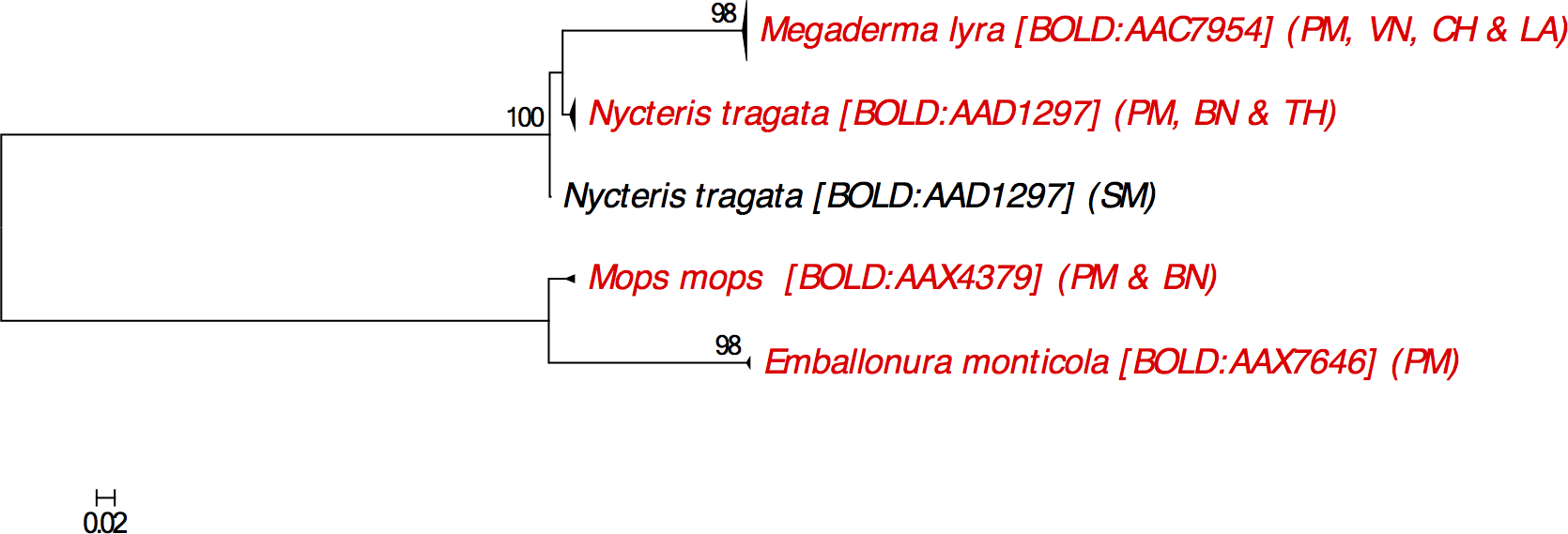
Sumber: A checklist of the bats of Peninsular Malaysia and progress towards a DNA barcode reference library
Biologi & Ekologieng
Habitat. Tropical rainforests including secondary forests and up into hill forests from sea level to elevations of c. 1800 m. Food and Feeding. The Lesser Sheath-tailed Bat preys on insects. Anecdotal reports suggest that it feeds on fruit, but they are unsubstantiated. It forages among tree gaps and over streams and rivers. Breeding. Lesser Sheath-tailed bats produce two litters / year in February — March and October-November. A single young is bom in each season. At birth, the mother will hold her young in her wings to prevent it from falling to the roost floor. Females carry young on a breast as they forage until young are too heavy to carry. Reproductive maturity of males and females occurs at about one year old. Activity patterns. The Lesser Sheath-tailed Bat is crepuscular. Foraging activity can begin in late afternoon in dense shade under forest canopies. It roosts in caves and rock crevasses, hanging rocks, earthen embankments, tree holes, fallen trees, and tree buttresses. It roosts on vertical walls clinging with feet and wrists. It remains exposed to dim light in twilight zones ofcaves and lit areas of other types of roost shelters. Echolocation call to search for prey is distinctive, beginning with upward sweep in frequency, then becomes steady at 48 — 51 kHz, and ends with downward sweep of this frequency range — all occurring for 6 - 8 milliseconds. In Singapore, echolocation call reportedly has a minimum frequency of 46 kHz and a maximum of 49 - 3 kHz. Movements, Home range and Social organization. Roost colonies of Lesser Sheathtailed Bats usually have 2 — 20 individuals, but up to 150 individuals can shelter in large caves. Males defend harems in a system of polyestry. Lesser Sheath-tailed Bats often co-occur in caves with Small Asian Sheath-tailed Bats {Emballonura alecto). This species emits an audible alarm when there is disturbance at the roost.
Sumber: Emballonuridae
Konservasieng
Status and Conservation. Classified as Least Concern on The IUCN Red List. The Lesser Sheath-tailed Bath has a large distribution and occurs in protected areas throughout its distribution. Nevertheless, overall population is believed to be slowly declining due to limestone extraction from caves and deforestation for smallholdings of agriculture, palm oil plantations, logging, and use of fire to clear land.
Sumber: Emballonuridae
Deskripsieng
Descriptive notes. Head-body 40 - 47 mm, tail 11 - 14 mm, ear 12 - 13 mm, forearm 38 - 45 mm; weight 4 - 5 - 7 g. No data available for hindfoot length. Dorsal fur of the Lesser Sheath-tailed Bat is uniformly dark brown, sometimes with reddish tinge. Rostrum and palate anterior to molars are relatively short. Karyotype for all species of Emballonura is 2 n = 24.
Sumber: Emballonuridae
Distribusieng
Distribution. Thai-Malay Peninsula, Sumatra, Borneo, Java, and Sulawesi and several offshore islands (Mergui Archipelago, Adang / Rawi Is, Langkawi I, Redang I, Tioman and Aur Is, Karimata I); also on Simeulue and Babi Is, Nias I, Batu Is (TanahbalaI), Mentawai Is (Siberut and Sipora Is), Enggano, Anambas Is, Natuna I, Riau Archipelago, Bangka, and Belitung Is; it might also occur on Buton I.
Sumber: Emballonuridae