Deskripsieng
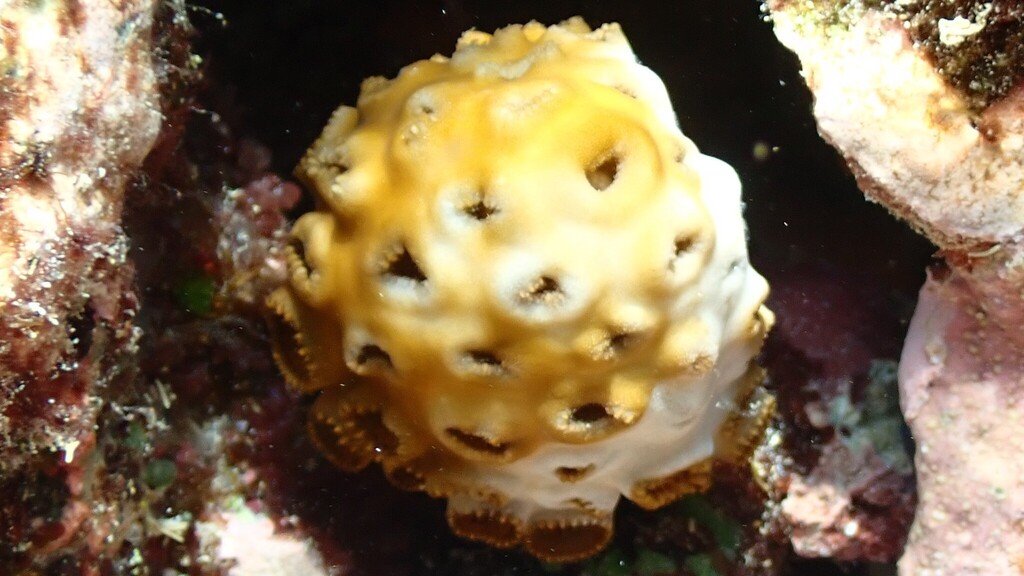
Description. This specimen superficially resembles zooxanthellate Palythoa sp. yoron sensu Shiroma and Reimer (2010) with its very well developed coenenchyme and ' intermediae-immersae' morphology (Figure 9 B). However, there are some differences between this specimen and Palythoa sp. yoron from Okinawa. The current specimen consists of two large portions of colonies consisting of> 50 polyps, while Palythoa sp. yoron usually is found in very small colonies of <10 polyps. As well, Palythoa sp. yoron consists of a very well developed coenenchyme from which all individual polyps partially emerge, while the current specimen appears to consist more of large robust polyps that have merged together at many locations, but not at others, giving the specimen the appearance of Palythoa tuberculosa from the top, and often of Palythoa mutuki from side angles. On the other hand, Palythoa sp. yoron has an appearance, although intermediate between Palythoa tuberculosa and Palythoa mutuki, unique to and of itself. Polyps' height (when not merged) is approximately 7.0 mm, and average width is 7.3 mm (n = 10 polyps). Thus, for now, this specimen is identified as Palythoa aff. tuberculosa. For details on Palythoa tuberculosa, refer to the relevant species section below.
Sumber: Shallow-water zoantharians (Cnidaria, Hexacorallia) from the Central Indo-Pacific
Distribusieng
Distribution. Regions recorded in this study (Figure 7): Moluccas (14). Previous records: NA.
Sumber: Shallow-water zoantharians (Cnidaria, Hexacorallia) from the Central Indo-Pacific
Deskripsieng
Description. This zooxanthellate species was originally described from India (Esper 1805), and subsequently redescribed utilizing specimens from the Red Sea (Klunzinger 1877). Recent work by Hibino et al. (2013) indicates the species may include some junior synonyms, and has a wide distribution across the subtropical and tropical Indo-Pacific. Polyps are embedded within a well-developed coenenchyme (' immersae', Pax 1910), and colonies vary in color from fluorescent green-yellow to dark brown or even ochre (Figure 9 A). Specimens in this study averaged 4.7 mm in polyp diameter (n = 29 specimens), ranging from 2 to 8 mm. One specimen, RMNH Coel 40553, was notable for its very small polyps (average diameter 2.4 mm, n = 10 polyps). Other colonies ranged from 3.1 to 6.5 mm in average diameter, similar to previous reported sizes. All specimens were ' immersae'. Generally, morphology fit well within the accepted range of Palythoa tuberculosa (see Table 1 in Hibino et al. 2013), although some specimens' polyps were somewhat smaller than previously observed. These smaller sizes may also be partly due to preservation methods.
Sumber: Shallow-water zoantharians (Cnidaria, Hexacorallia) from the Central Indo-Pacific
Distribusieng
Distribution. Regions recorded in this study (Figure 7). West Bali (4), east Bali (5), northeast Sumba (6), south Flores (7), Komodo (8), Spermonde Archipelago (9), Salayer Island (10), Tukang Besi Islands (12), Maisel Islands (13), Moluccas (14), Bo Islands (15), Bunaken (18), Berau Islands (19), Sulu Islands (20), Cebu (21), Madang (22). Previous records. This species has been phylogenetically confirmed as distributed over the entire subtropical and tropical Indo-Pacific, from at least the Red Sea to Singapore (Reimer and Todd 2009), Taiwan (Reimer et al. 2011 c), Japan (e. g. Reimer et al. 2006 a), New Caledonia (Sinniger 2006), and the Galapagos Islands (Reimer and Hickman 2009).
Sumber: Shallow-water zoantharians (Cnidaria, Hexacorallia) from the Central Indo-Pacific