
Distribusi
Breeding regions are AU. Breeding subregions are c, s Moluccas, w New Guinea, e to Bismarck Arch., Solomon Is., Vanuatu and New Caledonia.
Sumber: IOC World Bird List, v
Family Psittacidae · Order Psittaciformes
Data diperbarui secara berkala dari berbagai sumber observasi biodiversitas.
150 titik observasi Trichoglossus haematodus di Indonesia
Memuat peta...
Setiap titik merepresentasikan satu lokasi observasi yang tercatat. Klik titik untuk melihat detail.
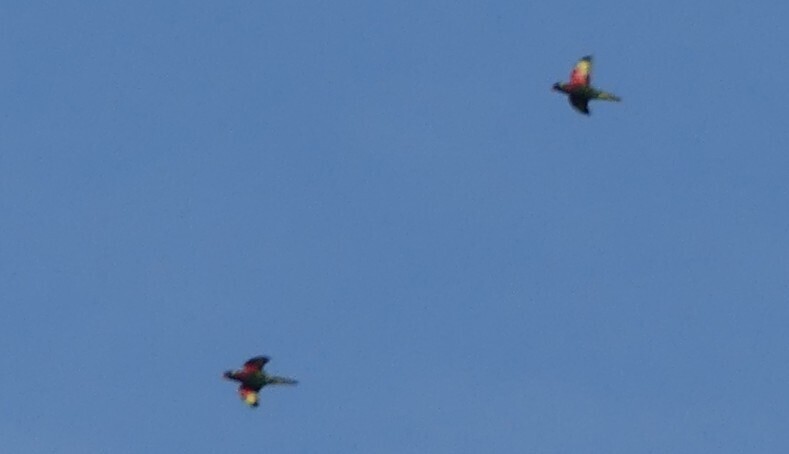
Foto: Tom Kirschey | http://creativecommons.org/licenses/by-nc/4.0/
Otoritas penamaan: (Linnaeus, 1771) (1771)
Status taksonomi: ACCEPTED
Status konservasi (IUCN): LC Risiko Rendah
Total Catatan di Indonesia
0
Provinsi Ditemukan
0
dari 38 provinsi
Catatan Pertama
0
tahun pertama tercatat
Tren Tahunan
-0%
-21.4% vs 2025
Perkici pelangi (Trichoglossus haematodus) termasuk dalam famili Psittacidae, ordo Psittaciformes, kelas Aves. Berdasarkan data yang terhimpun, spesies ini telah tercatat sebanyak 839 kali di Indonesia, tersebar di 9 provinsi. Catatan pertama tercatat pada tahun 1863.
Papua Barat merupakan provinsi dengan catatan observasi terbanyak untuk spesies ini, dengan 177 catatan (21.1% dari total). Data distribusi ini mencerminkan akumulasi dari berbagai kegiatan survei, penelitian, dan kontribusi citizen science. Pola distribusi yang tercatat mungkin tidak sepenuhnya menggambarkan persebaran alami spesies, karena dipengaruhi oleh intensitas pengamatan di masing-masing wilayah.
Tren observasi tahunan Trichoglossus haematodus menunjukkan penurunan signifikan (-21%) pada periode terakhir dibanding tahun sebelumnya, dengan catatan pertama pada tahun 1863.
Catatan deskriptif tentang Trichoglossus haematodus dari sumber literatur primer (via GBIF).
Breeding regions are AU. Breeding subregions are c, s Moluccas, w New Guinea, e to Bismarck Arch., Solomon Is., Vanuatu and New Caledonia.
Sumber: IOC World Bird List, v
Local name Man Pèspès (Sansundi). Range T. h. rosenbergii Biak, Supiori, T. h. haematodus Numfor, Yapen. Taxonomy Beehler & Pratt (2016) treated the Biak population as a subspecies of the polytypic and widespread Rainbow Lorikeet. This taxon is a member of a hyper-variable lineage for which species boundaries are problematic and full molecular analysis is needed. Conversely, del Hoyo & Collar (2014) and Gregory (2017) split T. haematodus into seven species including Biak Lorikeet T. rosenbergii. However, in the latest analysis (Joseph et al. 2020), the position of the taxon is still unresolved, which has important implications for conservation. Status Endemic subspecies. Obtained by seven collectors including Ripley and seen by virtually all visitors. During July 1982 KDB found it ‘ everywhere’ in southern Biak, invariably common and in flocks of 20 or more, sometimes flying over villages near the township of Biak. On Supiori KDB recorded it up to c. 360 m in primary forest on limestone karst, often feeding with Eos cyanogenia at flowering trees. Most visitors barely did more than list it until the proposed split (del Hoyo & Collar 2014), which dramatically changed their attitude to the taxon. It is difficult to determine when it began to decline on Biak, but clearly much smaller numbers were present from c. 2000 onwards. Birders now make special efforts to seek this endemic but invariably struggle to see more than one or two. However, these observations are all from southern Biak, the most heavily populated and degraded part of the island. Large areas of apparently undisturbed forest persist in northern Biak and over much of Supiori, and a survey of these areas to determine the status of the taxon there is much needed. M. Halaouate (in litt. 2021) noted that Rainbow Lorikeets usually lack much value for trappers and collectors. However, this is one of the most strikingly beautiful Trichoglossus and has attracted collectors on Java, Bali and in the international markets to intensively trap this taxon to a point where it may go extinct on Biak in the near future. It fetches a quite high price in Europe to where it is exported ‘ legally’ from Indonesia. Treating rosenbergii as a species has advantages (it can be formally protected) and disadvantages (it would become more sought after by collectors and trapping would thereby increase). Halaouate’s estimate of the remaining wild population is 2,000 ‒ 2,400 birds.
Nama-nama ilmiah lain yang pernah digunakan untuk Trichoglossus haematodus dalam literatur taksonomi.
| Nama Sinonim | Otoritas | Status |
|---|---|---|
| Psittacus haematodus | Linnaeus, 1771 | HOMOTYPIC_SYNONYM |
| # | Provinsi | Catatan | % |
|---|---|---|---|
| 1 | Papua Barat | 177 | 21.1% |
| 2 | Papua | 58 | 6.9% |
| 3 | Maluku | 32 | 3.8% |
| 4 | Nusa Tenggara Barat | 6 | 0.7% |
| 5 | Nusa Tenggara Timur | 6 | 0.7% |
| 6 | Bali | 4 | 0.5% |
| 7 |
Jumlah catatan observasi Trichoglossus haematodus di Indonesia per tahun
Trichoglossus haematodus
Foto: Tom Kirschey
http://creativecommons.org/licenses/by-nc/4.0/Trichoglossus haematodus
Foto: Tom Kirschey
http://creativecommons.org/licenses/by-nc/4.0/Trichoglossus haematodus
Foto: Mangiring Sibarani
http://creativecommons.org/licenses/by-nc/4.0/Trichoglossus haematodus
Foto: Ian timmer (WildMovementPhoto)
http://creativecommons.org/licenses/by-nc-nd/4.0/Trichoglossus haematodus
Foto: James Eaton
http://creativecommons.org/publicdomain/zero/1.0/Trichoglossus haematodus
Foto: James Eaton
http://creativecommons.org/publicdomain/zero/1.0/Trichoglossus haematodus
Foto: James Eaton
http://creativecommons.org/publicdomain/zero/1.0/Trichoglossus haematodus
Foto: rajaampatherping
http://creativecommons.org/licenses/by-nc/4.0/Trichoglossus haematodus
Foto: Morgan Wayne Luther Sawaki
http://creativecommons.org/licenses/by-nc/4.0/Trichoglossus haematodus
Foto: rajaampatherping
http://creativecommons.org/licenses/by-nc/4.0/Trichoglossus haematodus
Foto: rajaampatherping
http://creativecommons.org/licenses/by-nc/4.0/Trichoglossus haematodus
Foto: rajaampatherping
http://creativecommons.org/licenses/by-nc/4.0/| Nama | Bahasa | Sumber |
|---|---|---|
| Allfarblori | Jerman | Catalogue of Life |
| Bjerglori | dan | Catalogue of Life |
| Coconut Lorikeet | Inggris | Colaboraciones Americanas Sobre Aves |
| Coconut Lorikeet, Shawl-collared Lorikeet | Inggris | TAXREF |
| Coconut lorikeet | Inggris | The Paleobiology Database |
| Hindistancevizi Loriketi | tur | Catalogue of Life |
| Lori de cocotero | Spanyol | Integrated Taxonomic Information System (ITIS) |
| Lorichetto arcobaleno | Italia | Catalogue of Life |
| Lorichetto dei cocchi |
Berdasarkan data 839 observasi, Papua Barat adalah provinsi dengan catatan Perkici pelangi (Trichoglossus haematodus) terbanyak — 177 observasi (21.1% dari total catatan di Indonesia). Spesies ini tersebar di 9 provinsi.
Catatan pertama Perkici pelangi (Trichoglossus haematodus) di Indonesia tercatat pada tahun 1863. Hingga kini terdapat 839 catatan dari 9 provinsi, yang dihimpun dari survei lapangan, koleksi museum, dan platform citizen science.
Menurut IUCN Red List, Perkici pelangi (Trichoglossus haematodus) berstatus "Risiko Rendah" (kode LC). Status ini mencerminkan tingkat risiko kepunahan global spesies, bukan khusus Indonesia.
Di Indonesia dan Malaysia, Trichoglossus haematodus dikenal dengan beberapa nama lokal: Perkici pelangi. Penamaan dapat berbeda antardaerah dan bahasa.
Ya, Trichoglossus haematodus memiliki 1 nama sinonim ilmiah, di antaranya: Psittacus haematodus. Nama sinonim adalah nama-nama lain yang pernah digunakan untuk spesies yang sama dalam literatur taksonomi.
Trichoglossus haematodus diklasifikasikan sebagai berikut: Kingdom Animalia, Phylum Chordata, Class Aves, Order Psittaciformes, Family Psittacidae, Genus Trichoglossus. Spesies ini dideskripsikan oleh (Linnaeus, 1771).
Sumber: The avifauna of Biak Island, Papua, Indonesia with comments on status, conservation, natural history and taxonomy
| DKI Jakarta |
| 2 |
| 0.2% |
| 8 | Sulawesi Utara | 1 | 0.1% |
| 9 | Sulawesi Selatan | 1 | 0.1% |
| Italia |
| Catalogue of Life |
| Loriquet à tête bleue | Prancis | Catalogue of Life |
| Perkici pelangi | Indonesia | Catalogue of Life |
| Rainbow Lorikeet | Inggris | Integrated Taxonomic Information System (ITIS) |
| Rainbow Lorikeet (Coconut) | Inggris | The Clements Checklist |
| Rainbow Lorikeet (Marigold) | Inggris | The Clements Checklist |
| Rainbow Lorikeet (Sunset) | Inggris | The Clements Checklist |
| Rainbow/Scaly-breasted Lorikeet | Inggris | The Clements Checklist |
| Regenbooglori | Belanda | Catalogue of Life |
| Vinrød Lori | - | Catalogue of Life |
| Višebojni dugin lorikit | srp | Catalogue of Life |
| bíborhasú szivárványlóri | hun | Catalogue of Life |