Deskripsieng
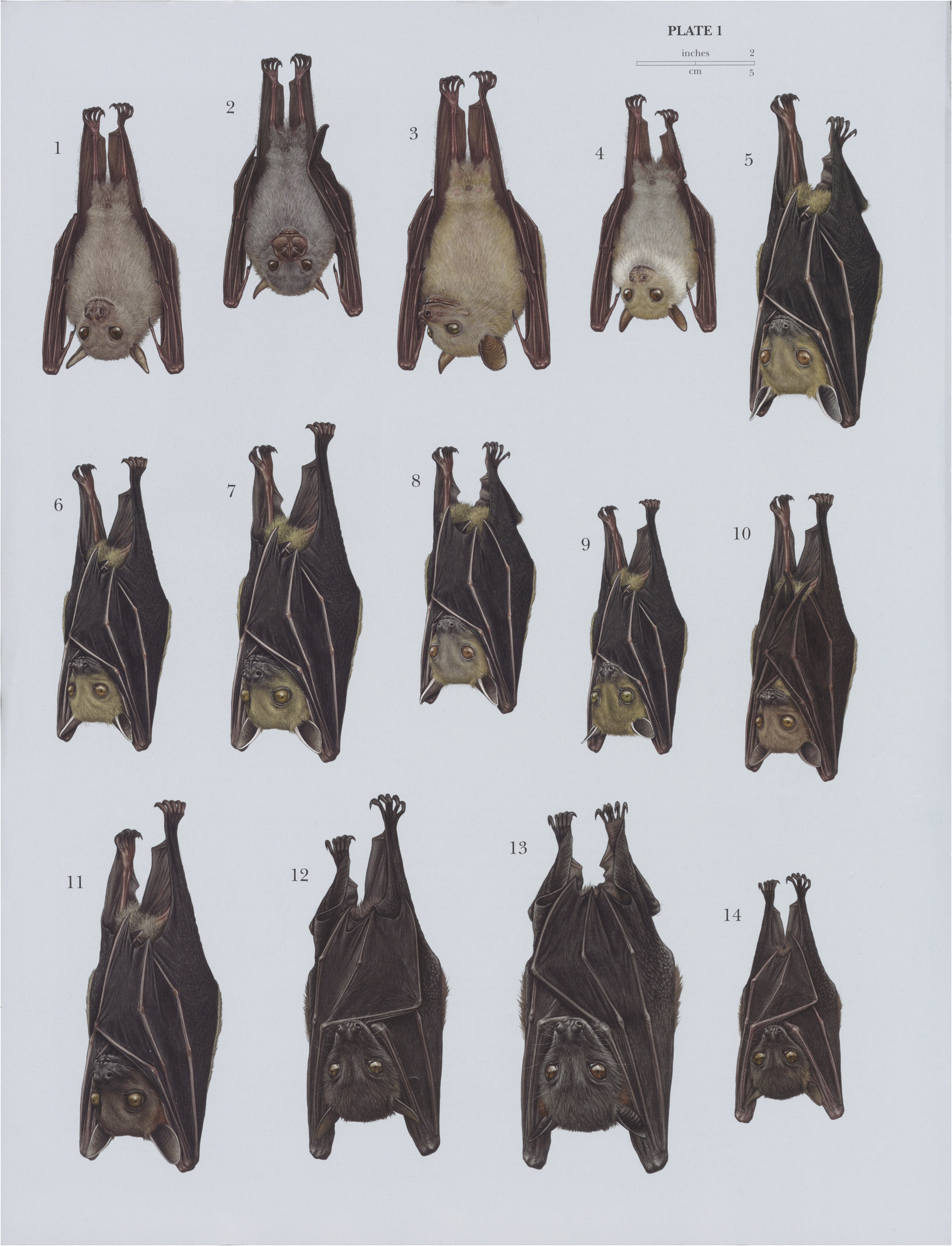
Descriptive notes. Head — body 89 - 109 mm, tail 13 - 18 mm, ear 19 - 23 mm, hindfoot 14 - 5 - 20 - 5 mm; forearm 67 - 76 mm; weight 34 - 53 g (males) and 28 - 70 g (females). Sexual dimorphism varies, with males larger in northern India and females larger in southern India. The Greater Short-nosed Fruit Bat has white ear rims and wing digits. Muzzle is moderately short; nostrils are shortly tubular, with roughened rims. Philtrum is marked, ending in two joined upper lip pads; two large, triangular lower pads occur on lip. Skin of muzzle and ears and around eyes is darklilac gray. Forehead slopes, top of head is rather wide and flat; eyes are separated and mid-sized, and 1 ris 1 s chestnutbrown. Ears are moderately long and oval, and tips are slightly attenuated, with white rims on medial and lateral sides. Head is brown, slightly darker (russet-brown) on crown, and hairs are longer on nape and dorsum, cinnamon-fawn to olive-brown on females and typically deeper olive-brown on males, and lighter near tail. Tail is short and c. 50 % ofits length is free from uropatagium, which is narrow and naked dorsally; calcar is small. Ample brownish orange ruff entersside of head up to ear bases. Chest and belly are drab gray, merging to deep olive buff posteriorly; hairs are short. Index claw is present; patagial and feet are dark lilac gray; and wing membranes originate on sides of body and attach to first toe. Skull lacks basicranial deflection, rostrum is moderately short, forehead slopes gently, orbit is moderately large, braincaseis flattened anteriorly and more rounded posteriorly, zygomatic rootis nearly level with alveolar line, and zygoma is moderately thin, arched, and wide open. Dorsally, paranasal recesses are greatly inflated, reaching large postorbital foramen; postorbital processes are relatively thick and pointed posterolaterally; postorbital constriction is small; and temporal lines are joined medially in low sagittal crest. Palate is flat, post-dental palate is long and convergent, and palatine spine isjoined to mid-sphenoidal ridge. Ectotympanic is small and wide, more so anteriorly; entotympanic is along medial edge of ectotympanic. Mandible has sloping symphysis and straight body; coronoid is tall and sloping; condyle is slightly above lower alveolar line; and angle is round off. Dental formula for all species of Cynopterusis 12 / 2, C 1 / 1, P 3 / 3, M 1 / 2 (x 2) = 30. Upperincisors are small but with distinct crowns; C! is moderately long and straight, with convex anterior surface; P' is a spicule; and posterior cheekteeth are elongated, with cusps slanted forward and decreasing in height, and additional surface cusps are inconspicuous. Lower incisors and C, are small, Pis peg-like, next premolar (P,) is subequal in height to C ,, and remaining cheekteeth decrease in size, with M, almost peg-like. Chromosomal complement has 2 n = 34 and FN = 58, with 22 metacentric, five subtelocentric, and seven acrocentric chromosomes. X-chromosome is subtelocentric, and Y-chromosome acrocentric.
Sumber: Pteropodidae