IUCN conservation status. Least Concern [2018].
Sumber: Singapore’s herpetofauna: updated and annotated checklist, history, conservation, and distribution
Family Scincidae
Data diperbarui secara berkala dari berbagai sumber observasi biodiversitas.

Foto: Figueroa, Alex;Low, Martyn E. Y.;Lim, Kelvin K. P.
Otoritas penamaan: (Stoliczka, 1870) (1870)
Status taksonomi: ACCEPTED
Status konservasi (IUCN): LC Risiko Rendah
Dipublikasikan dalam: Stoliczka, F. Observations of some Indian and Malayan Amphibia and Reptilia (abstract).
Total Catatan di Indonesia
0
Provinsi Ditemukan
0
dari 38 provinsi
Catatan Pertama
0
tahun pertama tercatat
Tren Tahunan
-0%
-88.2% vs 2025
Kadal Matahari (Eutropis rugifera) termasuk dalam famili Scincidae, kelas Squamata. Berdasarkan data yang terhimpun, spesies ini telah tercatat sebanyak 172 kali di Indonesia, tersebar di 17 provinsi. Catatan pertama tercatat pada tahun 1905.
Jawa Barat merupakan provinsi dengan catatan observasi terbanyak untuk spesies ini, dengan 41 catatan (23.8% dari total). Data distribusi ini mencerminkan akumulasi dari berbagai kegiatan survei, penelitian, dan kontribusi citizen science. Pola distribusi yang tercatat mungkin tidak sepenuhnya menggambarkan persebaran alami spesies, karena dipengaruhi oleh intensitas pengamatan di masing-masing wilayah.
Tren observasi tahunan Eutropis rugifera menunjukkan penurunan signifikan (-88%) pada periode terakhir dibanding tahun sebelumnya, dengan catatan pertama pada tahun 1905.
Catatan deskriptif tentang Eutropis rugifera dari sumber literatur primer (via GBIF).
IUCN conservation status. Least Concern [2018].
Sumber: Singapore’s herpetofauna: updated and annotated checklist, history, conservation, and distribution
Striped Sun Skink (Figure 14 H; Sime Road Forest)
Sumber: Singapore’s herpetofauna: updated and annotated checklist, history, conservation, and distribution
Redescription of holotype. Male, SVL 52.9 mm. Head moderately large (HL 24.9 % SVL, HL 50.2 % of axilla – groin distance), narrow (HW 56.1 % HL, HW 14.0 % SVL), indistinct from neck; snout short (snout length 34.1 % of head length, snout length 60.8 % of head width), slightly convex in lateral profile; rostral shield large, hemispherical, distinctly visible from above, posterior margin of midpoint curved; frontonasal broadly in contact with rostral; frontonasal wide, lateral border touching first loreal; prefrontals separated from each other, largest distance along the longitudinal axis of frontonasal equal to prefrontals in length, lower border touching both loreal scales, the posterior border touching the first supraocular, and frontal; frontal large, elongate, subtriangular, bluntly pointed posteriorly, equal in length to the frontoparietals and interparietal combined; frontoparietals two, in contact, distinct, larger than interparietal; parietals damaged (examined materials have parietals strongly keeled, large, and broadly in contact and overlapping behind the interparietal, touching pretemporal scales laterally); nuchals damaged (examined materials have a single pair of nuchals, overlapping middorsally behind interparietal). Nostril large and situated in the middle of the nasal; single supranasal; two loreals, anterior loreal touching nasal, supranasal, frontonasal, prefrontal, posterior loreal, and 2 nd supralabial; posterior loreal longer than the anterior loreal in the antero-posterior axis, touching prefrontal and first supracilliary; two presuboculars; eye large (orbit diameter 27.3 % head length), orbit diameter equal in length to tympanum – eye length, pupil rounded; interorbital distance broad; three small postoculars; four wide supraoculars, the second is the longest in the antero-posterior axis and the widest in the sagital axis and fully contacts the frontal; first supraocular in contact with prefrontal and frontal, 2 nd in contact with frontal and frontoparietal, 3 rd in contact with frontoparietals, and 4 th in contact with both frontoparietal and parietal; supracilliaries six; eyelid moveable with a scaly window composed of seven scales. Six supralabials, fifth largest and at the mid orbit position (5 th touching eye); three pretemporals; two primary temporals, three secondary temporals; infralabials six; ear opening deep, small, near spherical and approximately one quarter of eye diameter. Mental large; a single large postmental followed by two chin shield pairs, the first pair meeting in midline, the first chinshield in contact with first and second infralabial scales, the second pair in contact with second and third infralabials. Body scales have five keels with three median prominent and two secondary keels per scale; all scales imbricate and lack apical pits; scales on the dorsal surface of thigh keeled; body slender, elongate (axilla – groin distance 49.7 % SVL); midbody scale rows 25 + (damaged); paravertebral scales 30 + (damaged); six enlarged preanal scales. Forelimbs short; hind limbs relatively long (FEL 15.3 % SVL, TBL 14.2 % SVL); shank slightly shorter, 92.6 % FEL; dorsal surfaces of fore and hind limbs keeled; subdigital lamellae on Toe IV 25; relative length of fingers: IV> III> II> V> I; relative length of toes: IV> III> V> II> I. Tail complete, distal part regenerated; median subcaudal scale row of original tail subequal, median subcaudal scale row of regenerated tail enlarged, wider than long. Colouration in preservative. Colouration and markings almost faded; dorsal head, body and limbs uniform brown; Venter uniform cream coloured. Colouration in life. (Fig. 2) for live colouration of Eutropis rugifera based on UIMZ 0 0 51 in life in the Bali Barat National Park, Bali, Indonesia. Dorsal head, body and limbs chestnut brown; dorsal and ventral head with several black spots; a dark vertebral stripe on the back separated by a median pale stripe, commencing from posterior occipital area; two additional dark stripes situated laterally, commencing from snout; the vertebral stripe descends down to posterior end of body then fades away; the lateral stripes extend to the hind limbs. Lateral body creamy brown, and belly creamy white while ventral head sky blue. Habitat and Natural History. A fast-moving, litter dwelling skink, usually observed in dry mixed habitats with a thin layer of leaf litter on the forest floor, with semi-open canopy (canopy cover 50 %; Fig. 3), and mostly observed in the morning (06: 00 – 08: 00 hr) and evening (16: 00 – 18: 00 hr). Almost all the colour variations (with multi-stripes, two stripes, without stripes etc.) found sympatrically, usually found in the same pitfall trap network (25 m 2 area). Larger specimens tried to bite during handling and moved rapidly to escape. While handling their body scales loosened (and some scales fell off the body), this may be an escape strategy used by this species to escape from the predator. Insects should be the main food; because ants, dipterans, and orthopterans were the usual gut contents.

Nama-nama ilmiah lain yang pernah digunakan untuk Eutropis rugifera dalam literatur taksonomi.
| Nama Sinonim | Otoritas | Status |
|---|---|---|
| Mabuia quinquecarinata | Werner | SYNONYM |
| Mabuia rubricollis | Bartlett | SYNONYM |
| Tiliqua rugifera | Stoliczka | SYNONYM |
| # | Provinsi | Catatan | % |
|---|---|---|---|
| 1 | Jawa Barat | 41 | 23.8% |
| 2 | Jawa Tengah | 18 | 10.5% |
| 3 | Jawa Timur | 15 | 8.7% |
| 4 | DI Yogyakarta | 13 | 7.6% |
| 5 | Jambi | 9 | 5.2% |
| 6 | Sumatera Utara | 8 | 4.7% |
| 7 |
Jumlah catatan observasi Eutropis rugifera di Indonesia per tahun
Eutropis rugifera
Foto: Figueroa, Alex;Low, Martyn E. Y.;Lim, Kelvin K. P.
Eutropis rugifera
Foto: Thasun Amarasinghe, A. A.;Poyarkov Jr, Nikolay A.;Campbell, Patrick D.;Leo, Sandy;Supriatna, Jatna;Hallermann, Jakob
Eutropis rugifera
Foto: Thasun Amarasinghe, A. A.;Poyarkov Jr, Nikolay A.;Campbell, Patrick D.;Leo, Sandy;Supriatna, Jatna;Hallermann, Jakob
Eutropis rugifera
Foto: Thasun Amarasinghe, A. A.;Poyarkov Jr, Nikolay A.;Campbell, Patrick D.;Leo, Sandy;Supriatna, Jatna;Hallermann, Jakob
Eutropis rugifera
Foto: Thasun Amarasinghe, A. A.;Poyarkov Jr, Nikolay A.;Campbell, Patrick D.;Leo, Sandy;Supriatna, Jatna;Hallermann, Jakob
| Nama | Bahasa | Sumber |
|---|---|---|
| Grobschuppiger Sonnenskink | Jerman | Catalogue of Life |
| Kadal Matahari | Indonesia | Catalogue of Life |
| Nicobar Island Skink | Inggris | Catalogue of Life |
| Nicobaren-Mabuye | Jerman | Catalogue of Life |
| Rough-scaled Sun Skink | Inggris | Catalogue of Life |
| Ruskællet Solskink | dan | Catalogue of Life |
| Scinco delle Nicobare | Italia | Catalogue of Life |
| Scinco delle isole Nicobare | Italia | Catalogue of Life |
| จิ้งเหลนลายขีด |
Berdasarkan data 172 observasi, Jawa Barat adalah provinsi dengan catatan Kadal Matahari (Eutropis rugifera) terbanyak — 41 observasi (23.8% dari total catatan di Indonesia). Spesies ini tersebar di 17 provinsi.
Catatan pertama Kadal Matahari (Eutropis rugifera) di Indonesia tercatat pada tahun 1905. Hingga kini terdapat 172 catatan dari 17 provinsi, yang dihimpun dari survei lapangan, koleksi museum, dan platform citizen science.
Menurut IUCN Red List, Kadal Matahari (Eutropis rugifera) berstatus "Risiko Rendah" (kode LC). Status ini mencerminkan tingkat risiko kepunahan global spesies, bukan khusus Indonesia.
Di Indonesia dan Malaysia, Eutropis rugifera dikenal dengan beberapa nama lokal: Kadal Matahari. Penamaan dapat berbeda antardaerah dan bahasa.
Ya, Eutropis rugifera memiliki 3 nama sinonim ilmiah, di antaranya: Mabuia quinquecarinata, Mabuia rubricollis, Tiliqua rugifera. Nama sinonim adalah nama-nama lain yang pernah digunakan untuk spesies yang sama dalam literatur taksonomi.
Eutropis rugifera diklasifikasikan sebagai berikut: Kingdom Animalia, Phylum Chordata, Class Squamata, Family Scincidae, Genus Eutropis. Spesies ini dideskripsikan oleh (Stoliczka, 1870).
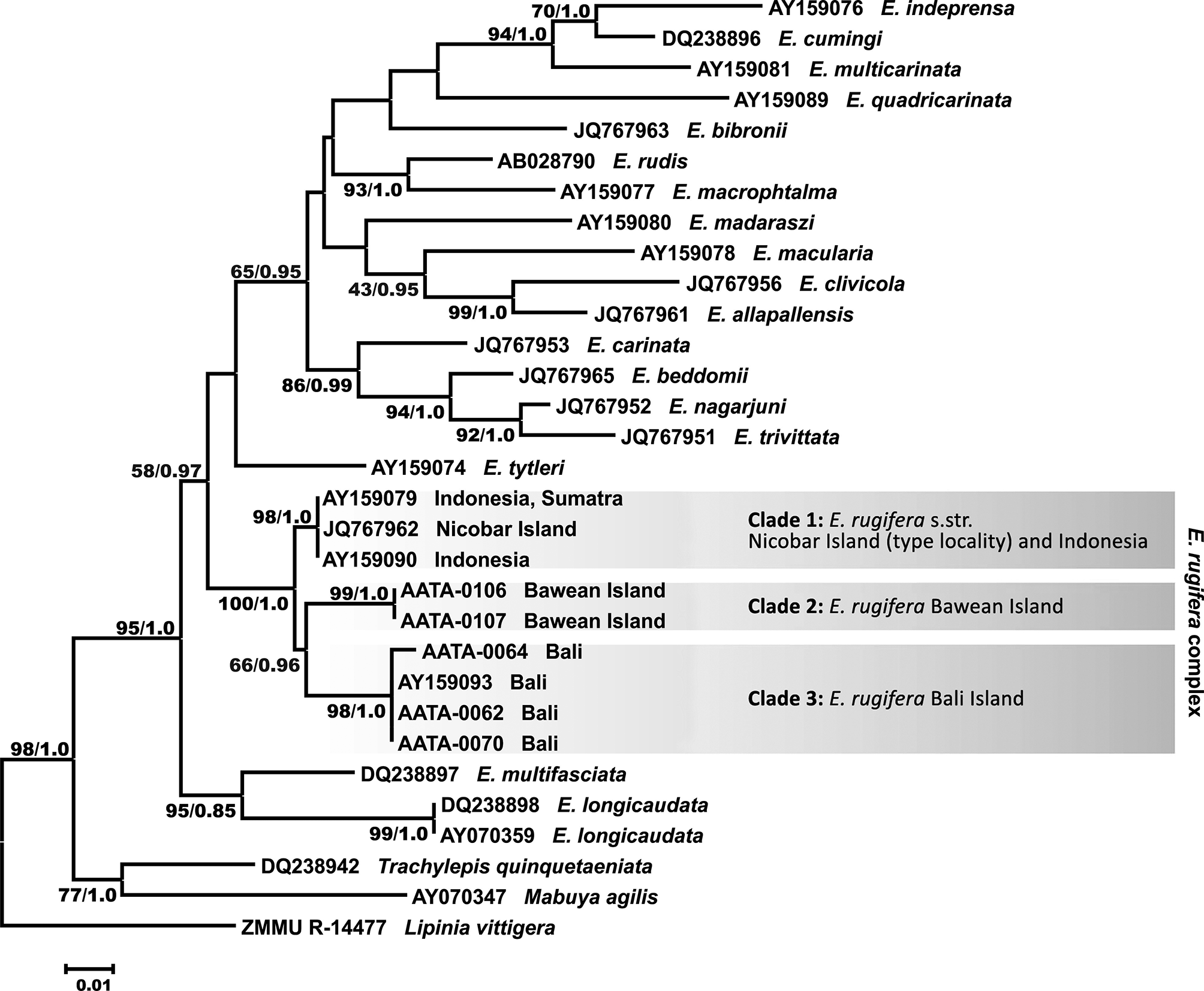
Sumber: Systematics of Eutropis rugifera (Stoliczka, 1870) (Squamata: Scincidae) including the redescription of the holotype
| Bali |
| 7 |
| 4.1% |
| 8 | Riau | 5 | 2.9% |
| 9 | Banten | 5 | 2.9% |
| 10 | Lampung | 3 | 1.7% |
| 11 | Sumatera Barat | 2 | 1.2% |
| 12 | Sumatera Selatan | 2 | 1.2% |
| 13 | Kalimantan Barat | 2 | 1.2% |
| 14 | Aceh | 1 | 0.6% |
| 15 | Bengkulu | 1 | 0.6% |
| 16 | Kepulauan Bangka Belitung | 1 | 0.6% |
| 17 | Kalimantan Timur | 1 | 0.6% |
| tha |
| Catalogue of Life |
150 titik observasi Eutropis rugifera di Indonesia
Memuat peta...
Setiap titik merepresentasikan satu lokasi observasi yang tercatat. Klik titik untuk melihat detail.