Distribusieng
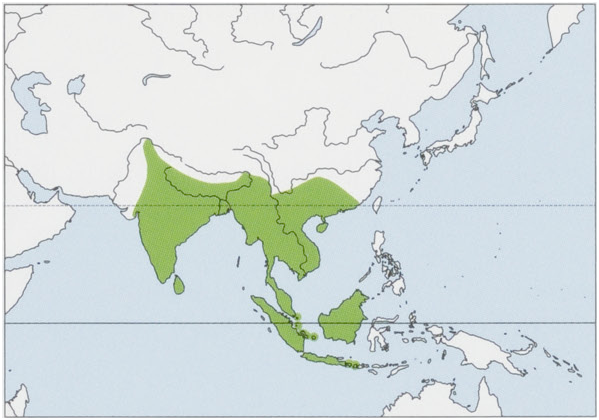
DISTRIBUTION: Sri Lanka; India; NE Pakistan; Nepal; Bhutan; Bangladesh; S China (Yunnan, Guangxi, Hainan Isl) south through Indochina to Peninsular Malaysia, Sumatra, Borneo, Java, Bali, Lombok and many smaller Indonesian islands.
Sumber: Order Artiodactyla
Biologi & Ekologieng
Habitat. It is a flexible forest-dwelling species that lives in deciduous and evergreen forests, old-growth and secondary forests, in exotic commercial plantations, sometimes in grasslands and croplands close to the forest edge. On Hainan Island it uses shrubland and savanna and tends to avoid woods. Normally found up to 1000 - 1500 m above sea level, in Himalayas up to 3000 - 3500 m.
Sumber: Cervidae
Biologi & Ekologieng
Movements, Home range and Social organization. It is very secretive, usually moving in a network of pathways in dense cover. Males have relatively large home ranges encompassing those of a few females. In Nepal males have mean home ranges of 7 km?; female ranges are 6 km? *. Red Muntjacs do not seem strictly territorial, with exclusive areas, but exhibit site-specific dominance. Males spend much time in scent marking and may be aggressive with individuals of the same sex. These muntjacs are essentially solitary, but not asocial; and it is possible that a local population forms some kind of social unit held together by a complex net of scent. The maximum number of animals observed together is four, generally undera fruiting tree or around a small waterhole. Groups of two individuals are a mating pair or mother and her young.
Sumber: Cervidae
Konservasieng
Status and Conservation. Classified as Least Concern on The IUCN Red List, two forms have been asessed independently; the race from the Sumatran mountains (montanus) was classified as Data Deficient and the mainland populations as Least Concern. It appears to be fairly resilient to hunting and habitat degradation and it is still common in most of its range, possibly decreasing. Its meat is among the most consumed in south and south-eastern Asia.
Sumber: Cervidae
Deskripsieng
Descriptive notes. Head-body 90 - 120 cm, tail 17 - 19 cm, shoulder height 50 - 70 cm; weight 20 - 28 kg (up to 35 kg in Vietnam andJava). Sexes are of equal size. Mediumto large-sized muntjacs, with long pedicles (8 - 15 cm in length) and thick frontal ridges; antlers generally well developed (8 - 20 cm; up to 27 cm long), typically with a short brow tine; the tips of the antlers tend to curve inwards. The coat is reddish, with paler, sometimes whitish or grayish underparts. The tail is orange to red-brown; in subspecies montanus it is dark brown. Two black lines along antler pedicles extend down to the face. Fawns are spotted. Two straightslits on the face indicate the pair of frontal glands. Antler cycles are synchronized at the local level. Antler casting generally occurs in a three-month period with a peak in April-May. The lowest number of chromosomes of any mammal; diploid number is 7 or 9 (males) and 6 or 8 (females).
Sumber: Cervidae
Distribusieng
Subspecies and Distribution. M. m. muntjakZimmermann, 1780 — PeninsularMalaysia, Sumatra, Java, Bali, Borneoandseveralassociatedsmallerislands. M. m. annamensisKloss, 1928 — SLaos, SVietnam, andCambodia. M. m. aureusC. H. Smith, 1826 — Pakistan, N & CIndia. M. m. curvostylisGray, 1872 — Myanmar, Thailand. M. m. malabaricusLydekker, 1915 — SIndiaandSriLanka. M. m. menglalisWang & Groves, 1988 — SChina (SYunnan); possiblyalsoinneighboringMyanmar, Laos, andVietnam. M. m. montanusRobinson & Kloss, 1918 — Sumatranhighlands. M. m. nigripesG. Allen, 1930 — HainanI. M. m. vaginalisBoddaert, 1785 — Nepal, Bhutan, NEIndia, andBangladesh. M. m. yunnanensis Ma & Wang, 1988 — S China (from C & N Yunnan and S Sichuan to S Fujian & Guangdong). Forms from mainland Asia have been introduced into the Andaman Is.
Sumber: Cervidae