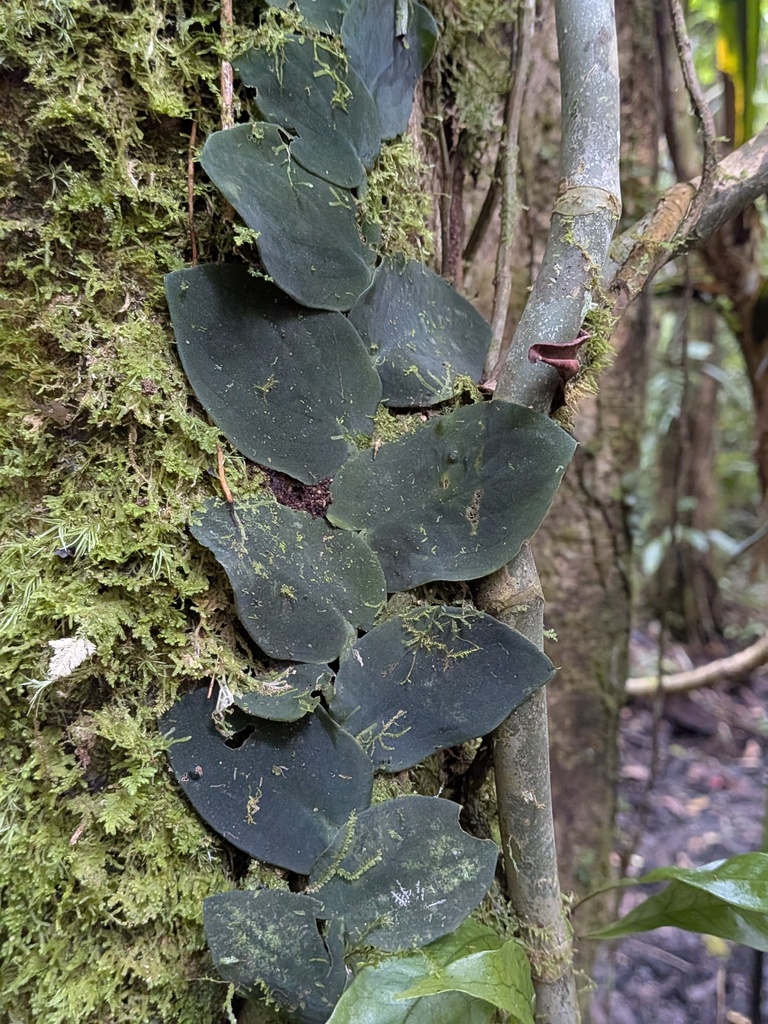
Umumeng
<p>Very large, occasionally enormous, slender to rather robust, pachycaul, heterophyllous liane to 20 m; seedling stage a non-skototropic shingling juvenile shoot; pre-adult plants never forming terrestrial colonies; adult shoot architecture comprised of greatly elongated, clinging, physiognomically monopodial, densely leafy, flowering stems; LEAVES: stems smooth, bright green, with sparse to copious prophyll, cataphyll and petiolar sheath fibre, especially at the stem apices, internodes to 15 x 3.5 cm, separated by prominent oblique leaf scars, older stems sub-woody; flagellate foraging stems absent; clasping roots densely arising from the nodes and internodes, prominently pubescent; feeding roots abundant, adherent and free, very robust, densely ramentose-scaly; leaves distichous; cataphylls and prophylls membranous, soon drying degrading to intricately reticulate fibres, these only very slowly falling; petiole shallowly grooved, upper part ± terete, (1 -) 9-65 x 0.2-1.5 cm, smooth, apical and basal genicula prominent; petiolar sheath prominent, membranous, strongly to slightly unequal on one side, extending almost to or reaching the apical geniculum, of ± short-duration, soon degrading into persistent netted fibres, these eventually falling to leave a prominent, slightly corky scar; lamina of seedlings overlapping in the manner of roof shingles, entire, lanceolate, 5-11 x 3.5-6 cm, base slightly cordate, lamina of pre-adult and adult plants free, entire, pinnatipartite, pinnatisect or pinnatifid, 10-44 x 14-94 cm, broadly oblong-elliptic to oblong lanceolate, slightly oblique, membranous to chartaceous or sub-coriaceous, base truncate and very briefly decurrent, apex acute to acuminate, individual pinnae 1-10 cm wide, frequently perforated basally adjacent to the mid-rib, thus appearing stilted; mid-rib very prominently raised abaxially, slightly sunken adaxially; primary venation pinnate, raised abaxially, somewhat impressed adaxially, 2-4 primary veins per pinna; interprimaries sub-parallel to primaries, slightly raised abaxially, slightly impressed adaxially; secondary venation strongly reticulate, slightly raised; tertiary venation invisible; INFLORESCENCE solitary to several together, first inflorescence subtended by a membranous prophyll and one or more cataphylls, these swiftly degrading to netted fibres, subsequent inflorescences subtended by one or more swiftly degrading cataphylls, the whole forming a mass of developing and open inflorescences and developing infructescences partially concealed by persistent netted cataphyll and prophyll remains; peduncle slightly laterally compressed to terete, 6-26 x 1-1.5 cm; spathe narrowly canoe-shaped, stoutly beaked, 10-30 x 3-5 cm, stiffly fleshy, greenish to dull yellow, gaping wide at female receptivity and then swiftly falling to leave a large straight scar at the base of the spadix; spadix cylindrical, sessile, inserted ± level on peduncle, 9-26 x 1.5-2 cm, dull green to dirty white; stylar region rather well developed, mostly rhombohexagonal, 1.5-2 x c.c. 2 mm, slightly conical; stigma punctiform to slightly elliptic, if the latter then mostly longitudinally orientated, c.c. 0.3-0.5 x 0.2-0.4 mm; anthers barely exserted at anthesis; INFRUCTESCENCE 14-27 x 3-3.5 cm, dark green ripening to dull orange, stylar tissue abscising to reveal orange ovary cavity pulp.</p>
Sumber: CATE Araceae