Biologi & Ekologieng
Habitats. Coniferous forests dominated by P. halepensis, mixed woods of Q. coccifera and Rosmarinus officinalis; garrigue with Cistus monspeliensis, Pistacia lentiscus, Lavandula sp.; also found in open coastal areas.
Sumber: The scolopendromorph centipedes (Chilopoda, Scolopendromorpha) of Tunisia: taxonomy, distribution and habitats
Distribusieng
Distribution in Tunisia (Map 2). Known from the Subhumid and Semiarid bioclimatic zones. Comparatively rare species, found in northeastern Tunisia only – Cap Bon Peninsula, Jebel Zaghouan, Jebel El Fahs and near Siliana. The species has been reported also from Medjez-el-Bab (Attems 1902), Tunis and its surroundings (Brölemann 1904) and Jebel Serdj (Dobroruka 1968). Altitudinal range in Tunisia. Known from sea level up to approx. 600 m.
Sumber: The scolopendromorph centipedes (Chilopoda, Scolopendromorpha) of Tunisia: taxonomy, distribution and habitats
Deskripsieng
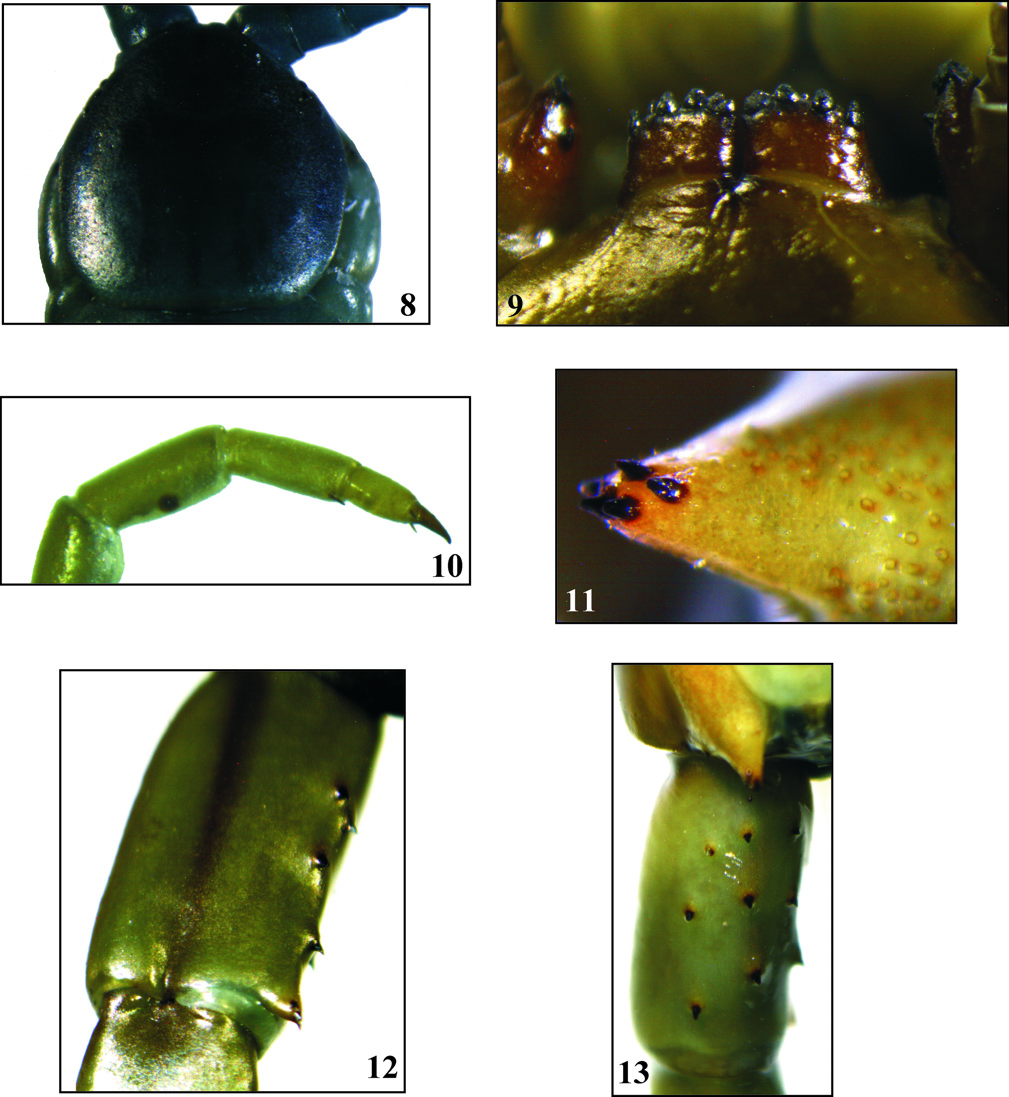
Anatomical illustrations: Attems (1930, figs. 38 – 39), Lewis (1966, figs. 2 – 4; 1968, figs. 3 – 9, 13 – 16, 20 – 24; & 1969, figs. 3 – 5, all as S. amazonica; 2001, figs. 2 – 4, as S. morsitans), L. E. Koch (1983, figs. 1 – 15), Shelley (2002, figs. 57 – 64), Shelley et al. (2005, fig. 1).
Sumber: A chronological catalog of the New World species of Scolopendra L., 1758 (Chilopoda: Scolopendromorpha: Scolopendridae)
Distribusieng
Distribution: believed to be native to Africa, Australia, & Asia from India to Papua New Guinea & the Philippines (L. E. Koch 1983, Khanna 2001, Shelley et al. 2005); its sporadic occurrence in the New World undoubtedly reflects human introductions. According to Shelley (2002) and Shelley et al. (2005), S. morsitans occurs on Anguilla, Antigua, Bahamas (Eleuthera, Exuma, New Providence), Barbuda, Cayman Islands (Grand & Little Cayman), Curaçao, Dominica, Grenadines (Bequia), Guadeloupe, Hispaniola (Haiti, Dominican Republic), Jamaica, Marie Galante, Martinique, Montserrat, Nevis, St. Barthélemy, St. Kitts, St. Vincent, Tobago, Turks and Caicos (Grand Turk, South & West Caicos), Puerto Rico, & the US Virgin Islands (St. Croix & St. Thomas). On the continental land mass, the centipede has been encountered in the US (Florida); Mexico (Baja California Sur, Colima, Tamaulipas, Veracruz, Yucátan), Belize, Costa Rica, Panama, Colombia (Casanare, Cordoba), Venezuela, Guyana, Surinam, French Guiana, Ecuador, Peru (Huanuco, La Libertad, Loreto, San Martinj), Brazil (Amazonas, Bahia, Goias, Mato Grosso, Pará, Paraiba, Rio de Janeiro, São Paulo), Paraguay, & Argentina (Brölemann 1901, 1902 a, b, 1903, 1909; Attems 1930; Bücherl 1939, 1942 a, 1950, 1974; Jeekel 1952; Shelley 2002; Shelley et al. 2005). Maps: Shelley et al. (2005, figs. 2 – 3).
Sumber: A chronological catalog of the New World species of Scolopendra L., 1758 (Chilopoda: Scolopendromorpha: Scolopendridae)