Biologi & Ekologieng
Habitat. Bantengs can occur from sea level to 2100 m. Their current range, and habitat availability within it, has been greatly reduced in the past century, and the species may now be relegated to less than preferred habitats. Early accounts suggested that the long legs of the Banteng, relative to other wild Asian cattle, predisposed it to lowlands, but other accounts suggest that it may be somewhat of a habitat generalist. On the Asian mainland, early investigations suggested that Bantengs avoided evergreen forests, preferring open dry deciduous forests with grassy openings and bamboo stands. In West Java, Bantengs seek cover in rainforests but tend to concentrate around open meadows where they feed. On Borneo, Bantengs use swamps and forests along rivers and lowland logged forests. Human activities such as cultivation and logging may force Bantengs to denser forests in upland areas, but in some places, they seem to tolerate humans. Availability of free water is important; Bantengs are said to drink daily when conditions permit it. Mineral licks also are visited regularly, and occasional drinking of seawater by some Banteng populations is thought to be a substitute for mineral licks.
Sumber: Bovidae
Biologi & Ekologieng
Movements, Home range and Social organization. Bantengs are non-migratory but will move extensively for food, water, and mineral licks. No information exists on home range sizes. A female and her offspring constitute the nucleus of social groups. Typical group sizes are about 8 - 12 individuals, but groups of 20 - 100 have been observed in open areas. Typical groups are made up of adult females, their offspring, and juveniles, often accompanied by one or more young and adult males; such groups probably are not stable. Sometimes females occur alone or in female-only groups without offspring. Mature males also occur singly or in bachelor groups, which break up as rut approaches. Sexual segregation may be minimal in some areas perhaps because of limited resources and clumped water availability (e. g. Baluran National Park, Java).
Sumber: Bovidae
Konservasieng
Status and Conservation. Classified as Endangered on The IUCN Red List. Bantengs only occur now in small and isolated populations. Wild Banteng only number about 5000 - 8000 individuals; no populations have more than 500 individuals and only 6 - 8 populations have more than 50 individuals — most are in decline. The species is extinct in Bangladesh, Brunei, and India. Most remaining wild populations of Bantengs occur in parks and reserves, providing a degree of protection and administrative control. Threats to conservation of wild Bantengs include habitat loss, degradation, and fragmentation; poaching for subsistence and trade in trophies, meat, and animal parts (horns are prized); disease transmission with domestic cattle; loss of genetic integrity and hybridization with domestic cattle; and predation by Dholes (Cuon alpinus), particularly in Java. Conservation efforts likely will have the greatest potential for success in Java and Cambodia where numbers of Bantengs are the highest, followed by Thailand and Borneo. The exotic population of Bantengs in the Northern Territory of Australia numbers about 6000 individuals and is genetically identical to wild Bantengs, despite the 20 or so founders being domesticated animals from Bali. This population may have conservation potential in the future. In 2003 following successful cloning of Gaur (B. gaurus), two clones of Banteng were produced from a single cell of frozen ear tissue of a male that died at the San Diego Zoo in 1980; one of the clones survived to at least 2007 but had not reproduced. The Banteng now has a permanent place in the history of such innovative and yet controversial approaches to recovery of endangered species.
Sumber: Bovidae
Deskripsieng
Descriptive notes. Head-body 190 - 225 cm, tail 65 - 80 cm, shoulder height up to 160 cm; weight 600 - 800 kg. The Banteng subspecies from Borneo tends to have a smaller cranium with smaller horn span than the other two subspecies; the cranium of mainland Banteng is comparable to the taxon from Java, but the horns are larger in all dimensions. Bantengs are generally built lighter than other wild Asian cattle, with longer legs, a more elongated head, and less developed hump on the withers. Bantengs are sexually dimorphic, particularly in size and coloration. Males are larger than females, who are more slender and domestic cattle-like. Males are black in Java and apparently peninsular Thailand, but they are orange-khaki with chestnut-brown hues elsewhere. Females and young are orange-khaki to chestnut with a dark dorsal line. Both sexes have distinctive white stockings on their lower legs, a white rump patch surrounding, but not including, the base of the tail, white muzzles, and small white spots above their eyes. The tail is long and tufted, reaching below the hocks. The horns of males are larger than those of females and curve outward and forward, with upward-turned tips; the length along the outer curve is 42 - 76 cm, the basal circumference is 26 - 43 cm, and the tip-to-tip length is 18 - 68 cm (considerable variation noted among subspecies / locations). Horns of mature males are connected by a cornified band across the intercornual ridge, particularly in the subspecies from Java. Smaller female horns grow upright from the base. Dental formula is I 0 / 3, C 0 / 1, P 3 / 3, M 3 / 3 (2) = 32,
Sumber: Bovidae
Distribusieng
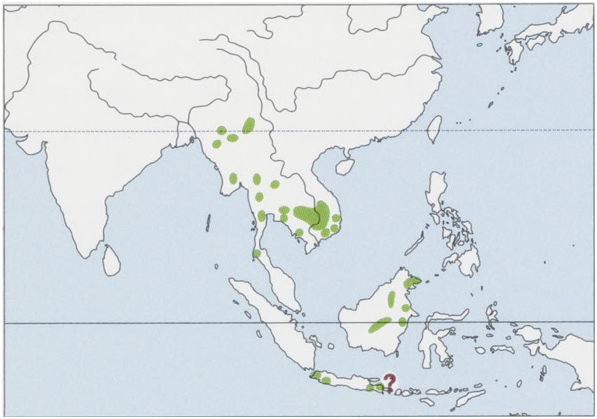
Subspecies and Distribution. B. j. javanicusd’Alton, 1823 — Java, perhapsBali. B. j. birmanicusLydekker, 1898 — AsianmainlandincludingMyanmar, SChina (SYunnan, currentpresenceuncertain), Laos, Vietnam, Thailand, Cambodia, andNPeninsularMalaysia. B. j. low: Lydekker, 1912 — Borneo. The domestic form of the Banteng has been introduced, and is now feral, in N Australia, New Guinea, and on various islands of Indonesia (Bali, Sangihe, Sulawesi, Sumbawa, Sumba, and Enggano) and occurs in domestication throughout the islands of SE Asia.
Sumber: Bovidae
Konservasieng
STATUS: U. S. ESA - Endangered; IUCN - Vulnerable.
Sumber: Order Artiodactyla