Biologi & Ekologieng
Habitat. Primary and secondary forests including coastal, montane, mangrove, swamp, and riparian forest in Sumatra and mainly riparian and mangrove forests in Borneo. The Silvered Langur is sometimes found in plantations. Depending on the region, it is sympatric with different species of Presbytis.
Sumber: Cercopithecidae
Biologi & Ekologieng
Movements, Home range and Social organization. There is no information available for this species.
Sumber: Cercopithecidae
Konservasieng
Status and Conservation. CITES Appendix II. Classified as Near Threatened on The IUCN Red List, including the nominate subspecies cristatus, but the subspecies vigilans is classified as Critically Endangered. Major risks for Miller’s Silvered Langur are its restricted distribution (only 62 km * on Serasan Island) and ongoing loss of suitable habitat due to deforestation. The nominate subspeciesis still wide-ranging, but it too is suffering from habitat loss throughoutits range. On Borneo, threats are mainly due to land clearance (oil palm plantations), and forest fires. Silvered Langurs are hunted for their meat in Sarawak and are often kept as pets in Sumatra. The nominate subspecies occurs in various protected areas, including Bukit Barisan Selatan and Gunung Leuser national parks in Indonesia and Bako National Park in Malaysia. An overall population estimate is not available.
Sumber: Cercopithecidae
Deskripsieng
Descriptive notes. Head — body 50 - 58 cm (males) and 46 - 51 cm (females), tail 67 — 75 cm (males) and 66 - 75 cm (females); weight ¢. 6 - 6 kg (males) and ¢. 5 - 7 kg (females). The Silvered Languris variable in color. Circumfacial hair is erect and forward-curled, there is a high pointed crest (but less pointed and high that in the Selangor Silvery Langur, 1. selangorensis), and face is slaty-black. Adult female Silvered Langurs have irregular patches of white on inner parts of upper thighs. Teeth and jaws are relatively short. The nominate subspecies cristatus can be divided into two main morphs, which are very distinct but not genetically and geographically separated (although they are somewhat more so in Sumatra). The silvery-gray “ wltimus ” morph predominates in northern Sumatra; it is uniformly dark gray, tipped with paler gray; it has a black-tinged forehead and yellowish groin and underside oftail. The “ cristatus ” morph has shorter hair tips, especially on its back, giving it an overall almost gray-green color. It occurs further south on Sumatra and on Bangka, Belitung, and Riau Islands. Both morphs occur at almost equal frequencies in Borneo, with the “ cristatus ” morph being perhaps slightly more common. There is an additional, rare reddish morph in Sabah, Borneo. “ Miller’s Silvered Langur ” (7. c. vigilans) is rather darker than the nominate subspecies, with less lightened hair tips. Its crown is dark and surrounded by a well-defined zone of long hair tips.
Sumber: Cercopithecidae
Distribusieng
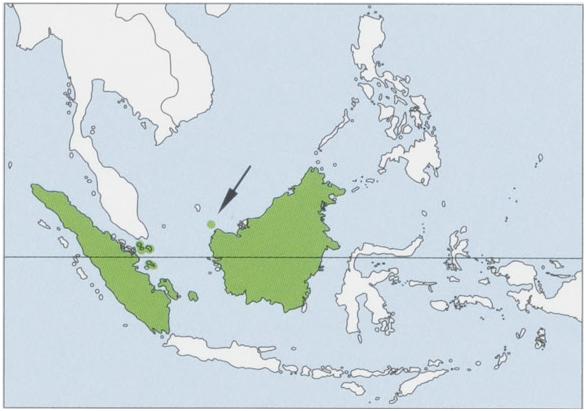
Subspecies and Distribution. 1. c. cnistatus Raffles, 1821 — Borneo, Sumatra, Bangka, Belitung, and Riau (Bintan, Combol, Sugi, and perhaps Batam) and Lingga (Bakung, Lingga) Archipelagos, off E Sumatra. 1: c. vigilans G. S. Miller, 1913 — Natuna Is (Serasan I), off W Borneo.
Sumber: Cercopithecidae
Konservasieng
Conservation: CITES – Appendix II.
Sumber: Order Primates