Distribusieng
Distribution and habitat. New Ireland: 2. — General distribution: Central Indonesia east to Marshall Islands and Tonga, north to Philippines, south to northern Australia and Lord Howe Island. Found in caves and crevices of coral reefs, 4 – 35 m depth. Marine.
Sumber: Checklist of the marine and estuarine fishes of New Ireland Province, Papua New Guinea, western Pacific Ocean, with 810 new records
Deskripsieng
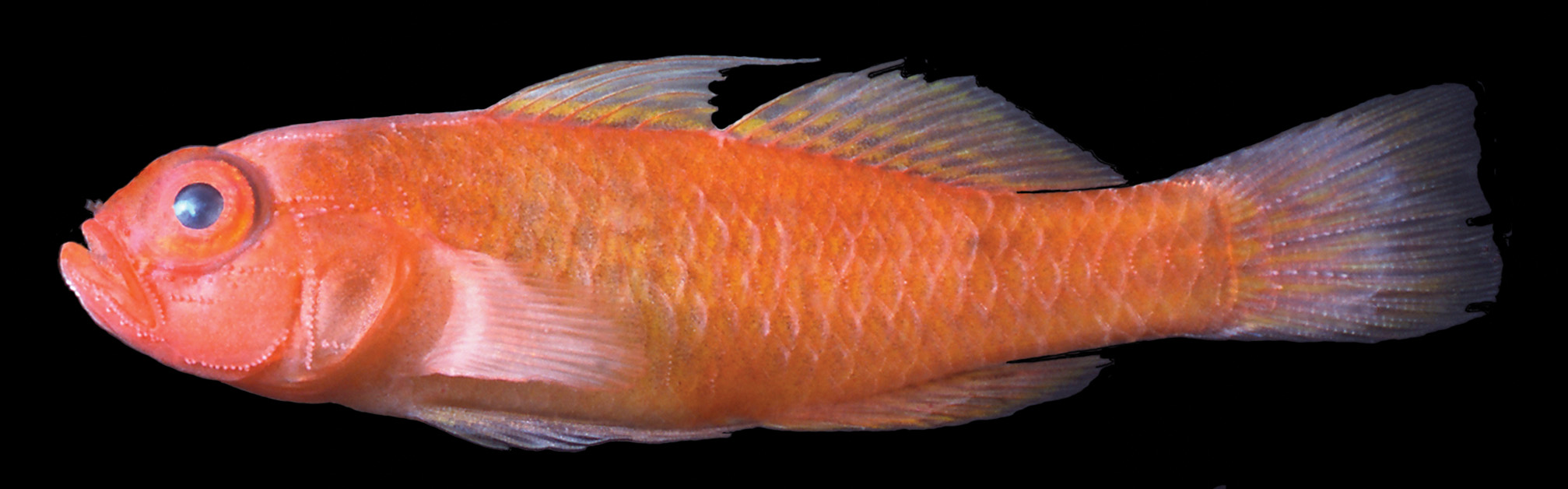
Description. The description is primarily based on specimens from the Great Barrier. Dorsal fin VI + I 10 (I 9 in 8.5 % of specimens, rarely I 8 or I 11 in <1 % of specimens, mean = I 9.9, n = 358), second spine longest, reaching to at least to second segmented dorsal ray to just beyond middle of second dorsal fin when adpressed, first ray of dorsal fin branched or unbranched (half of 30 specimens between 15 and 24 mm SL examined had a branched ray), anterior element of last element branched; anal fin I 9 (I 8 or I 10, in 7.3 % of specimens and rarely I 7 in <1 % of specimens, mean = I 8.9, n = 358), first ray usually unbranched, anterior element of last ray branched; pectoral-fin rays 17 – 20, usually 18 – 19 (in 93 % of specimens examined), but varying a little geographically (see Table 1), reaching just posteriorly to a vertical in line with anal spine or first 2 – 3 segmented anal rays, pectoral fin with 6 – 13 central rays branched, upper 3 – 5 rays usually unbranched and lower 4 – 8 usually unbranched, branching increasing with size (6 – 10 rays branched in specimens less than 20 mm SL to 8 – 13 rays branched in larger specimens); pelvic fin I 5, rays usually with 1 sequential branch, sometimes second, third or fourth segmented ray branched twice (with 3 terminal tips), fifth ray with a single dichotomous branch (two terminal tips), 65 – 75 % the length of the fourth ray, which reaches posteriorly to anterior few elements (second to fourth segmented ray) of anal fin; fraenum absent, basal membrane variably present in preserved specimens from just connected to basal 10 – 20 % of fifth ray in well preserved material, but often torn. Lateral scales 21 – 25, usually 23 or 24 (in 79 % of individuals), rarely 21 (in 2 % of individuals), mean = 23.5, n = 105 for Australia and 23.2, n = 102 for other localities; transverse scale count usually 7 – 8, (rarely 9 in <10 % of individuals), mean = 7.6, n = 105 for Australia and 7.8, n = 88 for other localities; scales on pectoral-fin base, breast, and anteriormost scales on midline of belly cycloid, remaining scales ctenoid; midline of nape naked, sides with scales extending anteriorly to just behind eye; scales below posterior end of second dorsal fin with small accessory scales; pectoral-fin base usually with 4 vertical rows of cycloid scales, 1 horizontal row dorsally and 3 ventrally, none of scales prominently enlarged or elongate; prepelvic area with 5 – 6 rows of cycloid scales, a single enlarged median scale and sometimes one or two smaller median scales covering membrane between pelvic fins. Teeth in lower jaw consist of an enlarged outer row of curved, spaced canines and an inner row of similar, but smaller canines (about two thirds size of outer teeth), with irregular rows of small conical teeth in between; outer row of teeth in the upper jaw similar to those of the lower jaw, with small irregular inner rows of teeth. Tongue rounded to truncate, about two-thirds pupil diameter in width, with pointed tip ventrally. Gill opening extending anteroventrally to below or just behind mid-pupil; gill rakers on first arch 3 – 5 + 13 – 15 (mean = 17.7 based on 58 specimens; Winterbottom (1996) reported 3 – 4 + 13 – 14 (mean = 3.8 + 13.8 )). Anterior nares at end of short tube just above upper lip; posterior nares pore-like with a raised rim, 1 nares diameter from anterior and 1 – 2 nares diameters from fleshy rim of eye. Nasal sac slightly elevated. Interorbital trough moderate and ‘ U’ - shaped, posterodorsal trough represented by a shallow groove between the epaxialis muscle along posterodorsal margin of eye and bony rim of orbit; bony interorbital width about half to one third pupil diameter; epaxialis musculature reaching to a point in line with a vertical with posterior margin of the pupil. Posterior abdominal / anterior caudal vertebral pattern is Type B. Colour pattern. Freshly collected. (From slides of a 22 mm SL specimen from the Great Barrier Reef, Fig. 5). Snout and lips red, rest of head and body normally red to reddish orange, rarely yellowish orange; a thin blue bar along posteroventral margin of eye expanding into a thin bar extending ventrally to behind jaws; anteriorly a thin blue line from anteroventral margin of eye extending to just behind middle of lips; often with a third blue mark just behind posterior nostril. Pupil surrounded by a thin yellow to gold circle; iris reddish orange, often golden ventrally. Body often with melanophores arranged in vertical wavy lines along centers of scales; caudal peduncle with faint grey stripes formed by dense subcutaneous dark pigment. Dorsal fins largely clear, with a thin yellow to red stripe just above base of fin; a second thin stripe just below middle of fin, most prominent on second dorsal fin. Second dorsal fin yellowish to pale orange above stripes, with a thin white to bluish distal margin. Anal fin red to reddish orange with thin blue to white distal margin. Caudal fin reddish orange to yellow basally grading posteriorly to a translucent grey, distal margin often pale blue. Pectoral and pelvic fins white to pale grey. Live specimens from type locality (Philippines), and those from Great Barrier Reef (Pl. 1 C) overall bright red with underlying dusting of brown chromatophores. Specimens from Palau and some other parts of western Pacific may be much yellower (although adult males exhibit a bright red head). Preserved. Head and body largely plain straw coloured; bar below eye often persisting as a grey band; fins largely pale, except dorsal fins often with scattered melanophores. Variation. Branching of pectoral rays increases significantly with size (p = 0.01, based on 70 specimens selected at random from 15 – 25.5 mm SL). Specimens below 20 mm SL usually have 5 – 7 branched rays, while specimens above 20 mm SL usually have 8 – 11 branched rays. The ranges of counts are, however, highly variable at all sizes. There is considerable variation in the length of the second filamentous dorsal spine. In most Australian material the spine is typically short, rarely reaching beyond the middle of the second dorsal fin when adpressed. In specimens from the Philippines, the spine often reaches beyond the end of the second dorsal fin. Pectoral ray counts show significant variation between samples (Table 1). Samples from Fiji average higher pectoral ray counts (19.0) than other localities. Analysis of Variance on samples of> 20 specimens indicate that the samples are not from a single population (p <0.05). Samples from the Great Barrier Reef show little variation, with means between 18.4 and 18.6. The blue lines below the eye are absent in photos of some fresh specimens from some localities (Yonge Reef, Queensland, Solomon Islands and Samoa). Other photos from these localities show the bar below the eye. The lines are faint in photos of a fresh specimen from New Caledonia. In others, the lines are sometimes incomplete, particularly ventrally on the cheek. The overall body colouration varies from bright red to a red head and reddish orange body. The red colouration fades rapidly in preserved material. Sex ratios were normally about even, with a total of 155 males and 193 females examined; however, because of the slightly larger size one would expect a bias of more males. The maximum size known is 29 mm SL from New Caledonia (with a 28 mm SL specimen from Lizard Island), but for most samples the maximum size is around 20 – 25 mm SL. Males average about 1 mm SL larger in most samples (p <0.05) and reach a size larger than females of 2 – 3 mm SL in any sample. In some small individuals the urogenital papilla of females is pigmented like that of males and it is possible that some individuals change sex.
Sumber: A revision of the Australian species of Trimma (Actinopterygii, Gobiidae), with descriptions of six new species and redescriptions of twenty-three valid species
Distribusieng
Distribution. Trimma benjamini is abundant on the Great Barrier Reef, currently known from One Tree Island on the southern part of the reef and from Pixie Reef off Cairns to Ashmore Reef on the northern part of the reef. It is also found on islands of the Coral Sea and Ashmore Reef in the Timor Sea. It is normally confined to offshore reefs along the eastern edge of the Great Barrier Reef and only rarely found on mid reefs near Lizard Island and never from coastal reefs. It is also known from Rowley Shoals and Ashmore Reef off Western Australia. In Australia it is most abundant in depths of 10 – 30 metres, but is found from 1 – 37 m. Outside of Australia the species was found in similar clear water reefs to depths of 68 m. The species is known from Vietnam and Western Australia eastward to the Marshall Islands and Samoa (Fig 6). Specific locations outside of Australia include Palau, Moluccas, Papua New Guinea, Marshall Islands, Vietnam, Fiji, Philippines, New Caledonia, Solomon Islands, Tonga, Vanuatu and Samoa. Comparisons. Among the species of Trimma which lack scales in the predorsal midline and have a uniform body colouration (i. e. lacking light spots, saddles, streaks or distinct stripes, at least when preserved), only two other species have an interorbital trough as deep as it is wide. Those species, Trimma corallinum (Smith 1959) and T. omanensis Winterbottom, 2000, are currently known only from the western Indian Ocean, have 20 – 21 (vs. usually 18 – 19) pectoral rays, a full basal (vs. one-tenth) membrane, a fifth pelvic-fin ray sub-equal (vs. 60 – 75 %) to the fourth, and a well-developed trough (vs. a slight groove) posterodorsal to the eye. Pale specimens without a bar under the eye can be similar in colouration to T. preclarum (which has faint stripes on the caudal peduncle). That species differs in having predorsal scales crossing the midline and lower dorsal ray counts. The analysis of the CO 1 gene suggests there are at least two haplogroups, one (n = 4) from the main islands of Palau, and the other from a more southerly part of the Pacific (three from the Great Barrier Reef, one from New Caledonia, and two from Helen Reef in the South West Islands of Palau) separated by approximately 5.6 % of the CO 1 genome (Winterbottom et al., 2014). The Helen Reef specimens are separated by about 0.3 % from those from Australia and New Caledonia. No specimens were available for genetic analysis from the type locality (Siquijor Island, Philippines).
Sumber: A revision of the Australian species of Trimma (Actinopterygii, Gobiidae), with descriptions of six new species and redescriptions of twenty-three valid species