
Distribusieng
Distribution in the area. Not endemic. Recorded from the lower Shatt Al-Arab.
Sumber: A Critical Checklist of the Inland Fishes Native to the Euphrates and Tigris Drainages
Family Syngnathidae · Order Syngnathiformes
Data diperbarui secara berkala dari berbagai sumber observasi biodiversitas.
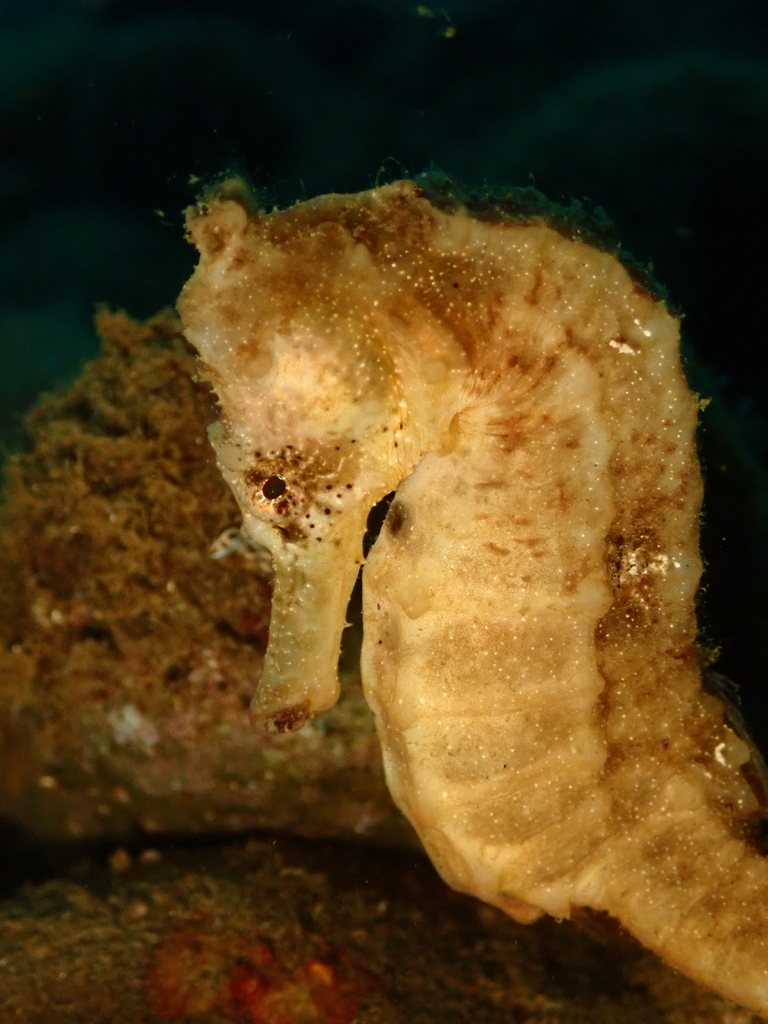
Foto: Febrianne S | http://creativecommons.org/licenses/by-nc/4.0/
Otoritas penamaan: Bleeker, 1852 (1852)
Status taksonomi: ACCEPTED
Status konservasi (IUCN): VU Rentan
Dipublikasikan dalam: Bleeker, P. (1852). Bijdrage tot de kennis der ichthyologische fauna van Singapore. <em>Natuurkundig Tijdschrift voor Nederlandsch Indië.</em> v. 3 (no. 1): 51-86.
Total Catatan di Indonesia
0
Provinsi Ditemukan
0
dari 38 provinsi
Catatan Pertama
0
tahun pertama tercatat
Tren Tahunan
-0%
-14.5% vs 2025
Common Sea Horse (Hippocampus kuda) termasuk dalam famili Syngnathidae, ordo Syngnathiformes. Berdasarkan data yang terhimpun, spesies ini telah tercatat sebanyak 474 kali di Indonesia, tersebar di 15 provinsi. Catatan pertama tercatat pada tahun 1857.
Sulawesi Utara merupakan provinsi dengan catatan observasi terbanyak untuk spesies ini, dengan 193 catatan (40.7% dari total). Data distribusi ini mencerminkan akumulasi dari berbagai kegiatan survei, penelitian, dan kontribusi citizen science. Pola distribusi yang tercatat mungkin tidak sepenuhnya menggambarkan persebaran alami spesies, karena dipengaruhi oleh intensitas pengamatan di masing-masing wilayah.
Tren observasi tahunan Hippocampus kuda menunjukkan penurunan signifikan (-15%) pada periode terakhir dibanding tahun sebelumnya, dengan catatan pertama pada tahun 1857.
Catatan deskriptif tentang Hippocampus kuda dari sumber literatur primer (via GBIF).
Distribution in the area. Not endemic. Recorded from the lower Shatt Al-Arab.
Sumber: A Critical Checklist of the Inland Fishes Native to the Euphrates and Tigris Drainages
Synonyms. H. aterrimus Jordan and Snyder 1902, H. borboniensis Duméril 1870, H. chinensis Basilewsky 1855, H. fuscus Rüppell 1838, H. hilonis Jordan and Evermann 1903, H. horai Duncker 1926, H. melanospilos Bleeker 1854, H. moluccensis Bleeker 1852, H. novaehebudorum Fowler 1944, H. polytaenia Bleeker 1854, H. raji Whitley 1955 (= H. kuda multiannularis Raj 1941), H. rhynchomacer Duméril 1870, H. taeniops Fowler 1904, H. taeniopterus Bleeker 1852, H. tristis Castelnau 1872 Syntypes. (2) RMNH 5167 (1 of several), BMNH 1867.11.28.360 (see also Bleeker specimens: NMV 46227 - 28 (2 )).
Sumber: A global revision of the Seahorses Hippocampus Rafinesque 1810 (Actinopterygii: Syngnathiformes): Taxonomy and biogeography with recommendations for further research
Distribution. Australia (northern), Bahrain, Cambodia, China (including Hong Kong SAR and Province of Taiwan), Comoros, Cyprus, Djibouti, Egypt, Eritrea, Fiji, France (Réunion), India, Indonesia, Iran, Israel, Japan, Kenya, Kuwait, Lebanon, Malaysia, Madagascar, Mauritius, Mozambique, Federated States of Micronesia, New Caledonia, Oman, Pakistan, Papua New Guinea, Philippines, Qatar, Saudi Arabia, Seychelles, Singapore, Solomon Islands, Somalia, South Africa (eastern), Sri Lanka, Sudan, Syria, Tanzania, Thailand, Tonga, Turkey, United Arab Emirates, USA (Hawaii), Viet Nam. Notes. Hippocampus kuda is a very widespread species (or species-complex) that exhibits localized haplotypes, phylogeographic structuring (Lourie 2004; Teske et al. 2005), and variable morphology. BOLD (2016) separates the 54 sequenced specimens into four BINS (Barcorde Identification Numbers) although they only differ from one another by 1.28 – 2.25 % (648 bp, CO 1), and two of the three BINS with more than a single specimen contain members of more than one purported species. Furthermore, overlapping meristics, paraphyly among purported species, genotypes from different clades (BINS) in the same populations, and lack of diagnostic morphological differences mean that, pending further research, we are unable to uphold purported species as valid in this revision. The global ‘ H. kuda - clade’ includes H. kuda, H. fuscus, H. borboniensis, H. capensis, H. algiricus, and H. reidi (Casey et al. 2004; Silveira et al. 2014; Teske et al. 2005; BOLD 2016). We have here synonymized H. fuscus and H. borboniensis due to a lack of distinguishable morphological, genetic, or geographic differences from H. kuda proper (from Southeast Asia). Note that this implies that H. kuda is in fact a Lessepsian migrant, meaning that it has passed through the Suez Canal and into the Mediterranean Sea (Golani & Fine 2002). We retain H. reidi and H. algiricus based on their subtly distinctive coronets, longer snouts, but mostly their large geographic separation (see Discussion). Further studies are needed to determine whether gene flow occurs across the Atlantic, as these two species appear to be very close genetically (1.3 % divergence in 1141 bp, cytb, according to Casey et al. 2004 and 1.6 % divergence in 652 bp, CO 1, according to Silveira et al. 2014). We also conservatively retain H. capensis based on its distinctive coronet, noticeably and consistently smaller size, ecological considerations (it appears to be one of the most brackish-water tolerant seahorses and has only been found in estuaries — Lockyear et al. 2006), and conservation status (it is the only seahorse listed as Endangered on the IUCN Red List — Czembor & Bell 2012). Comparisons of cyt b sequences of present-day specimens identified as H. kuda from Hawaii with the type specimen of H. hilonis revealed the same unique haplotype and led the authors to classify them as a subspecies H. kuda hilonis (Szabó et al. 2011). That said, the Hawaiian haplotype differs from Taiwanese and Philippines haplotypes by only one and two bases, respectively. Thus we do not support the acceptance of subspecific classification. The synonymization of H. melanospilos and H. taeniopterus with H. kuda was likely Bleeker’s own (according to manuscript notes to complete Bleeker’s Atlas of Ichthyology by Popta 1895). Lourie et al. (1999) followed Popta’s synonymy and we do here as well. According to Kuiter (2009), the type specimens of H. moluccensis are housed at the Museum of Victoria, although this identification is tentative. Kuiter further identifies them as a spiny species, however after examination of a photograph of one of the specimens we conclude that it is not spiny and more strongly conforms to H. kuda (SL pers. obs.). The type description of H. moluccensis also repeatedly mentions ‘ low tubercles’ and nothing about spines. The original description of H. tristis only mentions a single specimen (Castelnau 1872), however there are two type specimens in MNHN. Castelnau’s paper chiefly deals with fish from the Melbourne fish market and he gives no indication as to the origin of the specimens. The specimen labels however, suggest they are from ‘ Swan River, Australia’. Both Melbourne and Swan River are outside the range of H. kuda and it is possible that the specimens came from elsewhere. Morphologically they conform to H. kuda. Other names that we synonymise, based on our examination of the type material, morphologically conform to H. kuda (e. g. H. aterrimus, H. novaehebudorum, H. polytaenia — see also notes under H. spinosissimus, H. rhynchomacer, H. taeniops) (Appendix I). Remaining names lack type specimens, or we were unable to examine the types, and are synonymised based on the original morphological descriptions (e. g. H. chinensis, H. horai, H. raji and H. taeniopterus).
Sumber: A global revision of the Seahorses Hippocampus Rafinesque 1810 (Actinopterygii: Syngnathiformes): Taxonomy and biogeography with recommendations for further research
Nama-nama ilmiah lain yang pernah digunakan untuk Hippocampus kuda dalam literatur taksonomi.
| Nama Sinonim | Otoritas | Status |
|---|---|---|
| Hippocamphus kuda | Bleeker, 1852 | SYNONYM |
| Hippocampus aterrimus | Jordan & Snyder, 1902 | SYNONYM |
| Hippocampus chinensis | Basilewsky, 1855 | SYNONYM |
| Hippocampus hilonis | Jordan & Evermann, 1903 | SYNONYM |
| Hippocampus horai | Duncker, 1926 | SYNONYM |
| Hippocampus kuda multiannularis | Raj, 1941 | SYNONYM |
| Hippocampus melanospilos | Bleeker, 1854 | SYNONYM |
| Hippocampus moluccensis | Bleeker, 1852 | SYNONYM |
| Hippocampus novaehebudorum | Fowler, 1944 | SYNONYM |
| Hippocampus polytaenia | Bleeker, 1854 | SYNONYM |
| Hippocampus raji | Whitley, 1955 | HETEROTYPIC_SYNONYM |
| Hippocampus rhynchomacer | Duméril, 1870 | SYNONYM |
| # | Provinsi | Catatan | % |
|---|---|---|---|
| 1 | Sulawesi Utara | 193 | 40.7% |
| 2 | Bali | 56 | 11.8% |
| 3 | Papua Barat | 40 | 8.4% |
| 4 | Maluku | 28 | 5.9% |
| 5 | Nusa Tenggara Barat | 18 | 3.8% |
| 6 | Nusa Tenggara Timur | 11 | 2.3% |
| 7 | Sumatera Barat | 7 | 1.5% |
| 8 | Maluku Utara | 3 | 0.6% |
| 9 | Banten | 2 | 0.4% |
| 10 | Sulawesi Tenggara | 2 | 0.4% |
| 11 | Aceh | 1 | 0.2% |
| 12 | Riau | 1 | 0.2% |
| 13 | Jawa Timur | 1 | 0.2% |
| 14 | Kalimantan Timur | 1 | 0.2% |
| 15 | Sulawesi Tengah | 1 | 0.2% |
Jumlah catatan observasi Hippocampus kuda di Indonesia per tahun
Hippocampus kuda
Foto: Febrianne S
http://creativecommons.org/licenses/by-nc/4.0/Hippocampus kuda
Foto: Febrianne S
http://creativecommons.org/licenses/by-nc/4.0/Hippocampus kuda
Foto: Febrianne S
http://creativecommons.org/licenses/by-nc/4.0/Hippocampus kuda
Foto: Febrianne S
http://creativecommons.org/licenses/by-nc/4.0/Hippocampus kuda
Foto: Corinne THOMAS / Etienne VILLARET
http://creativecommons.org/licenses/by-nc/4.0/Hippocampus kuda
Foto: Corinne THOMAS / Etienne VILLARET
http://creativecommons.org/licenses/by-nc/4.0/Hippocampus kuda
Foto: Corinne THOMAS / Etienne VILLARET
http://creativecommons.org/licenses/by-nc/4.0/Hippocampus kuda
Foto: Corinne THOMAS / Etienne VILLARET
http://creativecommons.org/licenses/by-nc/4.0/Hippocampus kuda
Foto: Corinne THOMAS / Etienne VILLARET
http://creativecommons.org/licenses/by-nc/4.0/Hippocampus kuda
Foto: Nicola Crockford
http://creativecommons.org/licenses/by/4.0/Hippocampus kuda
Foto: Nicola Crockford
http://creativecommons.org/licenses/by/4.0/Hippocampus kuda
Foto: Nicola Crockford
http://creativecommons.org/licenses/by/4.0/| Nama | Bahasa | Sumber |
|---|---|---|
| Caballito de mar común | Spanyol | Catalogue of Life |
| Cavallet de mar comú | cat | Catalogue of Life |
| Cavalluccio d'estuario | Italia | Catalogue of Life |
| Cavalluccio giallo | Italia | Catalogue of Life |
| Cavalluccio maculato | Italia | Catalogue of Life |
| Cavalo-marinho-de-Singapura | Portugis | Catalogue of Life |
| Cheval marin, Grand hippocampe | Prancis | TAXREF |
| Common Sea Horse | Inggris | Catalogue of Life |
| Dull Seahorse | Inggris | Catalogue of Life |
| Estuarine seahorse | Inggris | Catalogue of Life |
| Gelbes Seepferdchen | Jerman | Catalogue of Life |
| Gewöhnliches Seepferdchen | Jerman | Catalogue of Life |
| Hippocampe d'estuaire | Prancis | Catalogue of Life |
| Ippocampo d'estuario | Italia | Catalogue of Life |
| Ippocampo giallo | Italia | Catalogue of Life |
| Ippocampo maculato | Italia | Catalogue of Life |
| Krönchen-Seepferdchen | Jerman | Catalogue of Life |
| Kuda merihobuke | est | Catalogue of Life |
| Kuroumiuma | Jepang | List of Japan's all fish species. Current standard Japanese and scientific names of all fish species recorded from Japanese waters. |
| Plettet søhest | dan | Catalogue of Life |
Berdasarkan data 474 observasi, Sulawesi Utara adalah provinsi dengan catatan Common Sea Horse (Hippocampus kuda) terbanyak — 193 observasi (40.7% dari total catatan di Indonesia). Spesies ini tersebar di 15 provinsi.
Catatan pertama Common Sea Horse (Hippocampus kuda) di Indonesia tercatat pada tahun 1857. Hingga kini terdapat 474 catatan dari 15 provinsi, yang dihimpun dari survei lapangan, koleksi museum, dan platform citizen science.
Menurut IUCN Red List, Common Sea Horse (Hippocampus kuda) berstatus "Rentan" (kode VU). Status ini mencerminkan tingkat risiko kepunahan global spesies, bukan khusus Indonesia.
Ya, Hippocampus kuda memiliki 12 nama sinonim ilmiah, di antaranya: Hippocamphus kuda, Hippocampus aterrimus, Hippocampus chinensis. Nama sinonim adalah nama-nama lain yang pernah digunakan untuk spesies yang sama dalam literatur taksonomi.
Hippocampus kuda diklasifikasikan sebagai berikut: Kingdom Animalia, Phylum Chordata, Order Syngnathiformes, Family Syngnathidae, Genus Hippocampus. Spesies ini dideskripsikan oleh Bleeker, 1852.
150 titik observasi Hippocampus kuda di Indonesia
Memuat peta...
Setiap titik merepresentasikan satu lokasi observasi yang tercatat. Klik titik untuk melihat detail.