
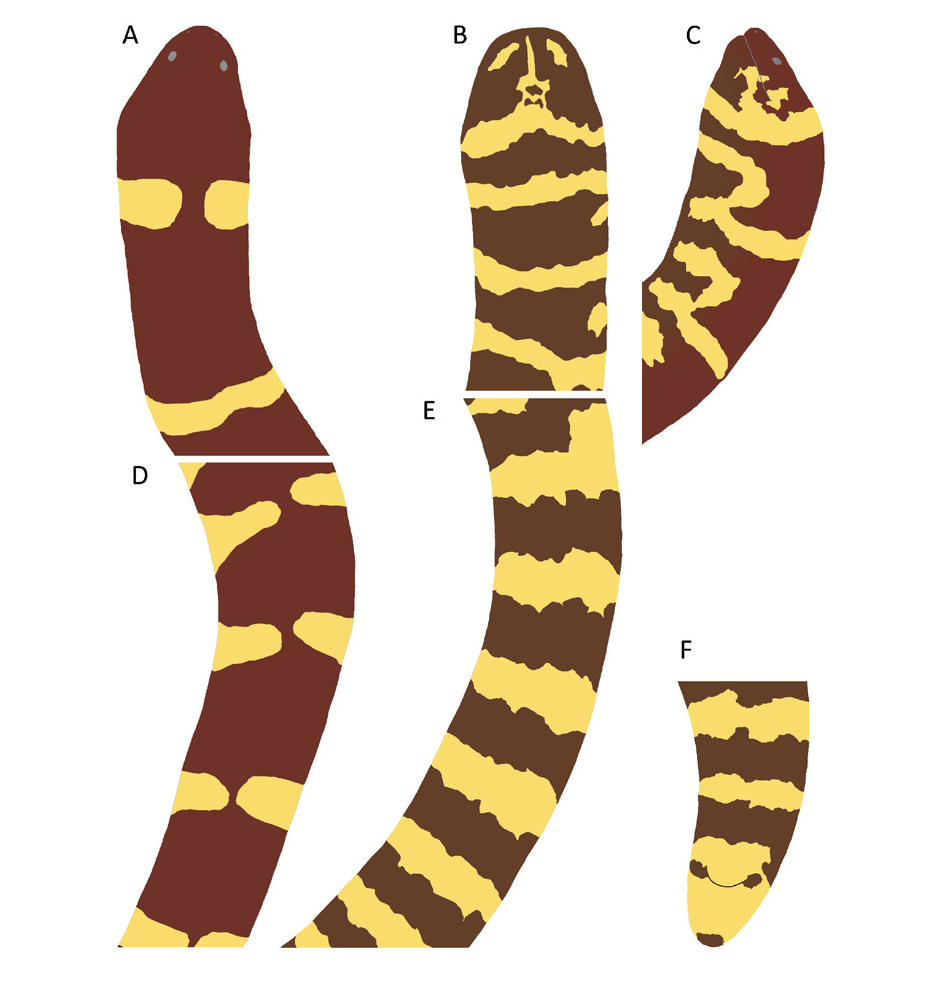
Description of examined materials: SVL 257 – 715 mm; body elongate, rounded in cross section; head not distinct from neck, broadened and dorsoventrally flattened in the orbital and sagittal regions; snout rounded in dorsal and lateral view. Rostral shield large, somewhat visible from a dorsal perspective with a conical apex; a single nasal, widely in contact behind the rostral, no internasals; nasals in contact with rostral anteriorly, with prefrontal dorsally, and the first and second supralabials ventrally; nostrils large; canthus rostralis weakly defined; prefrontal somewhat larger than the frontal and quadrangular; frontal large, triangular, and length same as its width; supraocular wide, triangular, posteriorly wider; parietal small, triangular, its rear border pointed, bordered by supraocular, frontal shield, upper posterior temporal shield, occipital shield, and two dorso-nuchal shields posteriorly on each side, the occipital shield is of equal size as other dorso-nuchal scales; loreal and preocular absent; eye small, pupil rounded; eye in broad contact with supraocular dorsally, prefrontal and third supralabial anteriorly, fourth supralabial ventrally, and postocular posteriorly; a single small postocular, quadrangular, posteriorly wider, in broad contact with supraocular, anterior temporal, and fourth supralabial; temporals 1 + 2, triangular; anterior temporal larger than posteriors; anterior temporal in contact with supraocular and both posterior temporal with parietal dorsally, 4 th – 6 th supralabials ventrally; anterior temporal does not meet parietals. Six supralabials, 3 rd – 5 th larger in size; first supralabial in contact with rostral anteriorly and nasal dorsally; second supralabial in contact with nasal and prefrontal dorsally, third supralabial in contact with prefrontal and eye dorsally, fourth supralabial in contact with the eye, postocular, and anterior temporal dorsally; fifth supralabial in contact with anterior and posterior temporals; sixth supralabial in contact with lower posterior temporal dorsally and body scales posteriorly. Mental small, triangular; first infralabial pair larger than mental plate and in broad contact with each other, in contact with anterior chin shield posteriorly; six infralabials in total, 1 st – 3 rd in contact with first chin shield, 4 th – 6 th in contact with gular scales, and not touching the chin shields; anterior chin shields larger than posterior ones; a mental groove continues from the posterior tip of the mental until the posterior chin shields. Body slender; transverse dorsal scale rows (20 – 23) – 19 – (17 – 18), all smooth, subcycloid, and weakly imbricate; vertebrals and midventrals undifferentiated from adjacent scales; 186 – 197 ventrals; cloacal plate divided, precloacal undivided and triangular, tail extremely short, relative TL (TL / total length) 2.1 – 2.9 %, with a conical robust and thick tip; 5 – 8 entire subcaudals. Coloration: All the examined specimens have a reddish brown back with wide and incomplete lighter bands encircling the body along dorsal surface from behind nape to tail, each band covering about two scales; head entirely darker, an incomplete, wide ring encircling the nape; the venter is dark brown with regular, cream colored stripes, divided at midline. See Fig. 1 for details of coloration in preservative.
Sumber: Two new species of the genus Cylindrophis Wagler, 1828 (Squamata: Cylindrophiidae) from Southeast Asia