Distribusieng
Distribution and habitat. New Ireland: 1, 2, 3. — General distribution: Red Sea, East Africa, Madagascar and Mascarenes east to Marshall Islands, Samoa and Tonga, north to southern Japan, south to Timor Sea (Western Australia), New South Wales (Australia) and New Caledonia. Found on various soft substrates associated with coral reefs, 1 – 20 m depth. Marine.
Sumber: Checklist of the marine and estuarine fishes of New Ireland Province, Papua New Guinea, western Pacific Ocean, with 810 new records
Deskripsieng
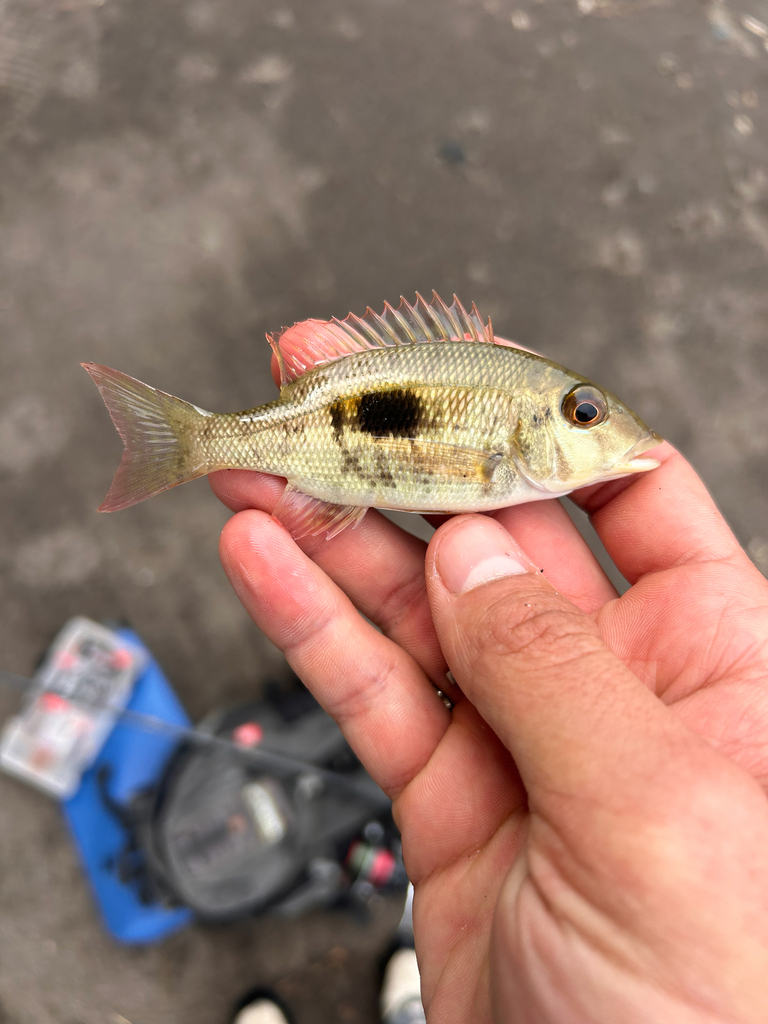
in field; fins mostly hyaline, off-white with diffuse dark blotches over anterior half of spinous fins. After death, patterns retained though faded. At 23 - 80 mm (PI. 2 A, B): body and head olive to greytan dorsally, belly off-white; dark banding and blotches more distinct, intensifying when stressed (PI. 2 A), most fading after death (PI. 2 B), rapidly switched on or off, " thumb-print " blotch distinct, cuboidal shoulder blotch below dorsal spines 4 - 5, rarely conspicuous, dark blotches between pectoral and anal fins now as series of 3 - 4 short bands, terminating mid-body; dark mid-lateral stripe often displayed in field, dark khaki, seldom fully obscuring " thumb-print " blotch, width approximately 4.0 in body depth; cheek silver to off-white, series of dark bands when stressed (PI. 2 A), intermittent dark band through eye until 60 mm; fins hyaline greyish yellow, margins often pink to pale scarlet in field. At greater than 80 mm, dark midlateral stripe absent, banding faded or absent, " thumbprint " blotch distinct. Colour in alcohol. Body and head pale off-white-tan, belly off-white; dark body and head markings dulled, " thumb-print " blotch often inconspicuous at less than 23 mm; fins hyaline, melanophore patterns retained. Ecology. Common, restricted to reef seagrass cover at less than 80 mm, without preference for particular seagrass species or canopy structures, larger juveniles also found over adjacent sand / coral rubble and sparse vegetative growth (Halimeda, Sargassum); settlers 16 - 18 mm, mostly solitary, not appearing sile attached, rapidly seek cover within the seagrass canopy when disturbed; at greater than 40 mm, occasionally found with similarly-sized juveniles of Parupeneus barberinus and P. indicus, Siganus fuscescens and congeners (particularly L. atkinsoni, L. obsoletus, L. genivittatus) in small loose schools, no aggressive interactions noted; observed resting on the substrate among seagrass shoots after dark, not fleeing when approached. Field identification. Generally an easily identified species, distinguished at greater than 25 mm by presence of the dark " thumb-print " blotch and the absence of coloured primary stripes. If intense banding is displayed, then the horizontal blotch is always visible. At less than 25 mm (PI. IH), the series of khaki blotches below the lateral-line, pale blue interspaces, and lack of primary stripes and intense mid-lateral stripe is diagnostic of L. harak. Small individuals often need to be followed for several minutes to confirm their identification. Previous descriptions. The early juvenile stage of L. harak has not been described previously. Masuda & Kobayashi (1994) included a colour plate of a specimen 40 mm total length.
Sumber: A description of the early juvenile colour patterns of eleven Lethrinus species (Pisces: Lethrinidae) from the Great Barrier Reef, Australia