
Konservasieng
Conservation: IUCN – Lower Risk (lc).
Sumber: Order Carnivora
Family Viverridae · Order Carnivora
Data diperbarui secara berkala dari berbagai sumber observasi biodiversitas.
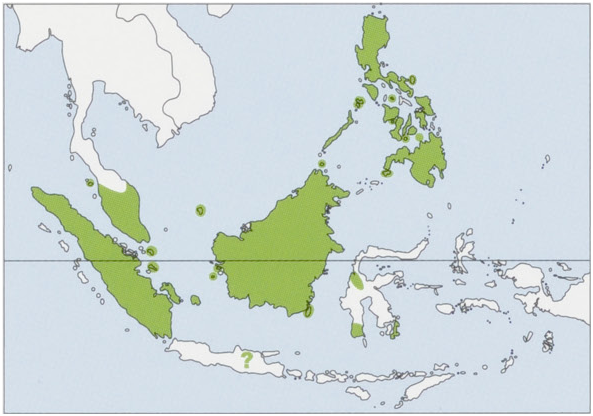
Foto: Don E. Wilson;Russell A. Mittermeier
Otoritas penamaan: Gray, 1832 (1832)
Status taksonomi: ACCEPTED
Status konservasi (IUCN): LC Risiko Rendah
Dipublikasikan dalam: Proc. Zool. Soc. Lond. vol.1832 p.63
Total Catatan di Indonesia
0
Provinsi Ditemukan
0
dari 38 provinsi
Catatan Pertama
0
tahun pertama tercatat
Tren Tahunan
-0%
-28.6% vs 2025
Musang Tenggalung (Viverra tangalunga) termasuk dalam famili Viverridae, ordo Carnivora, kelas Mammalia. Berdasarkan data yang terhimpun, spesies ini telah tercatat sebanyak 218 kali di Indonesia, tersebar di 17 provinsi. Catatan pertama tercatat pada tahun 1866.
Kalimantan Barat merupakan provinsi dengan catatan observasi terbanyak untuk spesies ini, dengan 15 catatan (6.9% dari total). Data distribusi ini mencerminkan akumulasi dari berbagai kegiatan survei, penelitian, dan kontribusi citizen science. Pola distribusi yang tercatat mungkin tidak sepenuhnya menggambarkan persebaran alami spesies, karena dipengaruhi oleh intensitas pengamatan di masing-masing wilayah.
Tren observasi tahunan Viverra tangalunga menunjukkan penurunan signifikan (-29%) pada periode terakhir dibanding tahun sebelumnya, dengan catatan pertama pada tahun 1866.
Catatan deskriptif tentang Viverra tangalunga dari sumber literatur primer (via GBIF).
Conservation: IUCN – Lower Risk (lc).
Sumber: Order Carnivora
Distribution: Cambodia, Indonesia (Sumatra, Rhio-Lingga Arch., Bangka Isl, Borneo, Karimata Isl, Sulawesi, Amboina), Malaysia, Philippines, and Thailand. Introduced throughout the Moluccas.
Sumber: Order Carnivora
DISTRIBUTION: Malaya; Sumatra; Rhio-Lingga Arch.; Bangka Isl.; Borneo; Karimata IsL; Sulawesi; Buru; Amboina; Philippine Isis.; Langkawi Isl.
Sumber: Order Carnivora
Habitat. Primary and disturbed forest, up to 1100 m. Also found in plantations and near villages that are adjacent to forest.
Sumber: Viverridae
Movements, Home range and Social organization. Generally solitary. Terrestrial, but can climb trees. In Sarawak, a male had a home range of 0 - 5 - 0 - 7 km ®. In Sabah, in an unlogged forest, the mean home range size for males was 0 - 93 km? and 0 - 80 km? for females; in a logged forest, the mean home range size for males was 1 - 59 km? ®, and 1 - 05 km? for females. On Sulawesi (Buton Island), the mean home range size for males was 0 - 86 km?, and 0 - 50 km? for females. In Sabah, there was considerable home range overlap in both sexes, indicating that this species was not territorial; however, there was low intra-sexual overlap on Sulawesi. In Sabah, the density of Malay Civets was lower in logged forest (1 per 1 - 1 km?) than unlogged forest (1 per 0 - 5 km *); minimum daily travel distance ranged from one to 9 - 7 km. On Sulawesi, the mean minimum distance covered in 24 hours was 415 m for males, and 286 m for females. A male civet has been observed scent marking using three methods: after protracted sniffing at a site, the civet elevated its tail, reversed into an upright tree trunk, and swayed its posterior from side to side; as it meandered aboutit paused momentarily, dipped and pressed its anal region onto the ground, raised it again and moved on; the side of the head and neck was rubbed against vegetation. Feces are found in latrines on the ground, generally in cavities and depressions.
Sumber: Viverridae
Status and Conservation. Classified as Least Concern on The IUCN Red List. Considered to be common, however, the exact population status in the wild is unknown. Its presence on some islands in South-east Asia possibly resulted from introduction. Although Malay civets seem able to tolerate habitat disturbance, forest loss and degradation could be a threatto this species, and their ability to survive in disturbed habitats and forage in plantation areas may be influenced by the proximity of undisturbed forest. They are hunted and snared for food. Malay Civets are often considered pests as they prey on small livestock and raid fruit orchards, and may be deliberately killed in retaliation. Malay Civets foraging in plantation areas may also be inadvertently killed if they ingest pesticides, either directly or via contaminated food and ground water.
Sumber: Viverridae
| # | Provinsi | Catatan | % |
|---|---|---|---|
| 1 | Kalimantan Barat | 15 | 6.9% |
| 2 | Riau | 14 | 6.4% |
| 3 | Kepulauan Riau | 13 | 6.0% |
| 4 | Kalimantan Selatan | 8 | 3.7% |
| 5 | Kalimantan Timur | 7 | 3.2% |
| 6 | Lampung | 6 | 2.8% |
| 7 | Kalimantan Tengah | 5 | 2.3% |
| 8 | Sulawesi Tenggara | 4 | 1.8% |
| 9 | Maluku | 4 | 1.8% |
| 10 | Sulawesi Tengah | 3 | 1.4% |
| 11 | Sumatera Utara | 2 | 0.9% |
| 12 | Kepulauan Bangka Belitung | 2 | 0.9% |
| 13 | Maluku Utara | 2 | 0.9% |
| 14 | Sulawesi Utara | 1 | 0.5% |
| 15 | Sulawesi Selatan | 1 | 0.5% |
| 16 | Gorontalo | 1 | 0.5% |
| 17 | Sulawesi Barat | 1 | 0.5% |
Jumlah catatan observasi Viverra tangalunga di Indonesia per tahun
Viverra tangalunga
Foto: Don E. Wilson;Russell A. Mittermeier
Viverra tangalunga
Foto: Don E. Wilson;Russell A. Mittermeier
| Nama | Bahasa | Sumber |
|---|---|---|
| Civeta Malaya | Spanyol | Catalogue of Life |
| Civeta malaya | - | Viverridae |
| Civeta-malaia | Portugis | Catalogue of Life |
| Civette malaise | Prancis | Viverridae |
| Kleinfleck-Zibetkatze | Jerman | Catalogue of Life |
| Malaiische Zibetkatze | Jerman | Viverridae |
| Malay Civet | Inggris | Viverridae |
| Malayan Civet | Inggris | Order Carnivora |
| Malayan civet | Inggris | The Paleobiology Database |
| Malaysivett | nob | Catalogue of Life |
| Maleise Civetkat | Belanda | Catalogue of Life |
| Musang | tgl | Catalogue of Life |
| Musang Tenggalung | Indonesia | Catalogue of Life |
| Oriental Civet | Inggris | Catalogue of Life |
| Tangalung | Melayu | Catalogue of Life |
| Tenggalong | Melayu | Catalogue of Life |
| Zibetto malese | Italia | Catalogue of Life |
| tangalunga | fin | Catalogue of Life |
| wiwera malajska | pol | Catalogue of Life |
| Островная виверра | rus | Catalogue of Life |
Berdasarkan data 218 observasi, Kalimantan Barat adalah provinsi dengan catatan Musang Tenggalung (Viverra tangalunga) terbanyak — 15 observasi (6.9% dari total catatan di Indonesia). Spesies ini tersebar di 17 provinsi.
Catatan pertama Musang Tenggalung (Viverra tangalunga) di Indonesia tercatat pada tahun 1866. Hingga kini terdapat 218 catatan dari 17 provinsi, yang dihimpun dari survei lapangan, koleksi museum, dan platform citizen science.
Menurut IUCN Red List, Musang Tenggalung (Viverra tangalunga) berstatus "Risiko Rendah" (kode LC). Status ini mencerminkan tingkat risiko kepunahan global spesies, bukan khusus Indonesia.
Di Indonesia dan Malaysia, Viverra tangalunga dikenal dengan beberapa nama lokal: Musang Tenggalung. Penamaan dapat berbeda antardaerah dan bahasa.
Viverra tangalunga diklasifikasikan sebagai berikut: Kingdom Animalia, Phylum Chordata, Class Mammalia, Order Carnivora, Family Viverridae, Genus Viverra. Spesies ini dideskripsikan oleh Gray, 1832.
98 titik observasi Viverra tangalunga di Indonesia
Memuat peta...
Setiap titik merepresentasikan satu lokasi observasi yang tercatat. Klik titik untuk melihat detail.