Biologi & Ekologieng
Habitat. Primary and secondary forests, mangrove forests, and swamps in coastal areas and on offshore islands from sea level and generally below elevations of ¢. 500 m (but up to 1370 m). In the Philippines, Indonesia, and Malaysia, the Large Flying Fox prefers to roost in areas with relatively pristine mangroves. It can be found in some mixed landscapes of natural, modified, and intensely farmed plots. In highly modified landscapes, it can be found in relatively undisturbed areas, such as a temple forests, botanical gardens, atop steep cliffs, or at other culturally significant sites such as burial grounds. In the Philippines, it prefers natural forest to human-modified habitats. It roosts in a variety of trees, often in riparian zones; trees become defoliated, suggesting high roost fidelity.
Sumber: Pteropodidae
Biologi & Ekologieng
Movements, Home range and Social organization. The Large Flying Fox is generally gregarious and roosts colonially in tall trees. It is tolerant of some habitat disturbance but prefers undisturbed habitat. Currently, the largest known colony is in Subic Bay on Luzon, Philippines (c. 20,000 individuals). It might roost with otherflying foxes in large colonies (up to 52,000 individuals). In Malaysia, severe declines in abundance have been recorded, and no roosts are known to have more than 1500 individuals. Foraging range of up to 50 km / night occurs in some parts of its distribution, but in others, they can be as short as 0 - 4 - 12 km. Home range with 90 % occupancy of the Large Flying Fox can be as large as 128,000 km * (i. e. almost 13 million ha) on the Malay Peninsula. Inter-island movement likely occurs at higher altitudes. It switches roosts according to food availability. In Sarawak, it has a continuous movement phase (roost sites appear to move daily) and a restricted movement phase (roost sites confined to narrow area).
Sumber: Pteropodidae
Konservasieng
Status and Conservation. CITES Appendix II. Classified as Near Threatened on The IUCN Red List. The Large Flying Fox has experienced significant declines throughout its distribution due to overhunting and ongoing degradation of habitat. Nevertheless, rate of decline is less than 30 %, but additional decline will likely qualify it as Vulnerable. Previously, the Large Flying Fox occurred in many large colonies throughout its distribution; colonies are now much rarer due to overhunting and habitat loss. Hunted individuals are normally sold only at a local level, making detection of illegal take difficult. Resident populations occur in urban parks or forests where they receive informal protection. Hunting of flying foxes in the Philippines is illegal, except for use by a few indigenous groups, but hunting is unregulated and therefore continues even now.
Sumber: Pteropodidae
Deskripsieng
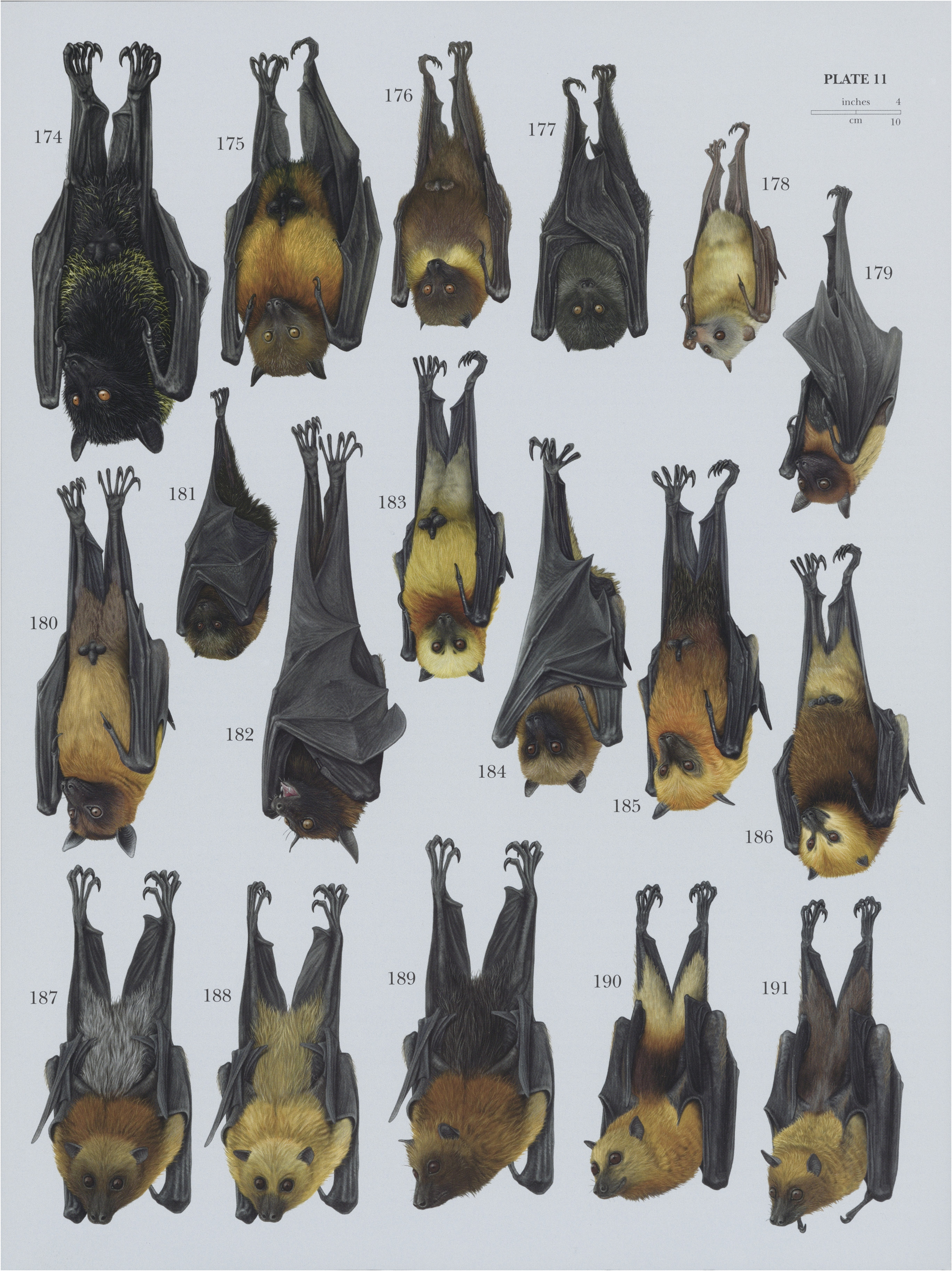
Descriptive notes. Head-body 225 - 290 mm (tailless), ear 35 - 45 mm, hindfoot 52 - 68 mm, forearm 175 - 230 mm; weight 0.7 - 1.4 kg. Greatest lengths of skulls are 78 - 90 mm and tibias 84 - 105 mm. Forearm lengths and body mass varies among subspecies and geographical regions: smallest subspecies is natunae (forearm 180 - 196 mm) and largest is pluton (200 - 230 mm). There are minor variations in color of subspecies. The Large Flying Fox generally has dark brown to blackish body, with distinct mantle varying from tawny brown, reddish brown, and orange yellow to blond. Head can be reddish brown to brown to blackish. Dorsal side of body is generally dark brown to blackish, with some flecks of gray. Males are generally larger than females. Ears are long, with pointed tips. Wing membranes are dark brown to blackish, with mildly rounded tips and fur only near body. Baculum is similar to that in other pteropodids, saddle-shaped in lateral view but without an apical prominence. Proximal prongs on baculum are separated instead of fused as in other pteropodids. Baculum is large (4 - 5 - 8 - 2 mm long). Skull is typical pteropine and generally large and robust, with large orbits and wide zygomatic arches. Upper incisors are separated from one another, and I' is slightly larger than I °. C! is long and pointed, with distinct cingulum but no secondary cusp, grooved labially and with smaller groove lingually. C, is smaller and lack grooves. Premolars and molars are broad and short, with no prominent cusps. P' is very small and lost in adults. Chromosomal complement has 2 n = 38 and EN = 72,
Sumber: Pteropodidae
Distribusieng
New records Lampung Province: Lombok Village, Sukaraja Forest, Sukaraja Village, Sumberjaya Village, Sumber Rejo Village. Previous records from Sumatra Jambi Province: Muara Bungo; West Sumatra Province: Mininjau; Lampung Province: Krui, Rata Agung (Sibuea and Herdimansyah, 1993); as throughout Sumatra by van Strien (1996).
Sumber: A recent bat survey reveals Bukit Barisan Selatan Landscape as a chiropteran diversity hotspot in Sumatra
Distribusieng
Recorded at: Pahang: Sungai Tembeling [23], Taman Negara [87], Gunung Tahan [92], Tanjung Agas [93]; Perak: Temengor Forest Reserve [47], Lenggong, Teluk Memali and Tambun [93]; Selangor: Bukit Kutu Wildlife Reserve [51], Ulu Gombak [52]; Terengganu: Kenyir Dam [87], Kampung Gong Tengah, Permaisuri and Kampung Kepah [93]; Johor: Benut [93].
Sumber: A checklist of the bats of Peninsular Malaysia and progress towards a DNA barcode reference library