Deskripsieng
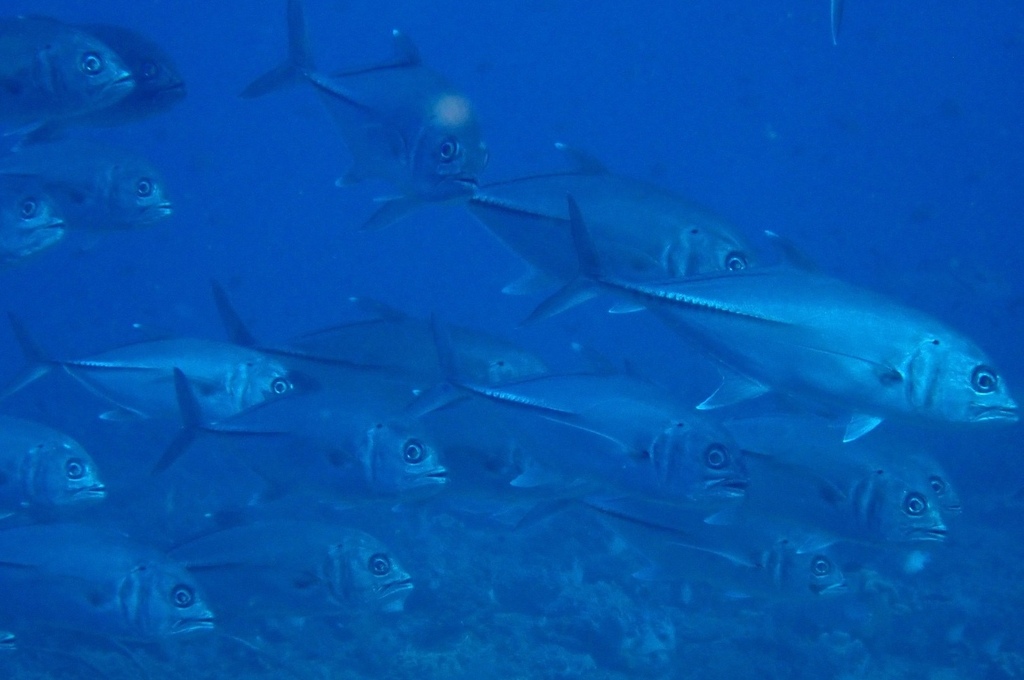
Group, Namatamai District by Fry et al. (2006: 129). Specimens observed at Kavieng fish market in 2004 – 2005 by Jeff Kinch during CFMDP Survey, and by Barry C. Russell during 7 – 28 June 2014; a video of a specimen taken at Martha's Shoal, off eastern New Hanover, at 7 – 41 m depth, St. KR 122, in 2014 (identified by Barry C. Russell).
Sumber: Checklist of the marine and estuarine fishes of New Ireland Province, Papua New Guinea, western Pacific Ocean, with 810 new records
Distribusieng
Distribution and habitat. New Ireland: 1, 2, 5. — General distribution: Red Sea, East and South Africa east to Hawaiian and Marquesas islands, south to Point Quobba (Western Australia), New South Wales (Australia), Norfolk and Austral islands; Galapagos Islands and Mexico to Ecuador. Found in lagoon and seaward coral reefs, occasionally entering rivers and streams, 0 – 146 m depth. Freshwater, transitional water and marine.
Sumber: Checklist of the marine and estuarine fishes of New Ireland Province, Papua New Guinea, western Pacific Ocean, with 810 new records
Konservasieng
Occurrence and conservation status: Nat, LC.
Sumber: New records and range extensions to the Costa Rican freshwater fish fauna, with an updated checklist
Distribusieng
Distribution: Global: Indo-Pacific Ocean; from East Africa to the Americas; entering estuaries and littoral lagoons and ascending river courses; Costa Rica: Pi (Pacific), 0 – 12 m. a. s. l., Per, Dia.
Sumber: New records and range extensions to the Costa Rican freshwater fish fauna, with an updated checklist
Deskripsieng
Bigeye Crevalle, Bigeye Trevally, or Sixband Jack. To 120 cm (47.2 in) TL (Sadovy and Cornish 2000). Indo-Pacific; western Pacific Ocean north to southern Japan (Senou in Nakabo 2002); San Diego Bay, southern California (Lea and Walker 1995) to northern Peru (Robertson and Allen 2015), including lower Gulf of California (Robertson and Allen 2002) and Islas Galápagos (Grove and Lavenberg 1997). Marine, brackish, and fresh waters (Fricke et al. 2020); depth: 1 – 146 m (3 – 479 ft) (min.: González-Acosta et al. 1999; max.: Myers 1999). Morera et al. (20019) report on a capture at a depth of 1,345 m (4,412 ft), however this capture was made in a bottom trawl and the fish may have been captured in midwaters during deployment or retrieval. A hybrid of this species and Caranx melampygus Cuvier, 1833 was taken off Panama (Angulo et al. 2020).
Sumber: Checklist of marine and estuarine fishes from the Alaska-Yukon Border, Beaufort Sea, to Cabo San Lucas, Mexico
Distribusieng
The species C. sexfasciatus is referred to as being present off Madeira by Maul (1948 a), with the indication of very rare occurrence. There are an additional twelve records of the species in the Atlantic Ocean. According to Nichols (1938), C. sexfasciatus is a circumtropical species. Hureau & Tortonese (1979) reported that Maul’s identification might be questionable.
Sumber: Updated checklist of marine fishes (Chordata: Craniata) from Portugal and the proposed extension of the Portuguese continental shelf