Deskripsieng
REFERENCES. — Bojer (1837: 285); Baillon (1861: 274); Müller Argoviensis (1865: 42; 1866: 868); Baker (1877: 314); Müller Argoviensis (1882: 27); Baillon (1895 b: 1197); Cordemoy (1895: 342); Palacký (1907: 25); Voeltzkow (1917: 447); Hemsley (1919: 148); Pax & Hoffmann (1924: 33); Leandri (1935: 43); Leandri (1942: 256); Renvoize (1975: 152); Coode (1982: 69, 78); Robertson (1989: 200); Govaerts et al. (2000: 68); Sagun et al. (2006: 124); Montero Muñoz et al. (2018 a: 99). DESCRIPTION Annual herbs, to 0.6 (- 0.8) m tall, monoecious. Branches tomentose to laxly pubescent with simple, curved trichomes, sometimes also with sparse short, subsessile, glandular trichomes, glabrescent when mature. Axillary buds naked, pubescent with simple, short, appressed trichomes. Stipules to 1 mm long, triangular-lanceolate, margin hispidulous-ciliate and with some sessile glands. Petioles slender, (1.5 -) 2.5 - 6.5 cm long, indumentum similar to that on young branches. Leaf blades (1.5 -) 2 - 4 (- 6) × (1 -) 1.5 - 3 (- 3.5) cm, usually broadly ovate-lanceolate, sometimes spathulate or subrhombic, membranous; base cuneate; apex acute to subacuminate; margin entire toward base, serrate above, teeth subacute, callose-edged; upper surface subglabrous, with simple, short, appressed trichomes on veins; lower surface laxly pubescent to subglabrous; venation actinodromous, basal veins 3 or 5, secondary veins 4 - 5 per side. Stipels absent. Inflorescences spiciform, androgynous, axillary, to 9 cm long, mostly female with short male segment; peduncle to 10 mm long, pubescent with simple trichomes, sometimes also with some subsessile glandular trichomes. Female segment laxly flowered, to 8 cm long; bracts 7 - 9, sessile, enlarging in fruit to 8 × 12 mm, reniform, sparsely hairy with simple, curved trichomes; margin crenate-denticulate, teeth 8 - 9, broadly triangular, central tooth not prominent; bracteoles absent. Male segment persistent, to 1.5 cm long; flowers glomerate; bracts to 0.8 mm long, elliptic-lanceolate, sparsely hairy. Male flowers: pedicel to 0.5 mm long, sparsely hairy; buds 0.5 mm diameter, sparsely hairy. Female flowers 1 per bract, sessile; sepals 3, to 0.5 mm long, triangular-lanceolate, ciliate; ovary c. 0.5 mm diameter, 3 - lobed, smooth, surface pubescent; styles 3, to 4 mm long, distinct, glabrous, each divided into 1 - 2 segments. Allomorphic flowers sometimes present at inflorescence apex; pedicel filiform, to 5 mm long, sparsely hairy; sepals 3, to 0.5 mm long, lanceolate, ciliate; ovary 1 - lobed, to 2 × 3 mm, pubescent, distally fimbriate; style 1, to 1.5 mm long, glabrous. Capsules to 2 mm diameter, smooth, surface pubescent. Seeds c. 1.5 × 1 mm, pyriform, minutely foveolate.
Sumber: Monograph of Acalypha L. (Euphorbiaceae) of the Western Indian Ocean Region, with the description of a new species from Mayotte
Distribusieng
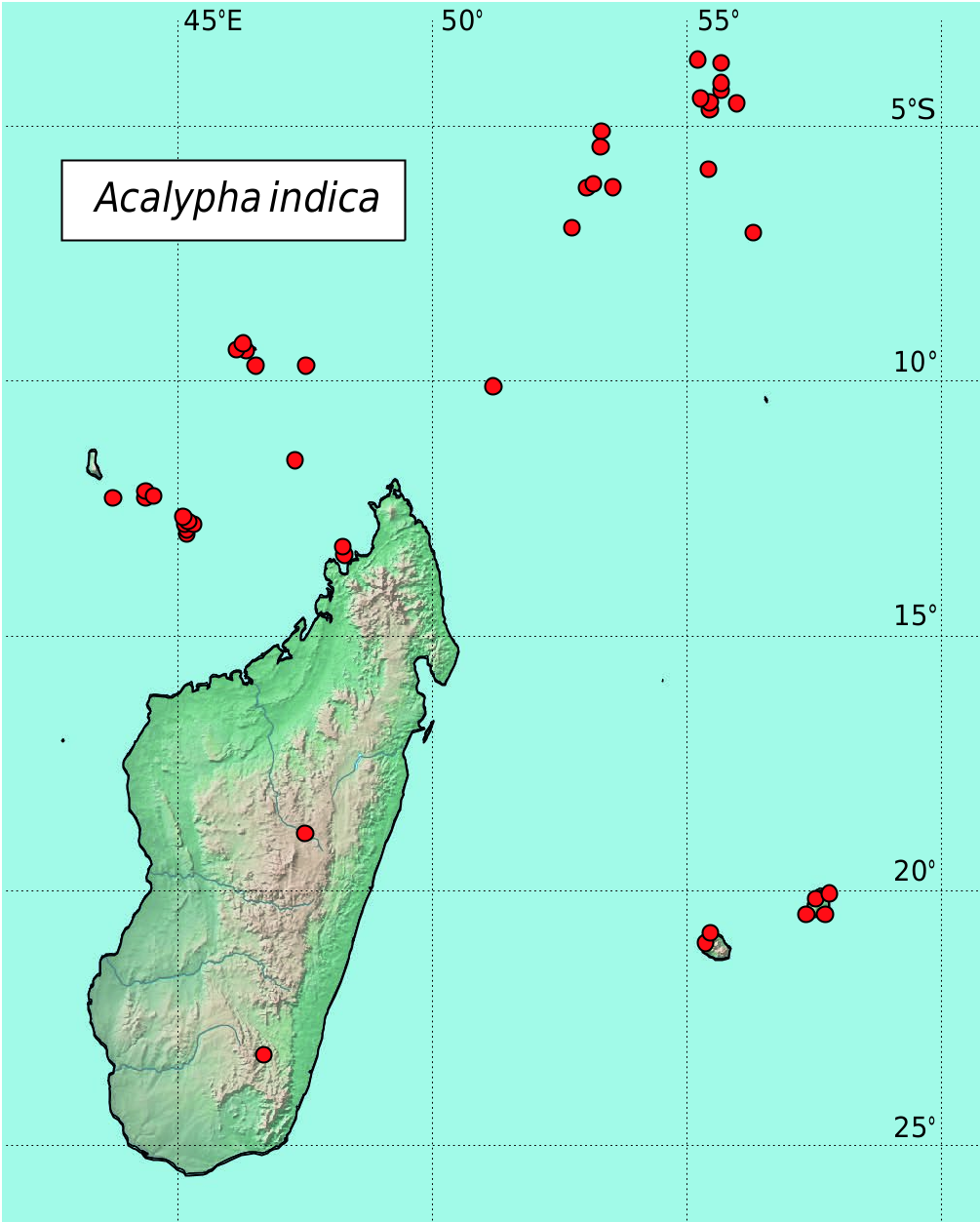
DISTRIBUTION AND HABITAT. — Acalypha indica is widely distributed in the Paleotropics and introduced in the Americas (Cardiel et al. 2023 in press); it probably is introduced in Madagascar (Diana, Analamanga, and Ihorombe), the Comoros Archipelago (Anjouan, Moheli and Mayotte), the Mascarene Islands (Mauritius and La Réunion), the Seychelles (Inner and Outer islands), and the Scattered Islands (Glorioso Islands). It is a weedy species associated with cultivated areas, paths, and beaches. Altitudinal range sea level to 450 m (Fig. 37).
Sumber: Monograph of Acalypha L. (Euphorbiaceae) of the Western Indian Ocean Region, with the description of a new species from Mayotte