Biologi & Ekologieng
Habitat. Lowland to montane forests, including mangrove forests, in all degrees of modification, including deforested areas such urban environments near forests, rural areas, and orchards, from sea level up to elevations of ¢. 1600 m. Nominate brachyotis tends to diverge ecologically: Forest lineage is a forest specialist and Sunda lineage is found in secondary and disturbed forests and rural / agricultural areas.
Sumber: Pteropodidae
Biologi & Ekologieng
Movements, Home range and Social organization. Each night, individuals commute 7 - 1 - 14 - 5 km between day roosts and feeding areas; both sexes commute double the distance during the breeding season. The Lesser Short-nosed Fruit Bat visits 1 - 6 feeding areas / night spending an average of one hour and 38 minutes in each feeding area during which individuals undertake 2 - 10 feeding bouts between fruiting trees and chosen night roosts where fruits are eaten. Total home ranges are 30 - 365 ha, marginally greater for females. Roost area is ¢. 5 % of total home range. Roost area is non-overlapping among males, which exhibit high roost and home range fidelity. Tents were used by a single solitary male or a harem group consisting of a defending male and 1 - 4 females with their young. The male roosts alone on the side of the tent, and harem females and their young cluster together. Tents can last up to years. Mating and lactation take place in tents. Activity of solitary vs. harem-holding malesis similar.
Sumber: Pteropodidae
Konservasieng
Status and Conservation. Classified as Least Concern on The IUCN Red List. The Lesser Short-nosed Fruit Bat faces no immediate conservation threats given its wide distribution, presumably large population, and environmental tolerance. It is considered vermin under Schedule V of the Indian Wildlife (Protection) Act. Resolution of exceedingly complex taxonomy of the C. brachyotis complex is required to correctly assess conservation status of these forms.
Sumber: Pteropodidae
Deskripsieng
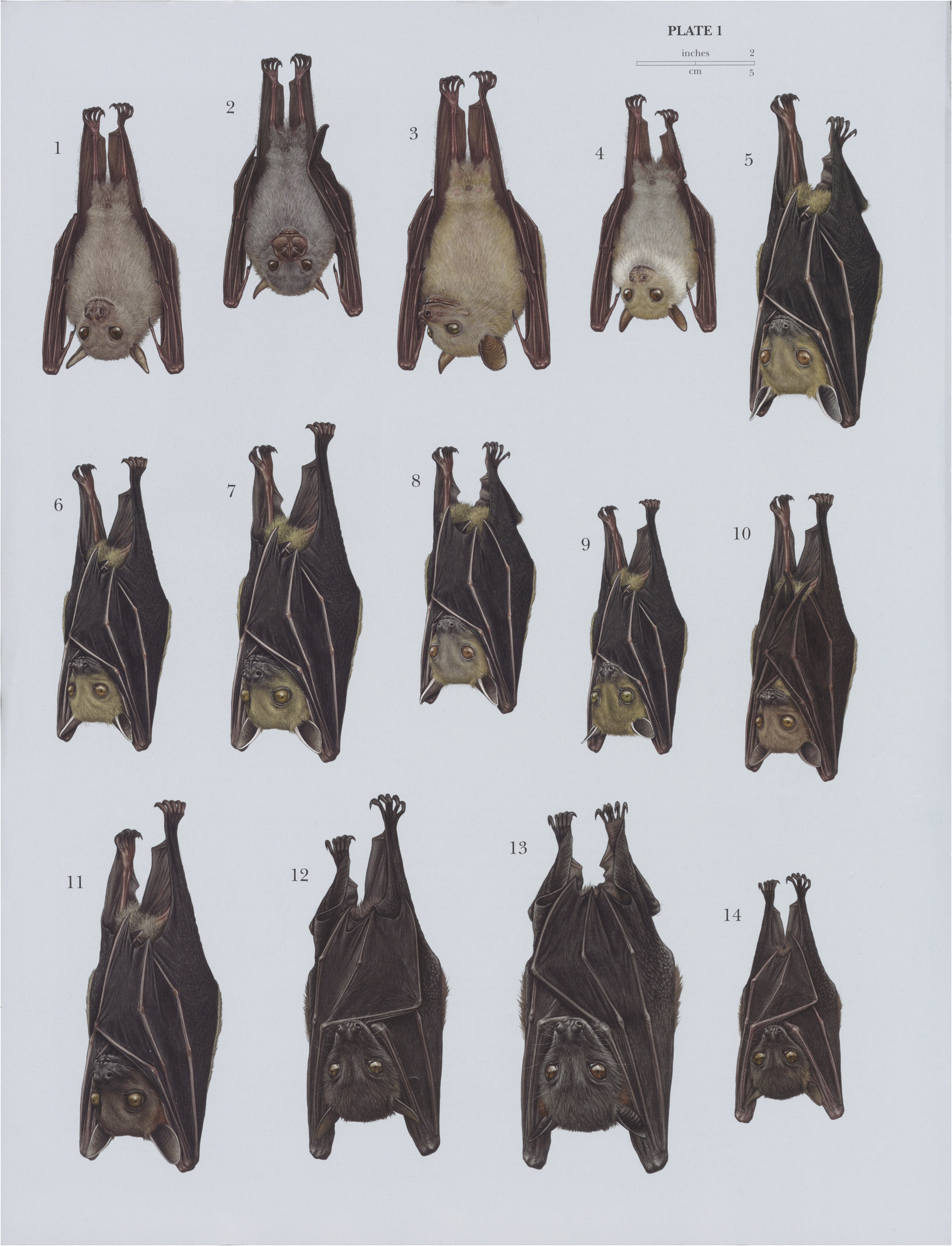
Descriptive notes. Head-body 72 - 96 mm, tail 10 - 16 mm, ear 15 - 20 mm, hindfoot 11 - 15 mm, forearm 55 - 66 mm; weight 27 - 45 g (mean 33 - 1 g). The Lesser Shortnosed Fruit Bat is small, with white ear rims and wing digits. Muzzle is short, almost naked; skin is dark brown; nostrils are shortly tubular; philtrum ends in two upper lip pads; and two triangular pads occur on lowerlip. Forehead slopesslightly, top of head is rounded, and crown is distinctly brown in some specimens. Eyesare large; iris is chestnut-brown to olive-brown. Ears are moderately short, oval, attenuated at tip, and pale brown, edged with white. Head pelageis short and brown to orange / yellowish brown; pelage is longer on nape and dorsum, brown suffused with warm russet to tawny olive. Females are generally paler. Pelage reaches dorsal bases of forearms and center of uropatagium. Tail is short and dorsally attached to uropatagium; calcaris short. Ruff is intensely orange on males, more so on sides of neck and paler on chest; it is generally paler on females. Chest and belly are grayish brown, occasionally with orange or yellowish tinge. Wing membranes are dark gray and attach to first toe; index claw is present. Skull lacks basicranial deflection, rostrum is short, forehead is relatively low and sloping, orbit is large, and braincase is rounded. Zygomatic rootis only slightly above level of alveolar line, and zygoma is thin and gently arched posteriorly. Dorsally, paranasal recesses are inflated, reaching small postorbital foramina; postorbital processes are thin and directed posterolaterally. There is almost no postorbital constriction; braincase is almost perfectly rounded, with only traces of temporal lines; and nuchal crest is modest. Palate is flat, upper tooth row is almost parallel, end of post-dental palate is rounded, and mid-sphenoidalridge is low. Ectotympanic is small and wide, more so anteriorly; entotympanic is variously reduced. Mandible is straight, with sloping tall coronoid; condyle is slightly above alveolar line; and angle is rounded off. Upper incisors are small but rather long (I? longer); C' is almoststraight; anterior surface is convex; and P' is long and minute; posterior cheekteeth decrease in height, are rounded to elongate posteriorly, and have no additional cusps. Lower incisors are small; I, is shorter; C, is small and short; Pis low and peg-like; posterior premolars and molars decreasing in size, with oval outline and no additional cusps; and M, is peg-like. There are eight interdental palatal ridges, undivided, arched, and rather thick, followed by one thin medially divided ridge, spaced from two divided denticulate ridges on posterior one-half of post-dental palate. Chromosomal complement of subspecies Javanicus has 2 n = 34 and FN = 58, with eleven pairs of variable-sized metacentric to submetacentric (pair with a secondary constriction), two pairs of subtelocentric, and three pairs of small to minute acrocentric chromosomes. X-chromosome is subtelocentric, and Y-chromosome is minute and acrocentric.
Sumber: Pteropodidae
Distribusieng
New records Lampung Province: Kuyung Arang Village, Lombok Village, Sidodadi Village, Sukabanjar Village, Sukaraja Forest, Sukaraja Village, Sumberjaya Village, Sumber Rejo Village.
Sumber: A recent bat survey reveals Bukit Barisan Selatan Landscape as a chiropteran diversity hotspot in Sumatra
Distribusieng
Previous records from Sumatra Throughout Sumatra (see detailed localities in Kitchener and Maharadatunkamsi, 1991).
Sumber: A recent bat survey reveals Bukit Barisan Selatan Landscape as a chiropteran diversity hotspot in Sumatra