Deskripsieng
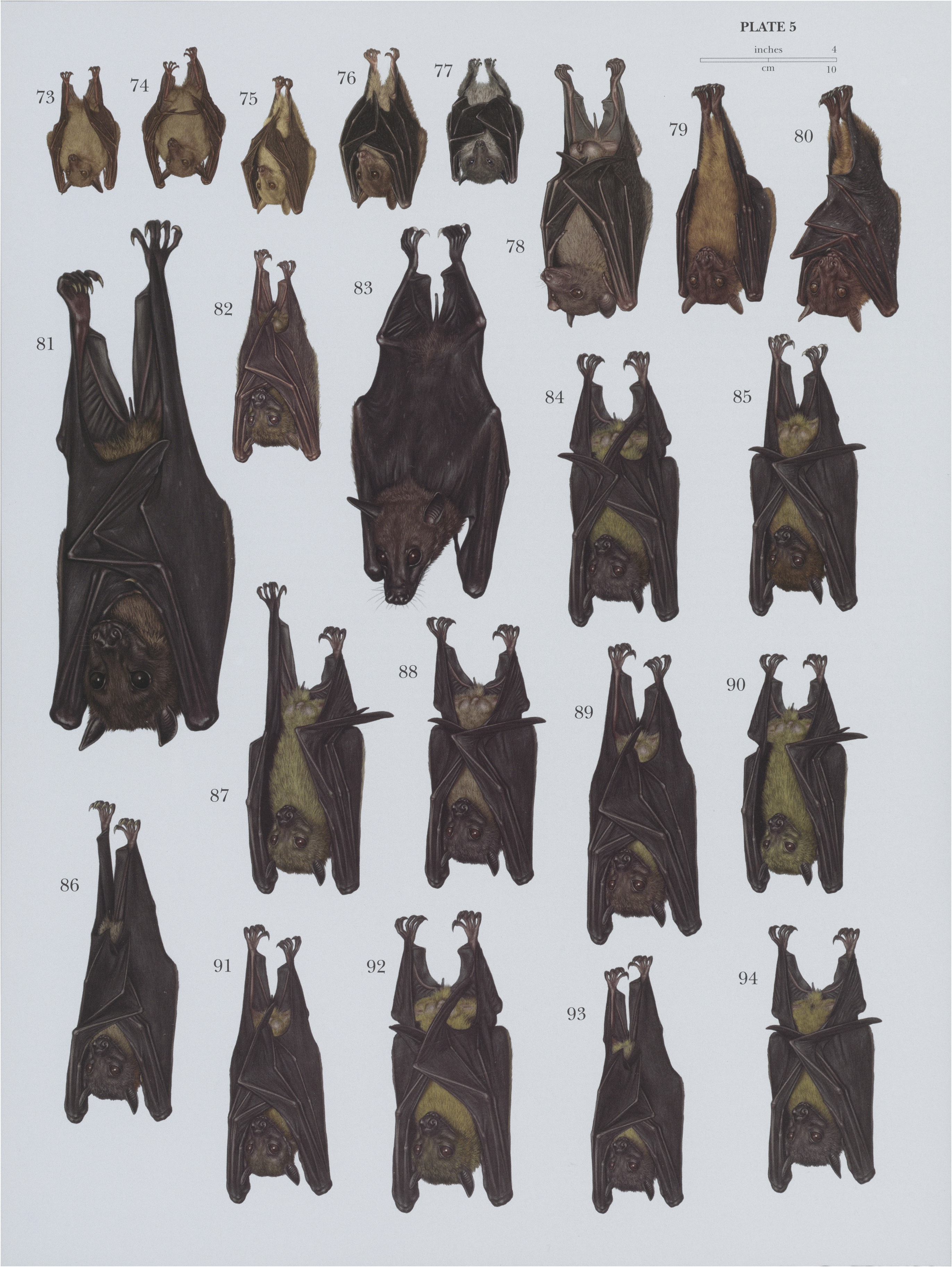
Descriptive notes. Head-body 49 - 77 mm, tail c. 0 - 4 mm, ear 11 - 18 - 5 mm, hindfoot 10 - 3 - 23 - 3 mm, forearm 37 - 4 — 45 mm; weight 8 - 25 g. Males average larger than females. The Lesser Long-tongued Blossom Batis the smallest species of pteropodid. It has elongated muzzle with very long papillae-tipped tongue, extremely reduced tail, reduced uropatagium along inner legs, and claw on second digits of wings. It is very similar to the Greater Long-tongued Blossom Bat (M. sobrinus) but is generally smaller with shorter muzzle, less prominent chin, slightly more side-facing nostrils with small groove under each nostril, and internarial medial groove that distinctly extends to upper lip. Head and muzzle are elongated, and nostrils are rounded and face forward. Dorsal pelage varies across populations and can be buffy brown, yellowish / golden brown, or russet-brown, with hairs having pale bases; ventral pelage is generally paler and grayer, being almost creamy in some individuals. Adult males have V-shaped apocrine gland complex running across chest that resembles a thick pink welt, giving adult males a pungent strong musky smell; Vsshaped gland is absent in females and young. Glands are apparently absent from populations on the Bismarck Archipelago but are found in most populations. Ears are relatively long, rounded, and dark brownish; eyes are large, with dark rufous brown irises. Tail is very minute and difficult to see or completely lacking. Uropatagium is highly reduced, attaching at base where tail would be and following leg up to ankles where it attaches to highly reduced calcar. Second digit of wing has a claw; third and fifth metacarpals are subequal in size, and wing is dark with fur extending over upper arm dorsally and ventrally. Skull is long, with very long and narrow rostrum; braincase is strongly deflected downward. Jaw is thin and comparatively weak. Dental formula for all species of Macroglossusis 12 / 2, C 1 / 1, P 3 / 3, M 2 / 3 (x 2) = 34. Molars and premolars are largely reduced and flattened; large gap occurs between P' and next premolar (P %); C, is long, thin, and strongly curved outward; extra molars have been reported in some specimens; and upper incisors are very reduced, project slightly forward, and are separated from one another and canines by small gaps. Chromosomal complement has 2 n = 34 and FN = 60 (Indochina) or 62 (Java).
Sumber: Pteropodidae