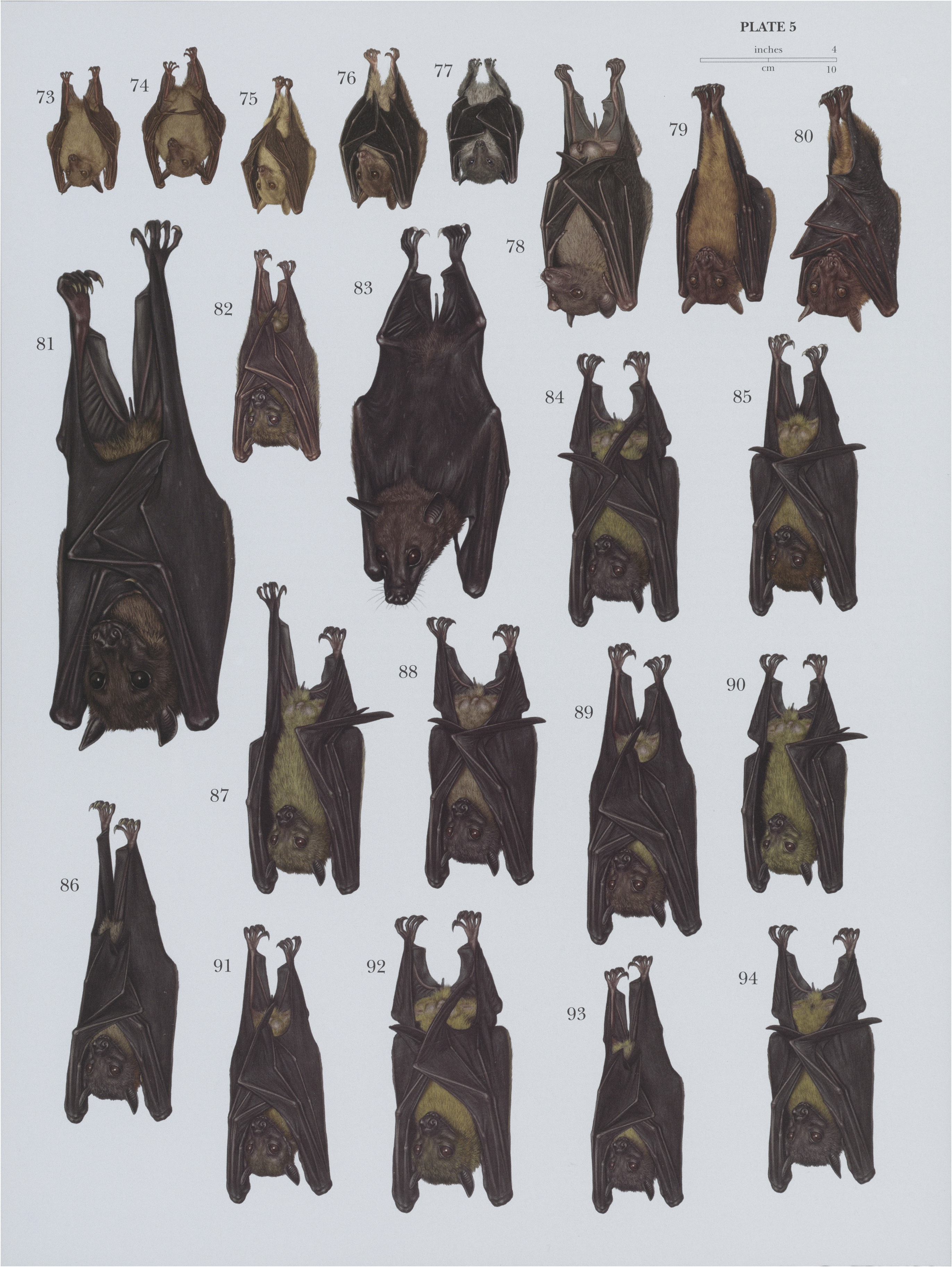
DISTRIBUTION: Thailand to Philippines, New Guinea, Bismarck Arch. (Papua New Guinea), Solomon Isis, and N Australia.
Sumber: Order Chiroptera
Family Pteropodidae · Order Chiroptera
Data diperbarui secara berkala dari berbagai sumber observasi biodiversitas.

Foto: Don E. Wilson;Russell A. Mittermeier
Otoritas penamaan: (E.Geoffroy, 1810) (1810)
Status taksonomi: ACCEPTED
Status konservasi (IUCN): LC Risiko Rendah
Dipublikasikan dalam: Ann. Mus. Natn. Hist. Nat. Paris vol.15 p.97
Total Catatan di Indonesia
0
Provinsi Ditemukan
0
dari 38 provinsi
Catatan Pertama
0
tahun pertama tercatat
Tren Tahunan
-0%
-87.2% vs 2018
Dagger-toothed Long-nosed Fruit Bat (Macroglossus minimus) termasuk dalam famili Pteropodidae, ordo Chiroptera, kelas Mammalia. Berdasarkan data yang terhimpun, spesies ini telah tercatat sebanyak 1.836 kali di Indonesia, tersebar di 18 provinsi. Catatan pertama tercatat pada tahun 1914.
Nusa Tenggara Timur merupakan provinsi dengan catatan observasi terbanyak untuk spesies ini, dengan 381 catatan (20.8% dari total). Data distribusi ini mencerminkan akumulasi dari berbagai kegiatan survei, penelitian, dan kontribusi citizen science. Pola distribusi yang tercatat mungkin tidak sepenuhnya menggambarkan persebaran alami spesies, karena dipengaruhi oleh intensitas pengamatan di masing-masing wilayah.
Tren observasi tahunan Macroglossus minimus menunjukkan penurunan signifikan (-87%) pada periode terakhir dibanding tahun sebelumnya, dengan catatan pertama pada tahun 1914.
Catatan deskriptif tentang Macroglossus minimus dari sumber literatur primer (via GBIF).
DISTRIBUTION: Thailand to Philippines, New Guinea, Bismarck Arch. (Papua New Guinea), Solomon Isis, and N Australia.
Sumber: Order Chiroptera
Habitat. Primary and secondary tropical moist forests, preferring secondary, agricultural, and disturbed habitats, and reportedly woodlands, mangroves, swamp forests, various plantations, and urban areas from sea level up to elevations of ¢. 2250 m (lower densities at high elevations). Lesser Long-tongued Blossom Bats occurin virtually every habitat type in the Philippines and are commonly found in various plantations (e. g. durians and bananas) and any environment that includes plants with large flowers to feed on.
Sumber: Pteropodidae
Movements, Home range and Social organization. Lesser LLong-tongued Blossom Bats mostly roosts alone or in small spaced-out groups in small roosts. They do not seem to move long distances but will travel fairly long distances to food. There is evidence for a significant amount of gene flow between islands of the Philippines, indicating that individuals do make large movements between islands relatively regularly. Density on NegrosIsland in habitat that has been 15 - 30 % deforested was 2 ind / ha. Home ranges of 18 individuals in Papua New Guinea were 1 - 9 - 15 - 1 ha, with some overlap among adults and young, primarily around gardens and other feeding areas. Adult males in the same study appeared to exclude conspecifics from richest feeding areas in primary forests.
Sumber: Pteropodidae
Status and Conservation. Classified as Least Concern on The IUCN Red List. The Lesser Long-tongued Blossom Bat has a wide distribution and is considered common. It might be threatened by local habitat destruction, butit is common in secondary habitats and agricultural areas.
Sumber: Pteropodidae
Descriptive notes. Head-body 49 - 77 mm, tail c. 0 - 4 mm, ear 11 - 18 - 5 mm, hindfoot 10 - 3 - 23 - 3 mm, forearm 37 - 4 — 45 mm; weight 8 - 25 g. Males average larger than females. The Lesser Long-tongued Blossom Batis the smallest species of pteropodid. It has elongated muzzle with very long papillae-tipped tongue, extremely reduced tail, reduced uropatagium along inner legs, and claw on second digits of wings. It is very similar to the Greater Long-tongued Blossom Bat (M. sobrinus) but is generally smaller with shorter muzzle, less prominent chin, slightly more side-facing nostrils with small groove under each nostril, and internarial medial groove that distinctly extends to upper lip. Head and muzzle are elongated, and nostrils are rounded and face forward. Dorsal pelage varies across populations and can be buffy brown, yellowish / golden brown, or russet-brown, with hairs having pale bases; ventral pelage is generally paler and grayer, being almost creamy in some individuals. Adult males have V-shaped apocrine gland complex running across chest that resembles a thick pink welt, giving adult males a pungent strong musky smell; Vsshaped gland is absent in females and young. Glands are apparently absent from populations on the Bismarck Archipelago but are found in most populations. Ears are relatively long, rounded, and dark brownish; eyes are large, with dark rufous brown irises. Tail is very minute and difficult to see or completely lacking. Uropatagium is highly reduced, attaching at base where tail would be and following leg up to ankles where it attaches to highly reduced calcar. Second digit of wing has a claw; third and fifth metacarpals are subequal in size, and wing is dark with fur extending over upper arm dorsally and ventrally. Skull is long, with very long and narrow rostrum; braincase is strongly deflected downward. Jaw is thin and comparatively weak. Dental formula for all species of Macroglossusis 12 / 2, C 1 / 1, P 3 / 3, M 2 / 3 (x 2) = 34. Molars and premolars are largely reduced and flattened; large gap occurs between P' and next premolar (P %); C, is long, thin, and strongly curved outward; extra molars have been reported in some specimens; and upper incisors are very reduced, project slightly forward, and are separated from one another and canines by small gaps. Chromosomal complement has 2 n = 34 and FN = 60 (Indochina) or 62 (Java).
Sumber: Pteropodidae

Recorded at: Pahang: Pulau Tioman [23], Krau Wildlife Reserve [41]; Selangor: Kuala Selangor [40], Bangi Forest Reserve [41], Ulu Gombak [52]; Perak: Temengor Forest Reserve [47]; Bayor River-Rantau Panjang [49]; Kelantan: Air Panas-Gua Musang [61], Gunung Chamah, Gunung Reng, Gua Musang and Lojing Highlands [62], Gunung Stong State Park [67].
Sumber: A checklist of the bats of Peninsular Malaysia and progress towards a DNA barcode reference library
| # | Provinsi | Catatan | % |
|---|---|---|---|
| 1 | Nusa Tenggara Timur | 381 | 20.8% |
| 2 | Maluku | 299 | 16.3% |
| 3 | Nusa Tenggara Barat | 270 | 14.7% |
| 4 | Bali | 114 | 6.2% |
| 5 | Sulawesi Selatan | 56 | 3.1% |
| 6 | Sulawesi Tenggara | 40 | 2.2% |
| 7 | Kalimantan Timur | 29 | 1.6% |
| 8 | Jawa Barat | 24 | 1.3% |
| 9 | Papua Barat | 12 | 0.7% |
| 10 | Jawa Timur | 11 | 0.6% |
| 11 | Maluku Utara | 11 | 0.6% |
| 12 | Kalimantan Barat | 10 | 0.5% |
| 13 | Jawa Tengah | 9 | 0.5% |
| 14 | Sulawesi Utara | 8 | 0.4% |
| 15 | Sulawesi Tengah | 5 | 0.3% |
| 16 | Papua | 4 | 0.2% |
| 17 | Sumatera Utara | 1 | 0.1% |
| 18 | Banten | 1 | 0.1% |
Jumlah catatan observasi Macroglossus minimus di Indonesia per tahun
Macroglossus minimus
Foto: Don E. Wilson;Russell A. Mittermeier
Macroglossus minimus
Foto: Don E. Wilson;Russell A. Mittermeier
Macroglossus minimus
Foto: Voon-Ching Lim;Rosli Ramli;Subha Bhassu;John-James Wilson
Macroglossus minimus
Foto: Voon-Ching Lim;Rosli Ramli;Subha Bhassu;John-James Wilson
| Nama | Bahasa | Sumber |
|---|---|---|
| Dagger-toothed Long-nosed Fruit Bat | Inggris | Catalogue of Life |
| Daggertoothed Flower Bat | Inggris | Pteropodidae |
| Daggertoothed Long-nosed Fruit Bat | Inggris | Catalogue of Life |
| Daggertoothed Longtongued Blossom Bat | Inggris | Pteropodidae |
| Kleiner Langzungenflughund | Jerman | Pteropodidae |
| Lesser Long-nosed Fruit Bat | Inggris | Pteropodidae |
| Lesser Long-tongued Blossom Bat | Inggris | Pteropodidae |
| Lesser Long-tongued Fruit Bat | Inggris | Pteropodidae |
| Lesser Long-tongued Nectar Bat | Inggris | Catalogue of Life |
| Macroglosus pequeno | - | Pteropodidae |
| Northern Blossom Bat | Inggris | Pteropodidae |
| Petit Macroglosse | Prancis | Catalogue of Life |
| lesser long-tongued fruit bat | Inggris | Integrated Taxonomic Information System (ITIS) |
Berdasarkan data 1.836 observasi, Nusa Tenggara Timur adalah provinsi dengan catatan Dagger-toothed Long-nosed Fruit Bat (Macroglossus minimus) terbanyak — 381 observasi (20.8% dari total catatan di Indonesia). Spesies ini tersebar di 18 provinsi.
Catatan pertama Dagger-toothed Long-nosed Fruit Bat (Macroglossus minimus) di Indonesia tercatat pada tahun 1914. Hingga kini terdapat 1.836 catatan dari 18 provinsi, yang dihimpun dari survei lapangan, koleksi museum, dan platform citizen science.
Menurut IUCN Red List, Dagger-toothed Long-nosed Fruit Bat (Macroglossus minimus) berstatus "Risiko Rendah" (kode LC). Status ini mencerminkan tingkat risiko kepunahan global spesies, bukan khusus Indonesia.
Macroglossus minimus diklasifikasikan sebagai berikut: Kingdom Animalia, Phylum Chordata, Class Mammalia, Order Chiroptera, Family Pteropodidae, Genus Macroglossus. Spesies ini dideskripsikan oleh (E.Geoffroy, 1810).
150 titik observasi Macroglossus minimus di Indonesia
Memuat peta...
Setiap titik merepresentasikan satu lokasi observasi yang tercatat. Klik titik untuk melihat detail.