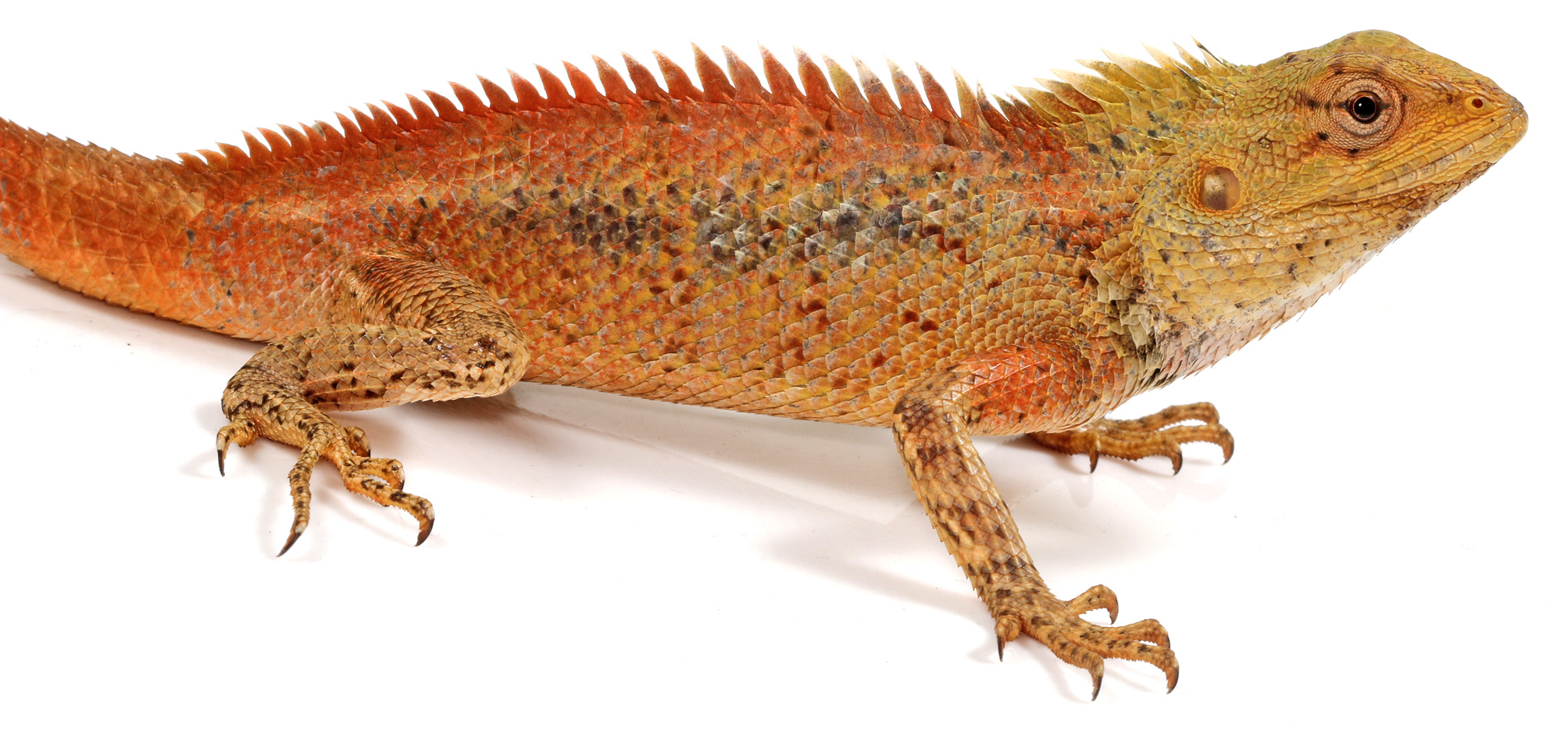
Description of neotype male NCBS AT 102. The neotype is an adult male measuring 110.1 mm SVL in a good condition with small longitudinal incisions on each hind thigh. The tail is entire and the specimen has no evident scar or damage. 38.7 mm SnForel, 50.8 mm TrunkL, 310 mm TailL, 17.8 mm TailH, 12.11 mm TailW, 20.9 mm PectW, 12.5 PelvW, 23.3 mm UpArmL, 21.5 mm LoArmL, 12.6 mm 4 FingLng, 26 mm UpLegL, 28.1 mm CrusL and 20.3 mm 4 ToeLng. Head pentagonal (dorsal outline) covered with heterogeneous, smooth scales juxtaposed in the anterior half to slightly overlapping in the posterior half; 25.8 mm HeadL, 25.6 mm HeadW, 28.3 mm JawW, 18.8 mm HeadH, 11.4 mm SnEye, 21.8 mm NarEye, 8.05 mm EyeEar, 7.5 mm SnW, and 13.9 mm InterOrb. Colouration in life (Fig. 2): Background colour yellowish, especially the head which is almost pale yellow, upper parts of trunk and tail with bright orange tinge, underparts light yellowish. A series of lateral dorsal scales on the trunk with a dark basal spot forming broken bands across the trunk at fairly regular intervals. Limbs in a shade of brown with randomly placed dark brown to black spots. Colour in preservative: Coloration faded in preservative. The orange dorsal coloration is reduced to shade of pink, largely restricted to the mid-dorsal crest and three rows bordering these. Head and tail much paler. Two black inter-parietal spots present. Chin whitish with remains of red coloration, throat scales in shade of red, belly scales nearly pinkish with a tinge of brown; underside of tail yellowish brown. Head distinct from neck (Fig. 3 A), as long as wide (HeadW / HeadL 0.99), makes up to a large part of the SVL (HeadL / SVL 0.23); snout to eye broadly acute and triangular, snout-tip blunt (Fig. 4 A); edges of head not parallel, especially posterior to orbital region with a large outward bulge of jaw muscle (Fig. 2 C). Sides of head flat, dropping from the sharp ridge from the supraciliary along the canthus rostralis up to the edge of supralabials (Fig. 4 B). Posterior portion of the head roundish with two large sub-conical processes that bear two large temporal spines on each; posterior part of head rotund, formed of muscular bulge of jaw muscles. Large posteriorly oriented scales form serrated edge of the posterior border of the head. Dorsal head scales heterogeneous, those posterior to rostral are small in size, juxtaposed (Fig. 4 A); these small scales continue to the interparietal in a longitudinal band composed of two to three scale rows, this band of small scales is edged by large scales on both sides of the supraocular area. Posterior to the interparietal, all scales merge into the dorsal trunk scales. Rostral as deep and wide as the adjoining supralabial, 7 SnS; 8 / 8 elongate, with their ends overlapping, form a sharply folded ridge along the CanthR. Large scales in the supraocular area do not form distinct supraocular plates; 17 HeadSL and 13 HeadSTr. Interparietal, large, sub-pentagonal, with a prominent parietal eye. A fairly large, oval shaped nasal scale perforated by a large naris, nasal scale touching rostral and separated from the labial scales by two rows of scales; loreal and preocular area with small scales, those above supralabials arranged in two parallel longitudinal rows extending to posterior marge of orbit; 11 / 11 Suplab, eye covered with small, non-granular scales and opening bordered by two rows of eyelid scales, outermost row of ridged scales that are subequal in their length and width and an inner row of smooth flat, wide scales 13 / 13 Eyelid; postocular and temporal scales nearly of same size as dorsal trunk scales, postocular scales smooth, temporal scales keeled; tympanum large, naked, 3.24 mm in diameter; cluster of spines in supratympanic area, two of these are large, anterior tympanic spine larger, dorsally directed positioned just above the tympanum, posterior spine dorsolaterally directed positioned posterior to the tympanum, tympanic spines separated by four scales; scales 12 / 12 rectangular Inflab scales along mouth margin; bordered below by 3 – 4 rows of smooth scales, first row among these scales is the smallest; medially the chin scales triangular, anterior scales smooth and those in the posterior region feebly keeled; single median subtriangular mental scale between left and right Inflab (Fig. 4 C). Trunk elongate (Trunk / SVL 0.46, Fig. 5 A), scalation strongly keeled dorsally and laterally; mid-dorsal crest of elongate scales, separated from interparietal by two large and one small scale, dorsal spine scales large, length of dorsal spine scales nearly equal up to vent where the size decreases and eventually flatten out on the tail to merge with adjacent dorsal scales of tail; 36 Dorsal, 42 Midbody (Fig. 5 A); all trunk scales keeled, increasing in size from neck to trunk; all scales oriented backward and diagonally upwards; scales on dorsum and venter sub-equal; preaxillary scales slightly smaller than dorsal trunk scales, feebly keeled. Limbs with modest to large scales, scales on dorsal aspect of limbs strongly keeled, those on the underside feebly keeled; scale on palm and heel smaller than adjacent scales; hind leg considerably longer than forelimb (CrusL / SVL 0.26, LoArmL / SVL 0.20) lamellae strongly bicarinate; 10, 15, 21, 21, 14 on manus (Fig. 5 C) and 12, 17, 23, 28, 16 on pes (Fig. 5 D); relative length of digits IV (12.1)> III (11.8)> II (8.6)> V (7.1)> I (7) right manus, IV (19.9)> III (16.8)> II (13.7)> V (13.4)> I (7.8). Tail long, about 2.8 times SVL (Fig. 3 A – B), oval in cross section near vent; 17 – 18 scale rows round the tail at base which progressively drop in number; eight dorsal spines extend on tail post vent. Scales similar to trunk scales.