
Konservasieng
Conservation: CITES – Appendix III (India); IUCN – Vulnerable as P. h. lignicolor, otherwise Lower Risk (lc).
Sumber: Order Carnivora
Family Viverridae · Order Carnivora
Data diperbarui secara berkala dari berbagai sumber observasi biodiversitas.
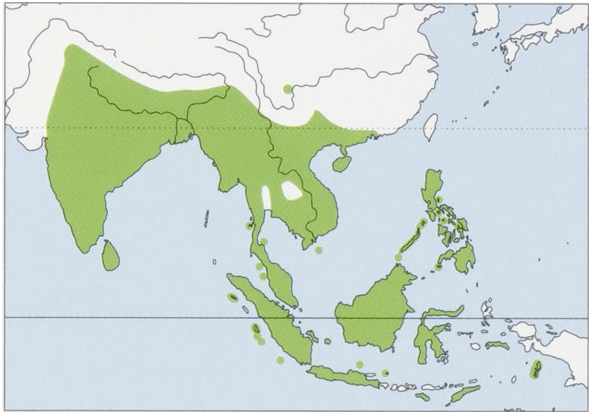
Foto: Don E. Wilson;Russell A. Mittermeier
Otoritas penamaan: (Pallas, 1777) (1777)
Status taksonomi: ACCEPTED
Status konservasi (IUCN): LC Risiko Rendah
Dipublikasikan dalam: In Schreber, Die Säugethiere vol.3 25 p.426 [1777]
Total Catatan di Indonesia
0
Provinsi Ditemukan
0
dari 38 provinsi
Catatan Pertama
0
tahun pertama tercatat
Tren Tahunan
-0%
-60.5% vs 2025
Musang (Paradoxurus hermaphroditus) termasuk dalam famili Viverridae, ordo Carnivora, kelas Mammalia. Berdasarkan data yang terhimpun, spesies ini telah tercatat sebanyak 836 kali di Indonesia, tersebar di 26 provinsi. Catatan pertama tercatat pada tahun 1863.
Jawa Barat merupakan provinsi dengan catatan observasi terbanyak untuk spesies ini, dengan 125 catatan (15.0% dari total). Data distribusi ini mencerminkan akumulasi dari berbagai kegiatan survei, penelitian, dan kontribusi citizen science. Pola distribusi yang tercatat mungkin tidak sepenuhnya menggambarkan persebaran alami spesies, karena dipengaruhi oleh intensitas pengamatan di masing-masing wilayah.
Tren observasi tahunan Paradoxurus hermaphroditus menunjukkan penurunan signifikan (-60%) pada periode terakhir dibanding tahun sebelumnya, dengan catatan pertama pada tahun 1863.
Catatan deskriptif tentang Paradoxurus hermaphroditus dari sumber literatur primer (via GBIF).
Conservation: CITES – Appendix III (India); IUCN – Vulnerable as P. h. lignicolor, otherwise Lower Risk (lc).
Sumber: Order Carnivora
Distribution: Bhutan, Burma, Cambodia, China, India, Indonesia, Laos, Malaysia, Nepal, New Guinea, Philippine Isls, Singapore, Sri Lanka, Thailand, Vietnam; scattered records in Sulawesi, Moluccas, and Aru Isls, probably resulting from introductions.
Sumber: Order Carnivora
DISTRIBUTION: Sri Lanka and India to S. China, Hainan Isl., and Malaysia; Philippine Isis.; W. Indonesia (incl. Lesser Sunda Isis.).
Sumber: Order Carnivora
Habitat. A wide range of habitats, including evergreen and deciduous forest (primary and secondary), plantations, and around human dwellings and settlements. Found up to 2400 m. In Thailand, one radio-collared male moved through an area that constituted 44 % dry dipterocarp forest, 30 % mixed deciduous forest, and 26 % dry evergreen forest; another male moved within 55 % dry dipterocarp forest, 32 % dry evergreen forest, and 12 % mixed deciduous forest.
Sumber: Viverridae
Movements, Home range and Social organization. Solitary. Mainly arboreal, but can be active on the ground. In Nepal, a radio-collared adult female had a home range of 0 - 12 km? In another study in Nepal, three males had home ranges of 0 - 17, 0 - 17, and 0 - 20 km?, and two females had home ranges of 0 - 06 and 0 - 12 km *. Home ranges were smaller during February and June, when the fruits of Coffea benghalensis and Murraya koeniggii were abundant, and largest in March to May, when ripe fruits were clumped or scarce. There was considerable overlap of home ranges among adjacent civets, but this changed according to food availability; more overlap was observed when ripe fruiting trees were at low density or clumped in distribution. In Thailand, the home ranges of two males were 4 - 2 and 17 km?: a shift in the range of the latter male occurred during the study. Mean daily movements were from 660 m to 1 km. In another study in Thailand, two males had home ranges of 1 - 1 and 3 - 4 km *, and a female had a home range of 1 - 4 km? The mean daily movement was 0 - 43 km for males and 0 - 48 km for the female. Common Palm Civets deposit scats on the ground and on tree branches.
Sumber: Viverridae
Status and Conservation. CITES Appendix III (India). Classified as Least Concern on The IUCN Red List. P. h. lignicolor (Mentawai Islands, Indonesia) is classified as Vulnerable. The subspecies kangeanus (Kangean Islands, Indonesia) and P. h. lignicolor are listed as Threatened in the 1989 IUCN Action Plan for the Conservation of Mustelids and Viverrids. Although widespread and generally considered common (even in disturbed habitats), on Borneo, it was found that the overall density of civets (including this species) in a logged forest was found to be significantly lower than in a primary forest. Common Palm Civets are often considered pests by fruit farmers and are killed. They are also trapped and traded for meat. Common Palm civets are kept as pets and used as rat catchers, which may explain why they were introduced to several areas. They may be under threat on the Mentawai Islands due to forest loss from commercial logging. Field surveys and ecological studies are needed to ascertain their distribution and conservation status, particularly on small islands on which they are known to occur.
Sumber: Viverridae
Nama-nama ilmiah lain yang pernah digunakan untuk Paradoxurus hermaphroditus dalam literatur taksonomi.
| Nama Sinonim | Otoritas | Status |
|---|---|---|
| Paradoxurus lignicolor | Miller, 1903 | SYNONYM |
| Paradoxurus philippinensis | Jourdan, 1837 | SYNONYM |
| Viverra hermaphrodita | Pallas, 1777 | SYNONYM |
| # | Provinsi | Catatan | % |
|---|---|---|---|
| 1 | Jawa Barat | 125 | 15.0% |
| 2 | Bali | 25 | 3.0% |
| 3 | Sumatera Barat | 18 | 2.2% |
| 4 | Riau | 18 | 2.2% |
| 5 | Jawa Timur | 18 | 2.2% |
| 6 | Banten | 17 | 2.0% |
| 7 | Sumatera Utara | 15 | 1.8% |
| 8 | Lampung | 12 | 1.4% |
| 9 | Nusa Tenggara Timur | 9 | 1.1% |
| 10 | Aceh | 8 | 1.0% |
| 11 | DKI Jakarta | 8 | 1.0% |
| 12 | DI Yogyakarta | 8 | 1.0% |
| 13 | Kepulauan Bangka Belitung | 7 | 0.8% |
| 14 | Kalimantan Barat | 7 | 0.8% |
| 15 | Kalimantan Tengah | 6 | 0.7% |
| 16 | Sumatera Selatan | 5 | 0.6% |
| 17 | Jawa Tengah | 5 | 0.6% |
| 18 | Kalimantan Timur | 4 | 0.5% |
| 19 | Jambi | 3 | 0.4% |
| 20 | Nusa Tenggara Barat | 3 | 0.4% |
| 21 | Bengkulu | 1 | 0.1% |
| 22 | Kepulauan Riau | 1 | 0.1% |
| 23 | Kalimantan Selatan | 1 | 0.1% |
| 24 | Sulawesi Tengah | 1 | 0.1% |
| 25 | Sulawesi Selatan | 1 | 0.1% |
| 26 | Maluku | 1 | 0.1% |
Jumlah catatan observasi Paradoxurus hermaphroditus di Indonesia per tahun
Paradoxurus hermaphroditus
Foto: Don E. Wilson;Russell A. Mittermeier
Paradoxurus hermaphroditus
Foto: Don E. Wilson;Russell A. Mittermeier
| Nama | Bahasa | Sumber |
|---|---|---|
| Alamid | tgl | Catalogue of Life |
| Asian Palm Civet | Inggris | Integrated Taxonomic Information System (ITIS) |
| Asian palm civet | Inggris | The Paleobiology Database |
| Asiapalmemår | nob | Catalogue of Life |
| Asiatisk Palmesivett | nob | Catalogue of Life |
| Azia palm-civeto | epo | Catalogue of Life |
| Azijska cibetka palmašica | hrv | Catalogue of Life |
| Careuh bulan | Sunda | Catalogue of Life |
| Civeta palmera asiática | Spanyol | Catalogue of Life |
| Civetta delle palme comune | Italia | Catalogue of Life |
| Civette hermaphrodite | Prancis | Viverridae |
| Common Palm Civet | Inggris | Integrated Taxonomic Information System (ITIS) |
| Common palm civet | Inggris | Phthiraptera.myspecies.info |
| Cầy vòi đốm | vie | Catalogue of Life |
| Fleckenmusang | Jerman | Viverridae |
| Indisk palmeruller | dan | Catalogue of Life |
| Indisk palmmård | swe | Catalogue of Life |
| Közönséges pálmasodró | hun | Catalogue of Life |
| Laku | - | Catalogue of Life |
| Loewak | Belanda | Catalogue of Life |
Berdasarkan data 836 observasi, Jawa Barat adalah provinsi dengan catatan Musang (Paradoxurus hermaphroditus) terbanyak — 125 observasi (15.0% dari total catatan di Indonesia). Spesies ini tersebar di 26 provinsi.
Catatan pertama Musang (Paradoxurus hermaphroditus) di Indonesia tercatat pada tahun 1863. Hingga kini terdapat 836 catatan dari 26 provinsi, yang dihimpun dari survei lapangan, koleksi museum, dan platform citizen science.
Menurut IUCN Red List, Musang (Paradoxurus hermaphroditus) berstatus "Risiko Rendah" (kode LC). Status ini mencerminkan tingkat risiko kepunahan global spesies, bukan khusus Indonesia.
Di Indonesia dan Malaysia, Paradoxurus hermaphroditus dikenal dengan beberapa nama lokal: Musang, Musang Luwak. Penamaan dapat berbeda antardaerah dan bahasa.
Ya, Paradoxurus hermaphroditus memiliki 3 nama sinonim ilmiah, di antaranya: Paradoxurus lignicolor, Paradoxurus philippinensis, Viverra hermaphrodita. Nama sinonim adalah nama-nama lain yang pernah digunakan untuk spesies yang sama dalam literatur taksonomi.
Paradoxurus hermaphroditus diklasifikasikan sebagai berikut: Kingdom Animalia, Phylum Chordata, Class Mammalia, Order Carnivora, Family Viverridae, Genus Paradoxurus. Spesies ini dideskripsikan oleh (Pallas, 1777).
150 titik observasi Paradoxurus hermaphroditus di Indonesia
Memuat peta...
Setiap titik merepresentasikan satu lokasi observasi yang tercatat. Klik titik untuk melihat detail.