
Biologi & Ekologieng
PHENOLOGY. — Flowering: February, August – September; fruiting: February, November.
Sumber: Avicennia (Acanthaceae: Avicennioideae) in North America and Mesoamerica
Family Acanthaceae · Order Lamiales
Data diperbarui secara berkala dari berbagai sumber observasi biodiversitas.
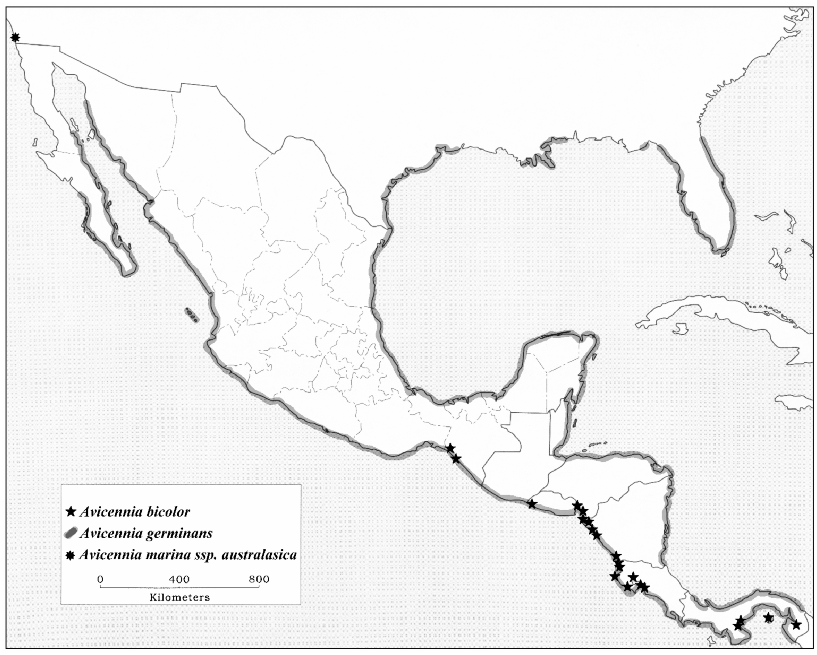
Foto: Daniel, Thomas F.
Otoritas penamaan: (Forssk.) Vierh.
Status taksonomi: ACCEPTED
Status konservasi (IUCN): LC Risiko Rendah
Dipublikasikan dalam: Denkschr. Kaiserl. Akad. Wiss., Wien. Math.-Naturwiss. Kl. 71: 435 (1907)
Total Catatan di Indonesia
0
Provinsi Ditemukan
0
dari 38 provinsi
Catatan Pertama
0
tahun pertama tercatat
Tren Tahunan
-0%
-65.4% vs 2025
Api-Api Putih (Avicennia marina) termasuk dalam famili Acanthaceae, ordo Lamiales, kelas Magnoliopsida. Berdasarkan data yang terhimpun, spesies ini telah tercatat sebanyak 423 kali di Indonesia, tersebar di 22 provinsi. Catatan pertama tercatat pada tahun 1841.
DKI Jakarta merupakan provinsi dengan catatan observasi terbanyak untuk spesies ini, dengan 10 catatan (2.4% dari total). Data distribusi ini mencerminkan akumulasi dari berbagai kegiatan survei, penelitian, dan kontribusi citizen science. Pola distribusi yang tercatat mungkin tidak sepenuhnya menggambarkan persebaran alami spesies, karena dipengaruhi oleh intensitas pengamatan di masing-masing wilayah.
Tren observasi tahunan Avicennia marina menunjukkan penurunan signifikan (-65%) pada periode terakhir dibanding tahun sebelumnya, dengan catatan pertama pada tahun 1841.
Catatan deskriptif tentang Avicennia marina dari sumber literatur primer (via GBIF).
PHENOLOGY. — Flowering: February, August – September; fruiting: February, November.
Sumber: Avicennia (Acanthaceae: Avicennioideae) in North America and Mesoamerica
CONSERVATION. — Avicennia marina has been assessed as a taxon of Least Concern (LC) by Duke et al. (2010). This taxon is not native in the New World, but has become naturalized locally and is potentially invasive. On his collection 28024 made in 1979, Moran noted that plants in California had been introduced from Aukland, New Zealand about 1966 – 69. He also noted the presence of about 100 or more flowering-size plants plus many seedlings in the wildlife reserve where his observations were made. Initial efforts to eradicate the species were unsuccessful.
Sumber: Avicennia (Acanthaceae: Avicennioideae) in North America and Mesoamerica
Figures 1 H – K, 2, 3 B, D Shrubs to 2.3 m tall. Young stems of reproductive shoots covered with dense shiny granules or scalelike projections to 0.05 m long (scurfy), soon glabrate. Leaves petiolate, blades ovate to elliptic (to obovate), 44 – 100 mm long, 19 – 41 mm wide, 1.7 – 2.8 (– 3.6) times longer than wide, acute (to rounded or emarginate) at apex, subattenuate to attenuate at base, surfaces discolorous (abaxial lighter), punctate-pitted (sometimes inconspicuously so abaxially), adaxial surface lacking trichomes, abaxial surface covered with a dense scurfy layer. Inflorescences of axillary and terminal (sessile to) pedunculate ± headlike spikes, peduncles (0 –) 1 – 40 mm long, scurfy or distally pubescent like rachis, rachis not or but barely visible, internodes near midspike 1 – 4 mm long, scurfy and pubescent with ± antrorse eglandular trichomes to 0.2 mm long. Bracts opposite, broadly ovate to triangular, concavoconvex, 3 – 4 mm long, abaxial surface scurfy and often pubescent like rachis. Bracteoles similar to bracts except smaller. Flowers mostly 4 – 16 per spike, sessile. Calyx 3.5 – 4 mm long, lobes elliptic to broadly elliptic, concavoconvex, imbricate, abaxially pubescent with antrorsely appressed eglandular trichomes to 0.8 mm long, margin ciliate with similar but spreading trichomes. Corollas 3.5 – 6. 5 mm long, internally drying dark or blackish proximally and light brownish distally (those from Australasia are usually described as yellowish or orangish and the color is often darker in the corolla tube), externally glabrous (tube and base of lobes) and densely pubescent with appressed eglandular trichomes to 0.2 mm long (remainder of lobes), tube 1.5 – 2 mm long, limb actinomorphic, 4 - lobed, lobes ovate-triangular to ovate-elliptic, 2 – 4. 5 mm long, apically entire (or 1 lobe sometimes slightly bifid apically with division to 0.2 mm long), internally lacking eglandular trichomes (at least distally) but sometimes punctate-pitted (proximally). Stamens 4, inserted in distal half of corolla tube near base of lobes, exserted from mouth of corolla tube, oriented symmetrically (i. e., equally distant from one another) around corolla with thecae opening toward central gynoecium, 1.5 – 2 mm long, filaments 0.5 – 0.8 mm long, anthers presented at same height, thecae 1 – 1.2 mm long; pollen prolate spheroidal to euprolate, polar diameter (P) 28 – 41 µm, equatorial diameter (E) 24 – 27 µm, P: E = 1.04 – 1.75. Style not evident, stigma lobes 0.2 mm long. Fruit ovoid to subellipsoid, proximally blackish and distally light brownish when dry, 15 – 24 mm long, 10 – 19 mm across at widest expanse, pubescent with erect to flexuose to antrorse eglandular trichomes to 0.3 mm long (especially when less mature) and scurfy (especially evident when more mature). 2 n = 64, 96 (Dawson 1989).
Sumber: Avicennia (Acanthaceae: Avicennioideae) in North America and Mesoamerica
ILLUSTRATIONS. — Munir (1986: 1179, fig. 546); Duke (1991: 314, fig. 7); Clarke and Myerscough (1991: 285, fig. 1).
Sumber: Avicennia (Acanthaceae: Avicennioideae) in North America and Mesoamerica
DISTRIBUTION AND HABITAT. — Avicennia marina has the most extensive distribution among species in the genus; it is native to eastern Africa, southern Asia, Indian Ocean and western Pacific Ocean islands, and Australia. Subspecies australasica occurs primarily in subtropical and temperate Australasia (i. e., southeastern Australia and northern New Zealand). It is the southernmost-occurring taxon among species of Avicennia in the Old World (to 38 ° 45 ’ S; Duke 2006), and the southernmost-occurring mangrove in the world. In southern California, where this taxon has been introduced and become naturalized (Fig. 2), plants occur in salt marshes with Batis, Juamea, Salicornia, Spartina, and Suaeda at or near sea level.
Sumber: Avicennia (Acanthaceae: Avicennioideae) in North America and Mesoamerica
Nama-nama ilmiah lain yang pernah digunakan untuk Avicennia marina dalam literatur taksonomi.
| Nama Sinonim | Otoritas | Status |
|---|---|---|
| Avicennia maritima | Naurois & Roux | SYNONYM |
| Avicennia mindanaense | Elmer | SYNONYM |
| Avicennia officinalis | Baker | SYNONYM |
| Halodendron thouarsii | Roem. & Schult. | SYNONYM |
| # | Provinsi | Catatan | % |
|---|---|---|---|
| 1 | DKI Jakarta | 10 | 2.4% |
| 2 | Jawa Barat | 9 | 2.1% |
| 3 | Jawa Tengah | 9 | 2.1% |
| 4 | Bali | 9 | 2.1% |
| 5 | Jawa Timur | 7 | 1.7% |
| 6 | Nusa Tenggara Barat | 6 | 1.4% |
| 7 | Banten | 5 | 1.2% |
| 8 | Kalimantan Timur | 5 | 1.2% |
| 9 | Papua | 4 | 0.9% |
| 10 | Papua Barat | 4 | 0.9% |
| 11 | Kalimantan Selatan | 3 | 0.7% |
| 12 | Kalimantan Barat | 2 | 0.5% |
| 13 | Sulawesi Utara | 2 | 0.5% |
| 14 | Maluku | 2 | 0.5% |
| 15 | Maluku Utara | 2 | 0.5% |
| 16 | Sumatera Utara | 1 | 0.2% |
| 17 | Jambi | 1 | 0.2% |
| 18 | Kepulauan Riau | 1 | 0.2% |
| 19 | DI Yogyakarta | 1 | 0.2% |
| 20 | Nusa Tenggara Timur | 1 | 0.2% |
| 21 | Kalimantan Utara | 1 | 0.2% |
| 22 | Sulawesi Tengah | 1 | 0.2% |
Jumlah catatan observasi Avicennia marina di Indonesia per tahun
Avicennia marina
Foto: Daniel, Thomas F.
Avicennia marina
Foto: Daniel, Thomas F.
Avicennia marina
Foto: Daniel, Thomas F.
| Nama | Bahasa | Sumber |
|---|---|---|
| Afi Afi | - | TAXREF |
| Afiafy | mlg | Catalogue of Life |
| Api-Api Putih | Indonesia | Catalogue of Life |
| Api-api Jambu | Melayu | Malaysian Mangrove |
| Api-api jambu | Melayu | Malaysian Mangrove |
| Api-api merah | Melayu | Malaysian Mangrove |
| Dadaiit | - | Catalogue of Life |
| Gray Mangrove | Inggris | Catalogue of Life |
| Gray mangrove | Inggris | Global Register of Introduced and Invasive Species - United States (Contiguous) (ver.2.0, 2022) |
| Grey Mangrove | Inggris | Catalogue of Life |
| Manglier gris | Prancis | Catalogue of Life |
| Mangrove | Inggris | Catalogue of Life |
| Mangrovia grigia | Italia | Catalogue of Life |
| Msiri | - | TAXREF |
| Palétuvier gris | Prancis | Catalogue of Life |
| avicénia prímorská | slk | Catalogue of Life |
| gray mangrove | Inggris | Integrated Taxonomic Information System (ITIS) |
| grey mangrove | Inggris | GRIN Taxonomy |
| isikaha-esimhlope | zul | Catalogue of Life |
| isikhungathi | xho | Catalogue of Life |
Berdasarkan data 423 observasi, DKI Jakarta adalah provinsi dengan catatan Api-Api Putih (Avicennia marina) terbanyak — 10 observasi (2.4% dari total catatan di Indonesia). Spesies ini tersebar di 22 provinsi.
Catatan pertama Api-Api Putih (Avicennia marina) di Indonesia tercatat pada tahun 1841. Hingga kini terdapat 423 catatan dari 22 provinsi, yang dihimpun dari survei lapangan, koleksi museum, dan platform citizen science.
Menurut IUCN Red List, Api-Api Putih (Avicennia marina) berstatus "Risiko Rendah" (kode LC). Status ini mencerminkan tingkat risiko kepunahan global spesies, bukan khusus Indonesia.
Di Indonesia dan Malaysia, Avicennia marina dikenal dengan beberapa nama lokal: Api-Api Putih. Penamaan dapat berbeda antardaerah dan bahasa.
Ya, Avicennia marina memiliki 4 nama sinonim ilmiah, di antaranya: Avicennia maritima, Avicennia mindanaense, Avicennia officinalis. Nama sinonim adalah nama-nama lain yang pernah digunakan untuk spesies yang sama dalam literatur taksonomi.
Avicennia marina diklasifikasikan sebagai berikut: Kingdom Plantae, Phylum Tracheophyta, Class Magnoliopsida, Order Lamiales, Family Acanthaceae, Genus Avicennia. Spesies ini dideskripsikan oleh (Forssk.) Vierh..
150 titik observasi Avicennia marina di Indonesia
Memuat peta...
Setiap titik merepresentasikan satu lokasi observasi yang tercatat. Klik titik untuk melihat detail.