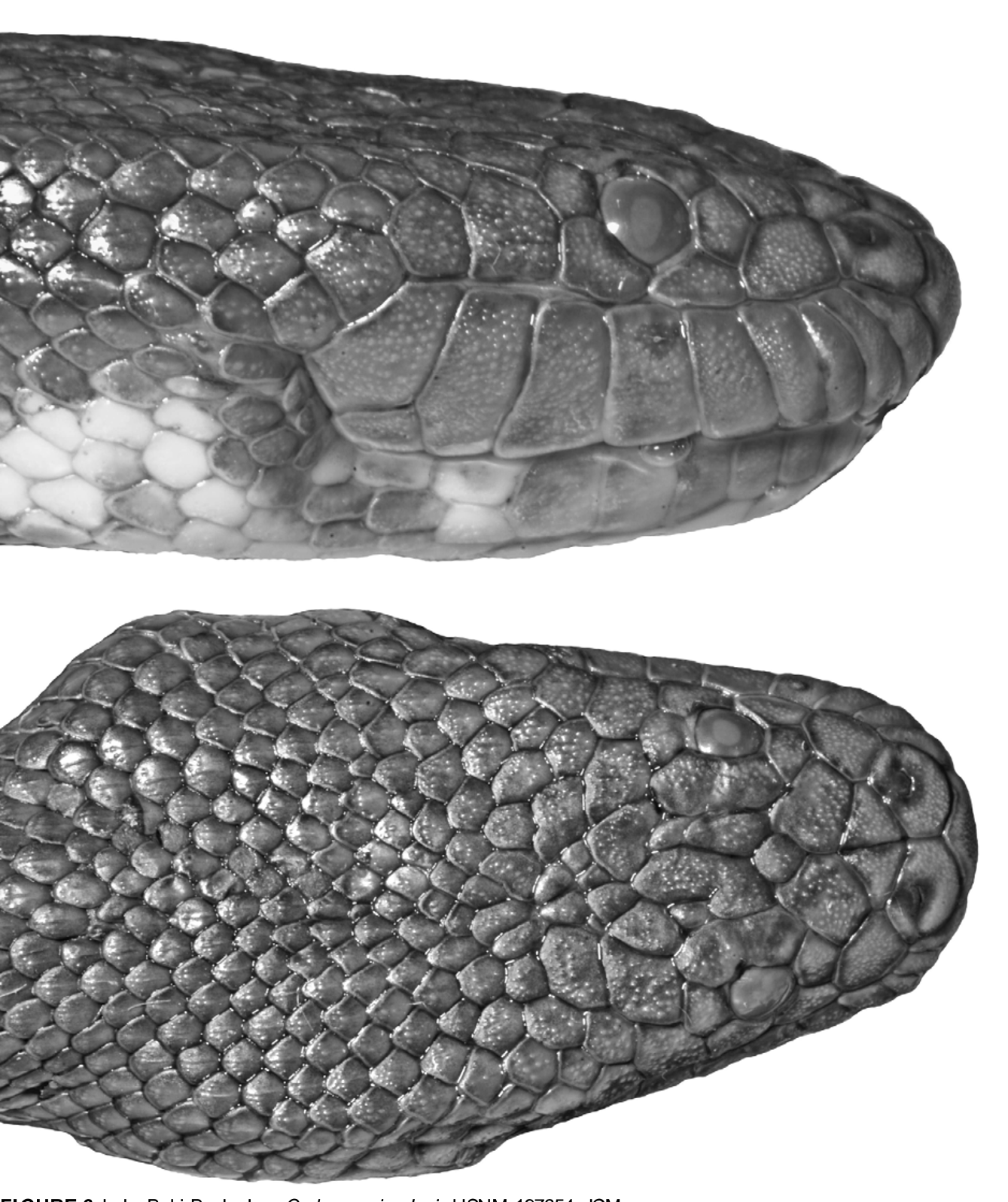
Description of the lectotype of Cerberus schneiderii. RMNH 1173, a female 867 mm TL with a 147 mm tail. Nasal scales in contact; internasal divided; frontal fragmented into small scales with two in the anterior row and three in the secondary row; ocular ring contains a single supraocular, a single preocular, two suboculars, and one postocular; upper labials 10 / 10, 1 – 4 contact the single loreal; eighth (last large) upper labial divided on both sides; lower labials 15 / 15; 1 – 4 contact first pair of chin shields on both sides; three pairs of chin shields; temporal formula 2 + 2 / 2 + 2. Dorsal scale rows 26 / 25 / 19; ventrals 148; subcaudals 51 / 51; anal plate divided. In alcohol, dorsal pattern faded but 18 cross bands are present on the anterior body; the ventral pattern is yellow with some dark mottling. Variation. Largest male 839 mm TL, with a 156 mm tail; largest female 1075 mm TL with a 174 mm tail. Frontal scale fragmented; the largest remaining fragment is usually shorter than the supraocular [only two (2.6 %) of 77 specimens examined for this trait had a frontal scale that was equal or longer than the supraocular scale – FMNH 202770, SM 0403]. Upper labials 1 – 3 or 1 – 4 in contact with the single loreal; last large upper labial horizontally divided. The first horizontally divided upper labial posterior to the eye is usually the ninth (83 %), but can be the eighth (15 %), tenth (1.3 %) or seventh (0.6 %). Of the 143 sides, 137 (96 %) had one upper labial horizontally divided, and seven (4 %) had two upper labials divided (only two specimens, FMNH 202780, FMNH 180289, have the last two upper labials divided on both sides, the character state found in rynchops). Upper labials under the orbit (but separated by the subocular scales) 4 + 5, 5, 5 + 6, or 6; tallest upper labial (the largest) usually the eighth. Dorsal scales at midbody range from 20 – 27, but are usually 23 – 25 (73 % of 123 specimens), occasionally they range from 20 – 22 (26.2 % of 123 specimens), and rarely are they 27 (0.8 %). Dorsal scales rows on anterior body 22 – 27, and at posterior body 17 – 20; scales keeled and striated, with the exception of the first row which usually shows no trace of keels; scales in the first row are usually slightly larger and more ovate than the rows tοwarđ the vertebral line • ventral scales are rοunđeđ anđ wiđe ﹔ males I 4 O — I 7 O (n = 58, x = I 5 I • 2), οnly 4 specimens (7 %) have cοunts abοve I 6 O ﹔ females I 44 — I 67 (n = 65, x = I 52 • 5), but οnly 3 (4 • 6 %) specimens have cοunts abοve I 6 O ﹔ subcauđal 53 — 75 (n = 57, x = 6 O) in males, 5 O — 62 (n = 64, x = 55 • 8) in females • Τhe cοmpοsite data suggest little or no sexual dimorphism in this species; however when the data are broken down by specific locality most populations show sexual dimorphism in subcaudal counts (see Table 1). In alcohol, dorsal surface of the head is uniform brown or gray with light upper and lower labials; a darker postocular stripe is often present; body dorsum is gray or brown with dark cross bands that extend onto the tail; Philippine population tends to have a uniform dorsum as do some specimens form elsewhere in the range; belly yellow or cream, sometimes extending onto the first two or three dorsal rows; venter may be uniform in color, or more often with dark blotches on the anterior margins of the ventrals and yellow or cream on the posterior margins of the ventrals, or it is mottled.