Distribusieng
Distribution. This species is cosmopolitan and is a known invasive mosquito, although originally confined to the Oriental Region (Azari-Hamidian et al. 2019). In the Middle East and North Africa, it has been found in Algeria, Iran, Israel, Jordan, Lebanon, Morocco, Oman, Palestine, Syria, Tunisia and Turkey (White 1980; Sabatini et al. 1990; Ibáñez-Bernal & Martínez-Campos 1994; Adhami & Reiter 1998; Schaffner et al. 2004; Klobucar et al. 2006; Aranda et al. 2006; Haddad et al. 2007; Gatt et al. 2009; Izri et al. 2011; Adawi 2012; Becker et al. 2012; Petrić et al. 2012; Šebesta et al. 2012; Oter et al. 2013; Tantely et al. 2016; Benallal et al. 2016; Doosti et al. 2016; Irish et al. 2016; Bennouna et al. 2017; Di Luca et al. 2017; Kanani et al. 2017; Medlock et al. 2017; Trari et al. 2017; Gunathilaka 2018; Al Awaidy & Khamis 2019; Azari-Hamidian et al. 2019; Ben Ayed et al. 2019; Bouattour et al. 2019; Merdić et al. 2020; Maquart et al. 2021; Wilkerson et al. 2021). There is no confirmation of the record of this species in Saudi Arabia. It is spreading very fast and there is speculation that it exists in other countries of the Middle East (Haddad et al. 2007; Kanani et al. 2017; Azari-Hamidian et al. 2019).
Sumber: An overview of the mosquitoes of Saudi Arabia (Diptera: Culicidae), with updated keys to the adult females
Deskripsieng
Another invasive mosquito species, Ae. albopictus is present on other Caribbean islands such as Barbados, Cayman Islands, Cuba, Dominican Republic and Trinidad, but has not yet been confirmed for the three focal islands (Benedict et al., 2007). Due to intensive travel and transport to the Dutch Leeward Islands, establishment seems probable. We therefore included this species in both the adult and larval identification keys. At the time of writing there is no definitive evidence to support the presence of Ae. albopictus on the Dutch Leeward Islands.
Sumber: Taxonomy, ecology and distribution of the mosquitoes (Diptera: Culicidae) of the Dutch Leeward Islands, with a key to the adults and fourth instar larvae
Deskripsieng
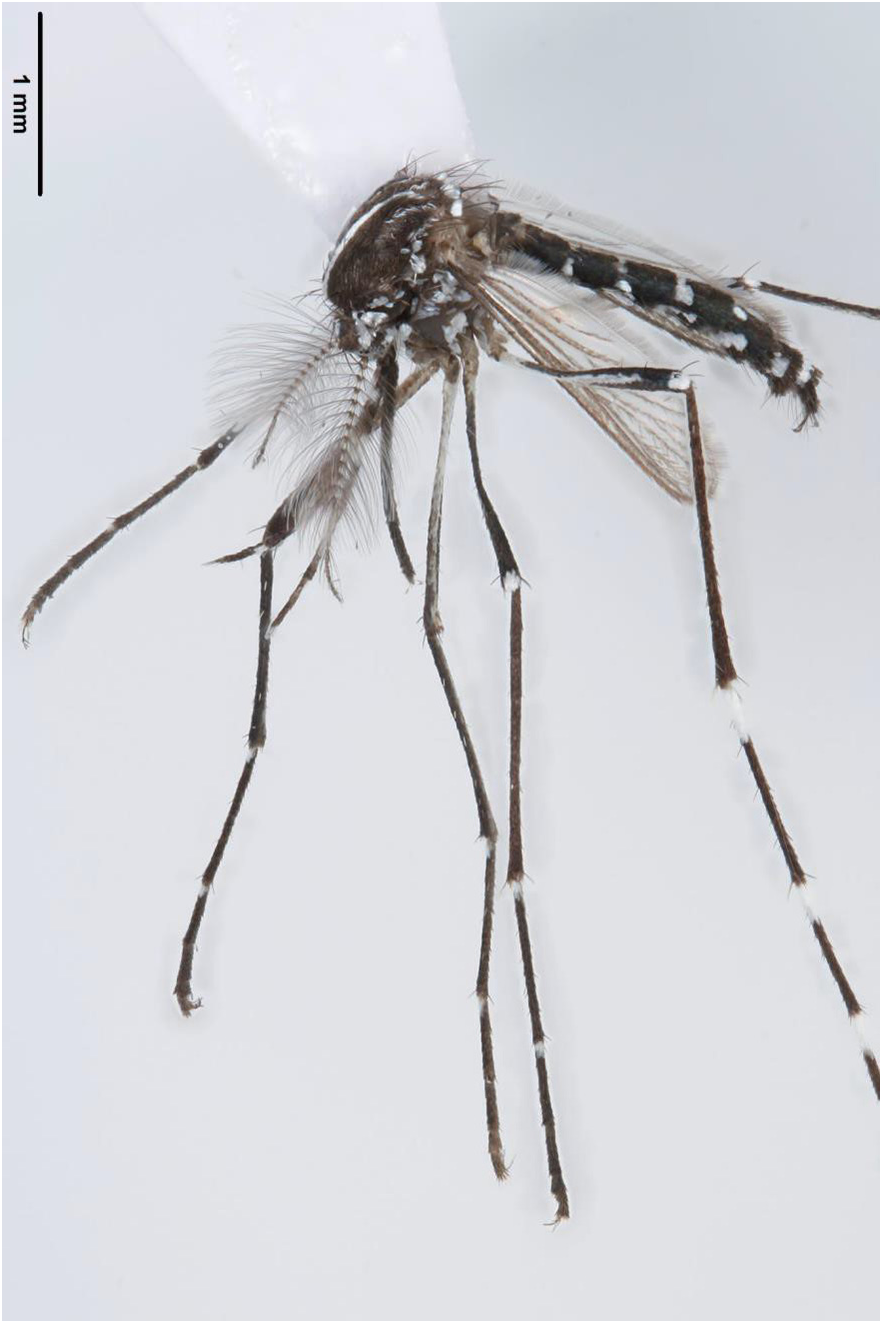
FEMALE. (Fig. 1 C). Essentially as in the male. Differs from the male in the following respects: Palpus % of proboscis, with white scales on apical half. Fore and mid-legs with tarsal claws equal, simple. Abdominal basal bands on terga II — VII; segment VIII largely retracted. PUPA. (Figs. 2 A, B). Chaetotaxy as shown in figure which was drawn from the skin of the neotype male. Hair 2 - 1 and 3 - 1 not widely separated, the distance between them as the distance between 4 - 1 and 5 - 1; hair l-I I branched; hair 2 - II laterad of hair 3 - II; hairs 3 - II and 3 - III simple, shorter than segment III; hairs 5 - IV, 5 - V and 5 - VI simple, not reaching beyond the posterior margin o f the following segment; hair 9 - VIII single, barbed; paddle margins with fringe; hair 1 - P single.
Sumber: Neotype Designation for Aedes (Stegomyia) albopictus (Skuse)
Deskripsieng
MALE. Head. (F ig. 1 A). Proboscis dark scaled, as long as fore femur; palpus longer than proboscis, with a white basal band on each of segments 2 - 5; those on segments 4, 5 incomplete dorsally; segments 4, 5 subequal, slender, upturned, and with only a few short hairs; antenna plumose, slightly shorter than proboscis; clypeus bare; torus covered with white scales except on dorsal side; decumbent scales o f vertex all broad and flat; erect forked scales dark, not numerous, restricted to occiput; vertex with a median stripe o f broad white scales, with broad dark scales on each side interrupted by a lateral stripe o f broad white scales followed by a patch o f white broad scales ventrally. Thorax. (Figs. 1 A, D). Scutum with narrow dark scales and a prominent median longitudinal stripe of similar white ones, the median stripe narrows slightly posteriorly and forks at beginning o f the prescutellar space, there is on each side a posterior dorsocentral white line which does not reach to the middle o f the scutum; a patch of broad flat white scales on the lateral margin just before the level o f the wing root and few narrow curved white scales over the wing root; acrostichal bristles absent; dorsocentral bristles present; scutellum with broad white scales on all lobes and with a few broad dark ones at the apex o f mid lobe; anterior pronotum (apn) with broad white scales; posterior pronotum (ppn) with broad white scales and some dark narrow ones dorsally; paratergite with broad white scales; postspiracular (psp) area without scales; patches o f broad white scales on propleuron (p p l), on the subspiracular (ssp) area, on the upper and lower portions of stemopleuron (stp) and on the upper and lower portions of mesepimeron (m ep); mesepimeron (m ep) scale patches connected forming a V-shaped white scale patch, the open side o f the V directed backwards; lower mesepimeron (m ep) without bristle; metameron bare. Wing. (Fig. 1 A). W ing with dark scales on all veins except for a minute basal spot of white scales on the costa. HaJtere with dark scales. Legs. (Fig. I E). Coxae with patches of white scales; knee-spots present on all femora; fore and mid femora dark anteriorly; paler posteriorly; hind femur anteriorly with a broad white longitudinal stripe which widens at base and is narrowly separated from the apical white scale patch; fore and mid tibiae dark anteriorly, paler posteriorly; hind tibiae dark; fore and mid tarsi with basal white bands on segments 1 - 2; hind tarsus with basal white bands on segments 1 — 4, segment 5 all white; fore and mid legs with tarsal claws unequal, the larger one toothed, the smaller one simple; hind leg with tarsal claws equal, simple. A bdomen. (Figs. 1 A, B). Abdominal segment I with white scales on laterotergite; terga III-V I each with a basal transverse white band which widens laterally; with lateral white spots; the lateral spots not connected with the basal transverse bands; terga II, VII with lateral white spots only; sternum VIII largely covered with white scales (the description was made before the terminalia were re- m oved). Terminalia. (F ig. 2 C). Basimere relatively short and broad, 2 times as long as wide; its scales restricted to dorsolateral, lateral and ventral areas; with a patch o f 9 hairs on the basomesal area o f dorsal surface; mesal surface extensively membranous; claspette large, mushroom-like, with numerous setae and with several widened specialized curved setae on the expanded distal part; distimere simple, elongate, apex somewhat swollen and with some hairs; with a spiniform process at apex; aedeagus with distinct lateral sclerotized plates; with several teeth on each side; paraprocts without teeth; cereal setae absent; ninth tergum with a conspicuous horn-like median projection and with two hairy lateral lobes.
Sumber: Neotype Designation for Aedes (Stegomyia) albopictus (Skuse)