Distribusieng
<p>Vietnam, Zanzibar, Tanzania, Mozambique, Somalia, Cameroon, Benin, Togo, Ivory Coast, Senegal, Gabon, Madagascar, Comores, Nossi Be, Mauritius, Pakistan, India, Sri Lanka, Nepal, Bangladesh, Bhutan, China, Myanmar, Laos, Thailand, Cambodia, Malaysia, Singapore, Indonesia, the Philippines, Japan, Melanesia, Micronesia, Australia, New Caledonia, Solomon Islands, Vanuatu. Additionally in western Asia (Saudi Arabia) and America (Guatemala, Mexico, USA).</p>
Sumber: New records and an updated checklist of the herpetofauna from Tay Yen Tu Nature Reserve, north-eastern Vietnam
Biologi & Ekologieng
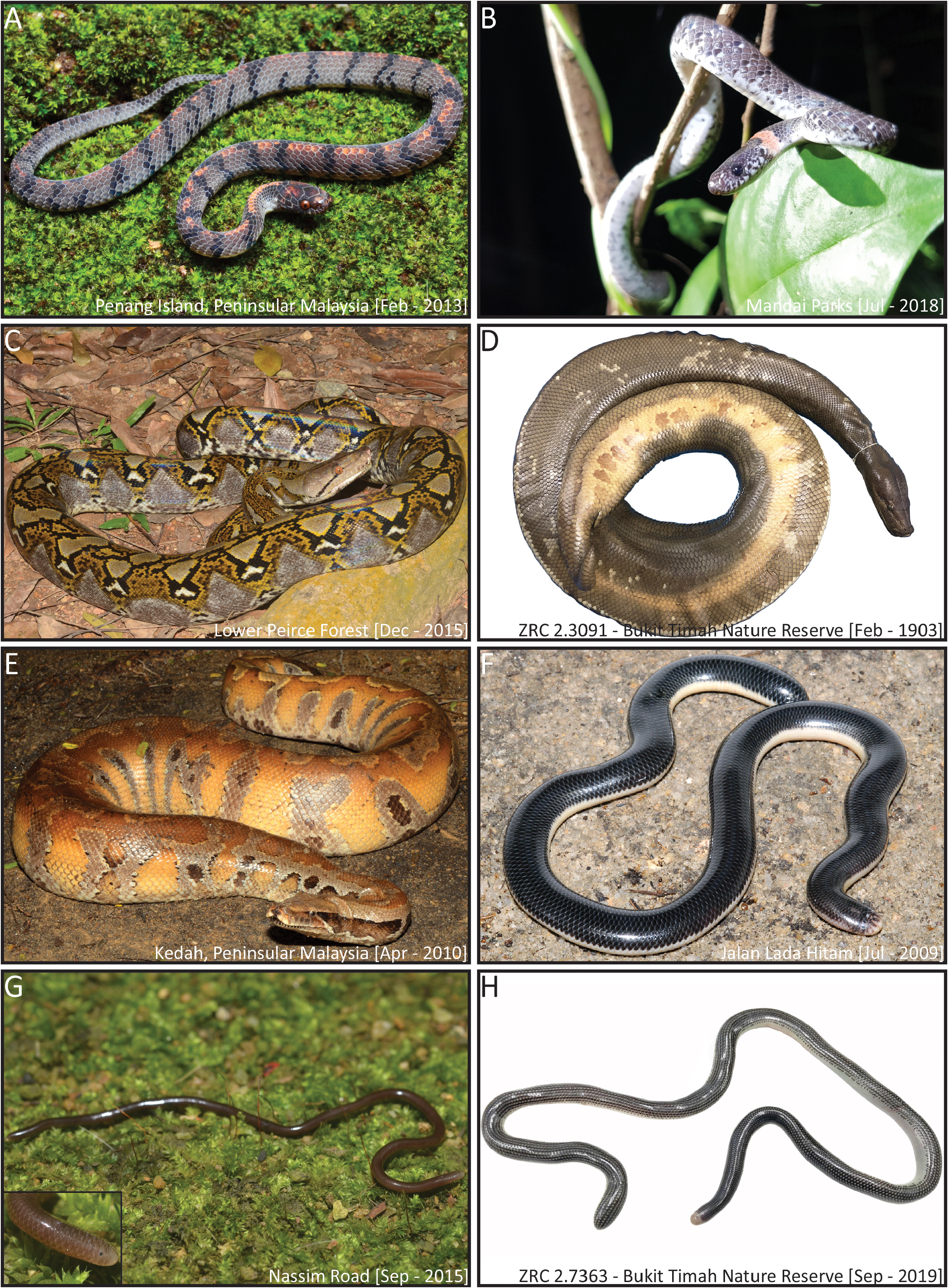
BIOLOGY The coloration is usually some shade of brown or black with the snout and venter being a slightly lighter shade. The chin, cloaca region, and tail tip are white. In desert regions the colour is generally lighter, from tan to pink. The tongue is white. They are not often seen on the surface in the daytime except after rains or floods, when they come up to breathe air. They are normally found when digging in the garden, raking leaves, excavating earth, or turning stones. This snake may be mistaken for an earthworm upon superficial inspection. However, a closer examination will easily determine that it is a snake as it is covered with shiny, hard scales, lacks segmentation, has a forked tongue, a pair of dark eyespots, wiggles rapidly like a snake on smooth surfaces (like the bathroom floor where it is frequently found), and disappears into loose soil very quickly. They all superficially resemble one another in comparison with other snakes and are fossorial or subterranean, active nocturnally, and feed exclusively upon ants and termites, preferably their eggs, nymphs, pupae, and larvae. Females lay an average of 3 eggs (range = 1 – 8) throughout the year in tropical regions (at least three times / year in the Seychelles) and only once every year or every other year in colder climates or higher elevations (NUSSBAUM, 1980; OTA et al., 1991).
Sumber: How to easily identify the flowerpot blindsnake, Indotyphlops braminus (Daudin, 1803), with proposal of a new genus (Serpentes: Typhlopidae)
Deskripsieng
The Leptotyphlopidae of Africa and the Americas can easily be distinguished from I. braminus by scale rows (14, rarely 16 vs. 20), eye (large distinct eye vs. small faint spot), ocular shield (forming border of upper lip vs. separated from upper lip by supralabials), cloacal shields (single large shield vs. multiple scales), tail length (2.1 – 20.0 % vs. 1.5 – 3.5 % LOA), and tail termination (rounded with minute spine vs. conical with large spine). The Anomalepididae mainly inhabit South America with only three species (each in a different genus) entering Central America. Anomalepis mexicanus from Honduras to Panama differs from I. braminus in having three enlarged dorsal head shields (two prefrontals and one frontal). Helminthophis frontalis from Costa Rica differs from I. braminus in midbody scale rows (22 vs. 20), middorsals (> 575 vs. <370), and SIP (A-VI vs. T-III). Liotyphlops albirostris from Panama is separable from I. braminus by middorsals (367 – 520 vs. 261 – 368), rostral width (0.5 – 0.6 vs. 0.3 – 0.4 head width), and SIP (A-VI vs. T-III).
Sumber: How to easily identify the flowerpot blindsnake, Indotyphlops braminus (Daudin, 1803), with proposal of a new genus (Serpentes: Typhlopidae)
Distribusieng
DISTRIBUTION Our knowledge of the geographic distribution of I. braminus was limited to fewer than 40 countries in the 19 th Century (1803 – 1900) but the 20 th Century (1900 – 1999) saw that number double to 81 and in just the past 20 years (2000 – 2020) it has been found in another 40 countries for a current total of 118 countries or island entities (WALLACH, 2020). It occurs on more than 540 islands worldwide and ranges in elevation from sea level to more than 3000 m.
Sumber: How to easily identify the flowerpot blindsnake, Indotyphlops braminus (Daudin, 1803), with proposal of a new genus (Serpentes: Typhlopidae)
Konservasieng
CONSERVATION STATUS [IUCN]. — The conservation status of Indotyphlops braminus has not been assessed for the IUCN Red List [2016] ver. 3.1, but IUCN notes that it is listed in the Catalogue of Life as Ramphotyphlops braminus.
Sumber: Synopsis of the Snakes of the Philippines A Synthesis of Data from Biodiversity Repositories, Field Studies, and the Literature
Distribusieng
PHILIPPINE DISTRIBUTION (Map 19 C [p. 130]). — (widely distributed) Babuyan Ids. (Camiguin Norte, Dalupiri), Basilan, Batanes Ids. (Batan, Ivojos), Bohol, Busuanga, Calamian Ids. (Calauit), Camiguin Sur, Cebu, Guimaras (also Panubolon Id.), Luzon (Prov.: Albay, Bataan, Batangas, Cavite, Ilocos Norte, Kalinga, Laguna, Manila, Quezon, Rizal, Sorsogon, Zambales), Mindanao (Prov.: Bukidnon, Lanao del Norte, Sarangani, Zamboanga del Norte), Marinduque, Masbate, Mindoro, Negros (Prov.: Negros Occidental, Negros Oriental), Palawan, Panay (Prov.: Aklan, Antique, Iloilo; also Ids.: Borocay, Gigantes Sur, Semirara, Sibay), Polillo, Samar, Sibuyan, Sulu Archipelago (Jolo [fide Taylor [1923: 542]), Tablas. GENERAL DISTRIBUTION (OTHER THAN PHILIPPINES). — Widely distributed throughout Southeast and Southwest Asia, Africa, and elsewhere (see Mcdiarmid et al. [1999: 61]), Wallach [2009: 34 et seq.], Wallach et al. [2014: 614].
Sumber: Synopsis of the Snakes of the Philippines A Synthesis of Data from Biodiversity Repositories, Field Studies, and the Literature